Balbieran urged logistics companies to prepare their warehouses, workforce and digital systems for a possible surge in business next year as public infrastructure spending recovers and private construction follows.
Companies that have not digitized their operations, expanded their warehouses or secured drivers could miss the opportunity by the second or third quarter of 2027, he warned.
Balbieran, vice president of the Research, Education, and Institutional Development Foundation, spoke at the 2026 Logistics Conference organized by the Mandaue Chamber of Commerce and Industry on Sept. 24.
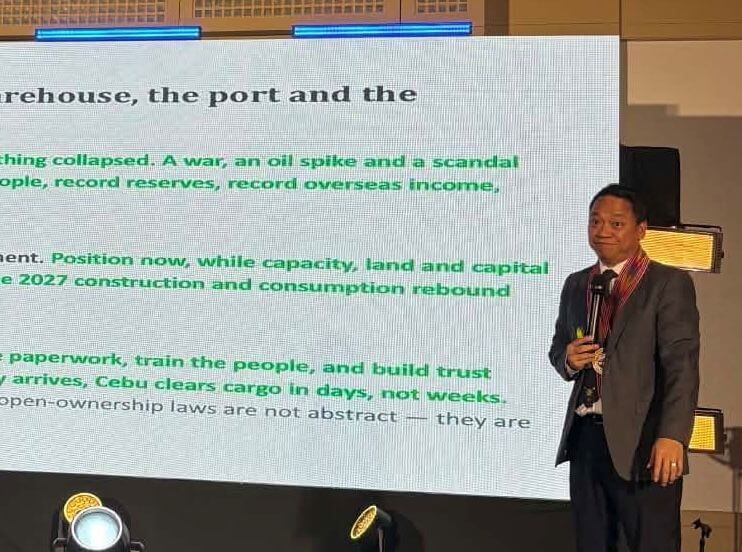
In his talk, “Macroeconomic Outlook and Its Implications for Logistics and Supply Chain Competitiveness,” Balbieran said the current economic slowdown was cyclical rather than structural.
He pointed to structural reforms already in place, ample dollar reserves and strong inflows from overseas Filipino workers as factors supporting an eventual recovery.
‘Bad year in a good decade’
Balbieran said the Philippines was having “a bad year inside a good decade.” The economy grew by 2.3 percent year on year in the second quarter of 2026, compared with the 4-to-8-percent growth range that he said had generally characterized the past 75 years.
He, however, rejected the narrative that global oil prices amid tensions in the Middle East were the main culprit. Instead, he attributed the slowdown to the steep decline in infrastructure spending—a drop of about 40 percent that had weighed on construction, income and demand across related industries.
He described construction as the “mother of all industries” and said infrastructure accounted for 40 percent of the sector.
“The economic slowdown, it’s not because of (high) oil prices. It’s because of the 30 to negative 40 percent government underspending on infrastructure,” he said. “We have been underspending by Covid-19 pandemic proportions for four quarters.”
“Ladies and gentlemen, your problem is 10 percent oil prices and 90 percent infrastructure crisis,” he added.
Government infrastructure and other capital outlays fell 40.8 percent in the first half of 2026 compared with the same period last year, Department of Budget and Management figures show.
The agency said the decline partly reflected stricter reviews and payment safeguards for infrastructure projects. Balbieran said a lack of money was not the main obstacle to growth: banks and other financial institutions had funds available to lend, but uncertainty has made businesses reluctant to invest, slowing the circulation of money.
Bounce-back in spending
Balbieran expects 2027 to bring what he calls a “great recovery,” arguing that the current slowdown is cyclical and driven largely by the decline in infrastructure spending.
He said the question was no longer whether the economy would recover, but “how big” the rebound would be, citing forecasts from major multilateral institutions that put Philippine economic growth at about 5.2 percent to 5.5 percent in 2027.
Balbieran expects government infrastructure spending to accelerate in the fourth quarter of 2026 and continue into the first half of 2027. Private construction could follow about two quarters later, increasing demand to move and store materials, he said.
The recovery would also coincide with the run-up to the 2028 national elections.
Transportation and logistics will feel the upswing right after public and then private construction take off, as builders, importers and consumers will demand more movement of materials and goods.
Balbieran pointed out that even in this “bad year,” transportation and storage still grew by about 3.8 percent in the second quarter of 2026 despite a roughly 40-percent plunge in construction. He said this showed how much more the sector could expand once infrastructure spending rebounds.
Cebu in the center of recovery
Cebu would be “right in the middle” of the recovery he expects in 2027, given its position as a natural logistics hub.But Balbiera urged local operators to prepare for increased trade and construction activity by expanding warehouse capacity, securing drivers, digitizing paperwork and building trust with regulators.
He also warned of a tighter labor market as economic activity picks up. Companies already struggling to hire drivers and warehouse supervisors could face greater difficulty next year, he said, forcing firms to compete for one another’s workers.
Companies should use the slowdown to improve their operations.
“Digitize your paperwork, train the people, build trust with regulators,” said Balbieran. With customs processes becoming more digital, he added, logistics firms would need to move shipments in days rather than weeks. — Ed: Corrie S. Narisma

Contributor