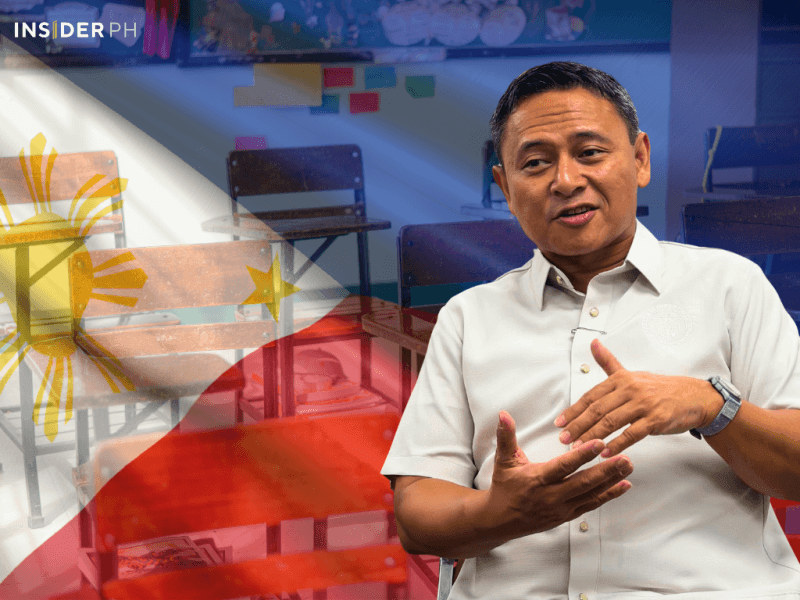
As the latest PISA results showed the Philippines posting one of the world's fastest improvements in reading, InsiderPH senior reporter Daxim L. Lucas sat down with Education Secretary Sonny Angara for a wide-ranging conversation on the management philosophy driving his overhaul of the country's largest bureaucracy. In Insider Hour, Angara explains why he believes DepEd's biggest challenge is not a lack of ideas, but a failure of execution. From classroom construction and textbook delivery to cutting bureaucracy and demanding measurable results, he outlines an efficiency doctrine that seeks to make the education system perform better before expecting better outcomes from Filipino students.
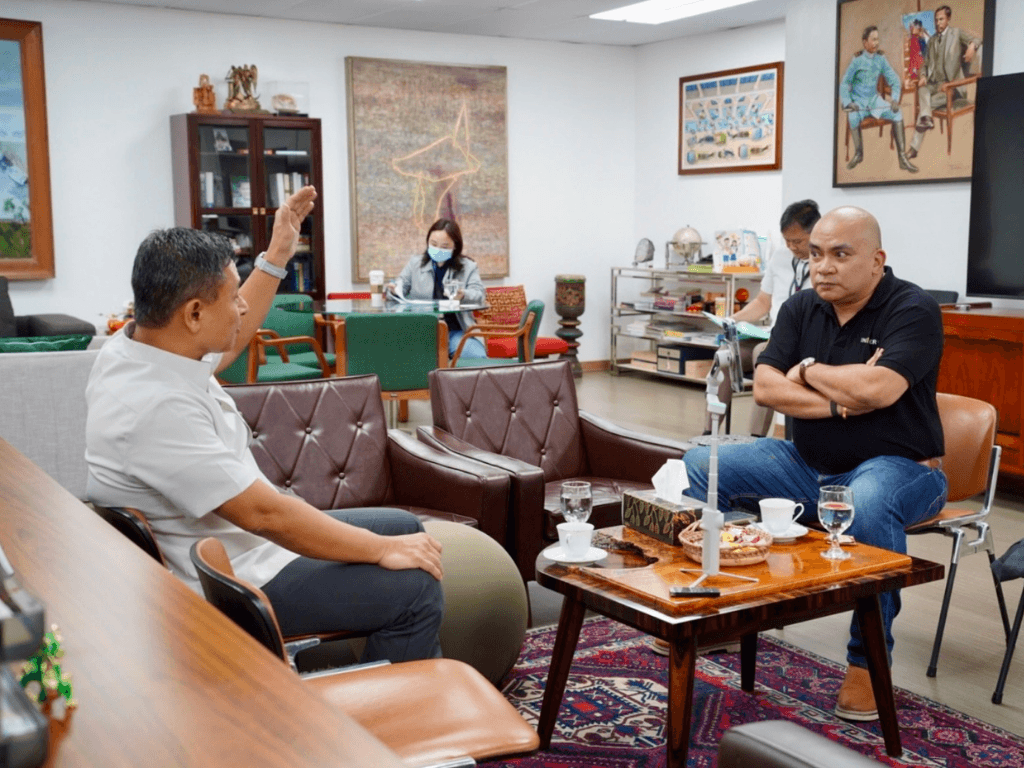
Education Secretary Sonny Angara's office is unmistakably a working office. Papers occupy the desk. A large meeting table one side of the room. The bright fluorescent white lighting is utilitarian rather than flattering. Nothing about the space suggests ceremony.
That turns out to be a fitting introduction to the man now running an organization of more than one million employees serving some 24 million Filipino learners.
The news hook for our conversation was encouraging. The Philippines had just posted its strongest improvement yet in the OECD's Programme for International Student Assessment (PISA), becoming the fastest-improving country in reading over the past decade. After years of occupying the basement of international education rankings, the country had finally climbed several places.
It would have been easy for Angara to celebrate the rankings, but he barely did. Instead, he kept returning to something far less glamorous: efficiency.
It surfaced almost unconsciously.
Why were textbooks taking years to reach classrooms? Inefficiency.
Why were assessments arriving too late to help struggling students? Inefficiency.
Why were teachers drowning in paperwork? Inefficiency.
Why were classrooms still unbuilt despite billions of pesos in budgets? Inefficiency.
Near the end of our conversation, after describing procurement reforms, decentralization and feedback systems, Angara finally offered what sounded like a personal confession: ”I've always hated waste.”
That may be the most revealing sentence he uttered all morning because it explains almost everything else.
For decades, Philippine education policy has revolved around familiar arguments: budgets, curriculum, teacher salaries, class sizes, governance and learning outcomes. These are important debates, but Angara appears to be making a different argument: The country's education crisis, in his telling, is also an execution crisis.
His examples are strikingly operational.
He talks about shortening procurement cycles. He talks about getting books printed on time instead of three years later. He talks about letting schools choose from pre-approved textbooks instead of waiting for Manila to produce every manuscript itself.
He talks about real-time feedback instead of annual reports. He talks about reducing teachers' administrative workload so they can spend more time teaching.
None of these ideas would excite a political rally. But collectively they reveal an interesting philosophy.
Government, he believes, does not necessarily need to become bigger before it becomes better. It first has to become more competent.
That is a surprisingly business-like way of thinking about public administration.
Corporate executives often discover that growth eventually becomes less about strategy than execution. Once the vision has been agreed upon, competitive advantage comes from removing friction inside the organization.
Angara is applying that logic to a bureaucracy that accounts for more than half of the national government's workforce, and that is no small undertaking.
One exchange captured the philosophy particularly well.
Asked whether DepEd should become more decentralized, Angara readily embraced the idea—but with a caveat.
The more authority local offices receive, he argued, the more accountability must accompany it. Decentralization without measurement merely relocates inefficiency instead of eliminating it.
That is a subtle but important difference because many Philippine reform programs confuse delegation with reform.
But Angara's version depends on feedback loops.
He repeatedly returned to the need for measuring outcomes faster, identifying learning gaps earlier and intervening sooner. He spoke admiringly of education systems that detect problems in kindergarten instead of discovering them years later when students have already fallen irretrievably behind.
This sounds less like educational philosophy than process engineering, and perhaps, that is precisely the point.
There is, however, an unresolved tension in his argument: execution can improve outcomes but it cannot, by itself, guarantee continuity.
Angara himself acknowledges that educational transformation requires at least a decade of sustained investment and reform. Singapore did not build its system in one administration. China certainly did not. Even the Education Commission's own assessment argues that meaningful reform will require ten years or more.
Yet Philippine politics rarely rewards continuity. Each incoming administration feels compelled to distinguish itself from the last. Programs are renamed, priorities shift, institutional memory evaporates. And Angara knows this.
Perhaps the most candid observation of the entire interview came not about schools but about politics itself.
"Our political system is winner-take-all," he said, lamenting how succeeding administrations often abandon what came before. That may prove a greater obstacle than any classroom shortage.
For sure, the improved PISA scores deserve recognition.
After years of grim headlines, they offer evidence that the system is capable of moving in the right direction. But they should also be viewed with restraint.
Angara himself resisted declaring victory. He described the gains as the beginning of a long process rather than its conclusion.
That restraint is refreshing, because the temptation in Philippine governance is often to mistake movement for arrival. One good set of numbers becomes proof that the problem has been solved.
But education rarely works that way. Instead, small improvements accumulate.
Momentum matters, but discipline matters even more.
As our hourlong conversation ended, I looked again around the office. Nothing about it projected triumph. It looked exactly like what it was: a temporary headquarters running a work still very much in progress.
Perhaps that is the right metaphor for Philippine education itself: neither a success story, nor a failure — just a system discovering that before it can teach millions of children to solve problems, it must first learn how to solve its own.
— Daxim L. Lucas | Ed: Corrie Narisma