Insider Spotlight
The move reflects a broader push by device makers to capture student and faculty workflows as hybrid learning and digital coursework become standard.
Why it matters
Universities are increasingly looking for flexible, portable tools that can handle both content creation and consumption. Huawei is positioning the MatePad as a laptop replacement that integrates writing, editing, and creative functions into a single device.
The company highlights a “4-in-1” setup combining tablet, keyboard, stylus, and mouse, designed to shift seamlessly between study, work, and entertainment use cases.
The pitch
Huawei’s strategy centers on replicating PC-level functionality in a lighter form factor. The MatePad supports desktop-style document editing through WPS Office 3.0 and features tools like pivot tables and LaTeX support for academic work.
“The seamless transition between laptop and split modes is a game-changer for teaching. I can type up a syllabus and then instantly detach the keyboard to walk around and annotate slides live during a lecture,” Marco Agonia, faculty member at UA&P School of Economics, said in a press statement on April 6, 2026.
The device also emphasizes stylus precision and low-latency input, targeting note-taking and annotation-heavy coursework.
Zoom in
Huawei is leaning into display and usability as differentiators. The MatePad’s paper-like screen aims to reduce eye strain during long reading sessions, while creative apps such as GoPaint and Huawei Notes are designed to help students visualize complex concepts.
“It’s much easier on the eyes compared to other displays. I can review lengthy research papers and grade student submissions for hours without feeling fatigued,” said Diane Rueda, faculty member at UA&P School of Economics.
The business angle
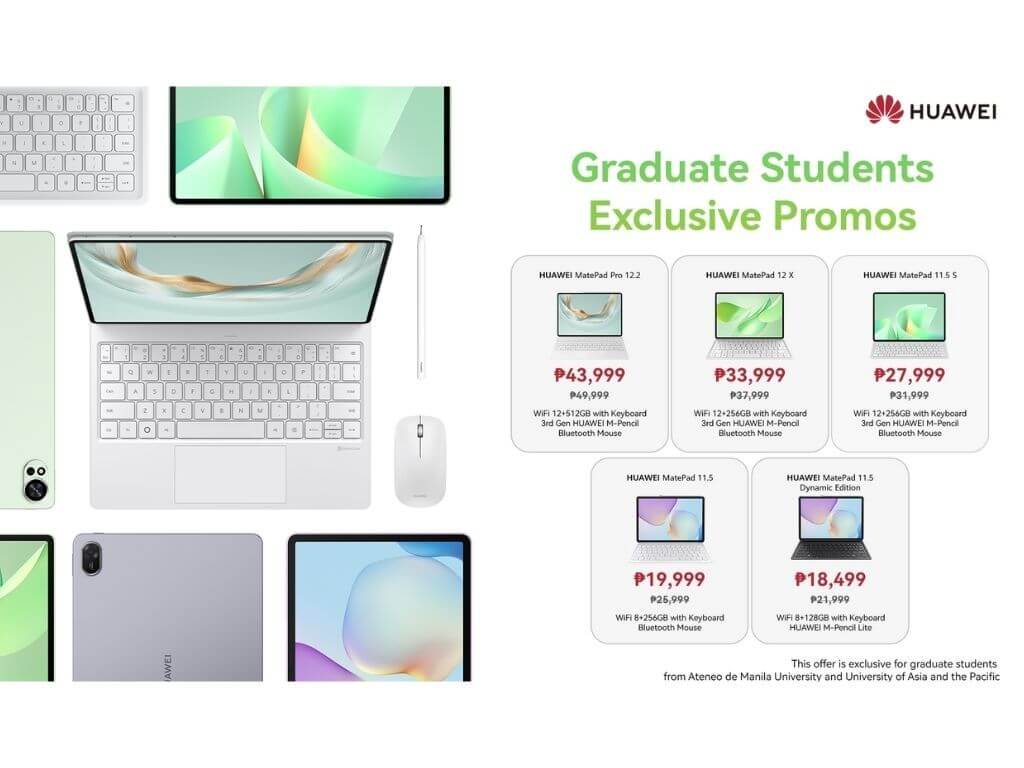
To accelerate adoption, Huawei is offering student discounts and bundled accessories through university partnerships, including UA&P. The campaign runs through April, signaling a targeted, campus-based sales strategy.
Bottom line
Huawei is betting that a hybrid device combining portability with laptop-grade capability can carve out a stronger foothold in education—an increasingly competitive segment for consumer tech brands. —Vanessa Hidalgo | Ed: Corrie S. Narisma