Insider Spotlight
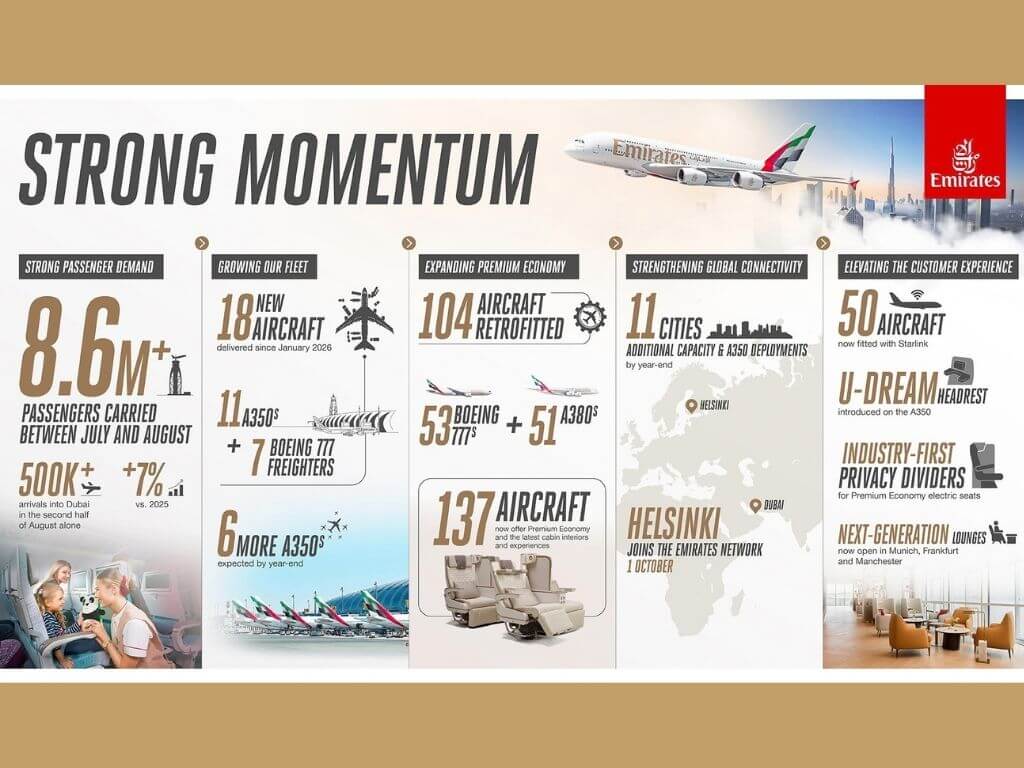
The Dubai-based airline carried more than 8.6 million passengers between July and August while operating at about 93 percent of its pre-disruption capacity. Winter bookings, beginning in late October, are tracking positively despite customers increasingly making travel decisions closer to departure.
More than 500K arrivals
South Africa, Brazil, India, Portugal, Egypt, Ghana, Colombia, Saudi Arabia and Pakistan are among markets where demand is running ahead of last year. Nepal is also showing stronger demand through Emirates' partnership with flydubai.
Dubai remains an important traffic driver. More than half a million Emirates customers arrived in the city in late August, 7 percent higher than the comparable 2025 period. Premium Economy demand also grew across the network, led by the Americas.
Fleet expansion
Emirates is pairing demand growth with accelerated investment in aircraft and onboard products. Since January, it has received 18 aircraft, comprising 11 A350s and seven Boeing 777 freighters, with another six A350s scheduled before year-end.
The airline has completed retrofits on 104 aircraft, including 53 Boeing 777s and 51 A380s. Its Premium Economy and latest cabin products are now offered on 137 aircraft, a figure expected to reach 155 by the end of December.
32 weekly flights in PH
Helsinki joins Emirates' network on Oct. 1 with A350 service. Accra, Tokyo Narita, Ho Chi Minh City and Hanoi will gain second daily flights, while one daily Delhi service will shift to the A380.
The expansion also builds on Emirates' 168 codeshare, interline and intermodal partnerships, which provide access to another 1,750 cities.
In the Philippines, where Emirates has operated for 36 years, the airline currently runs 32 weekly flights linking Manila, Cebu and Clark with Dubai following a capacity expansion earlier this year. —Vanessa Hidalgo | Ed: Corrie S. Narisma