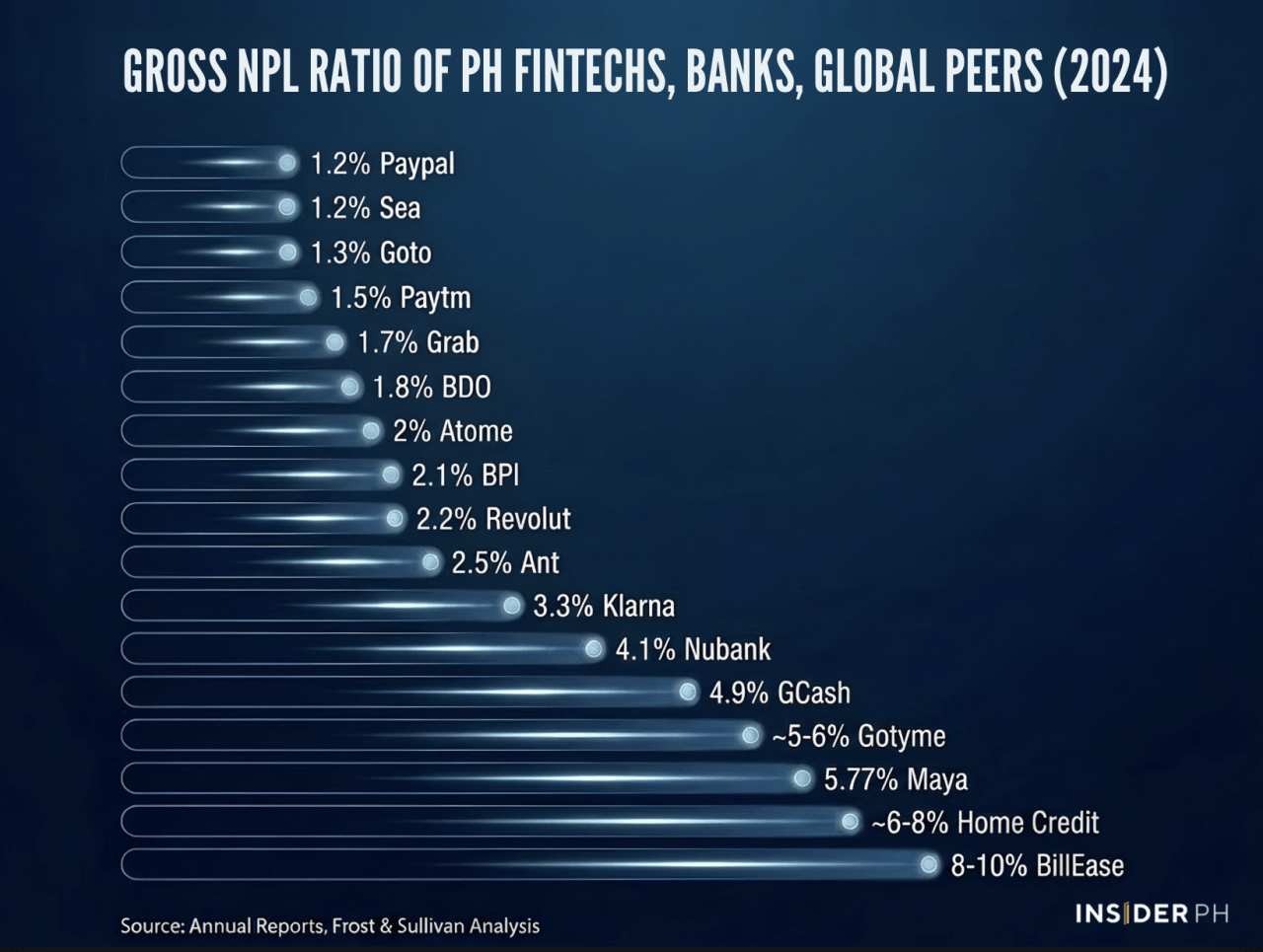
A Frost & Sullivan comparison of 2024 lending portfolios showed GCash posted a 4.9 percent gross non-performing loan (NPL) ratio, compared with 1.8 percent for BDO and 2.1 percent for BPI, but below BillEase’s roughly 8 to 10 percent and Home Credit’s 6 to 8 percent.
The data was part of initial public offering (IPO) documents of parent firm Mynt as the company prepares to launch a record breaking Philippine listing in October.
Higher risk, wider access
An NPL ratio measures the share of loans that borrowers have stopped repaying.
While GCash is best known as a digital wallet rather than a bank, loans offered through GLoan and GGives have become a major growth engine.
CreditTech is now the company’s second-largest revenue behind payments, whose contributions declined after the Bangko Sentral ng Pilipinas ordered mobile wallets to delink from online gambling apps.
The higher bad ratio also reflects its focus on unsecured, collateral-free digital loans for first-time and previously underserved borrowers rather than the lower-risk customer base of traditional banks, widening access to formal credit while taking on greater lending risk.
Higher rates, higher costs
To help offset that risk, Mynt uses risk-based pricing, with GLoan charging 1.59 percent to 6.99 percent a month and GGives carrying monthly rates ranging from 0 percent to 5.49 percent, depending on the borrower and product, its prospects showed.
Even with those rates, money set aside to cover expected loan defaults reached P12.62 billion in 2025, which was almost half of its CreditTech revenue, underscoring how costly unsecured digital lending can be.
Regional gap
Among Philippine digital lenders, GCash also compared favorably with Maya’s 5.77 percent gross NPL ratio and was broadly in line with GoTyme Bank’s estimated 5 to 6 percent.
The gap widens across Southeast Asia, where Sea (1.2 percent), Grab (1.7 percent), GoTo (1.3 percent), Atome (2.0 percent) and Paytm (1.5 percent) all reported substantially lower bad loan ratios. Globally, Nubank (4.1 percent), Klarna (3.3 percent), Revolut (2.2 percent), Ant (2.5 percent) and PayPal (1.2 percent) also reported lower or broadly comparable figures.
“Globally, GCash's NPL ratio places it among higher-risk fintechs, yet this outcome underscores its strategic focus on financial inclusion: deliberately expanding into underserved segments to achieve long-term scale and socioeconomic impact, rather than optimizing short-term margins,” Frost & Sullivan said.
—Edited by Miguel R. Camus