
This was according to Colliers' report, "VisMin Wins: Where Growth Begins and Demand Spins," released during its midyear forum on the state of the Visayas and Mindanao property market on July 1.
Based on the report, VisMin continues to be a compelling growth corridor for real estate investments outside Metro Manila, fueled by expansion in the residential, office, and hospitality sectors.
Cebu remains the leading real estate market in the Visayas, dominating almost every major segment, although Iloilo is emerging as a strong player in the office sector.
It is also the largest condominium market outside Metro Manila. Together with Davao, Cebu is projected to account for more than 60 percent of the 45,000 new condominium units expected to be delivered across the VisMin region between 2026 and 2029.
Cebu also has the largest house-and-lot inventory in VisMin, with a healthy cumulative take-up rate of 93 percent, followed by Davao, Negros Occidental, Iloilo, and Misamis Oriental.
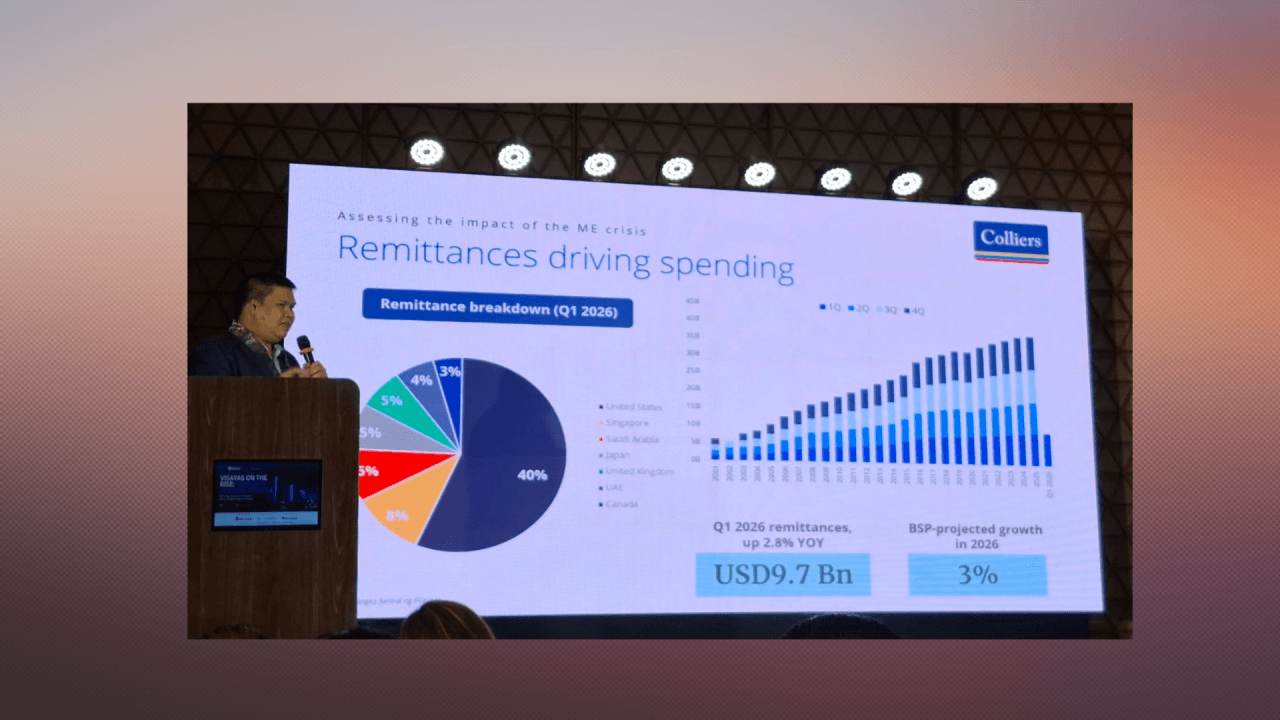
Fueled by OFWs
Demand for house-and-lot developments in these provinces has been driven by economic housing projects priced between P580,000 and P2.5 million. Average take-up rates range from 87 percent to 96 percent as of end-2025, reflecting strong demand from end-users, particularly overseas Filipino worker (OFW) households.
During the forum, Joey Roi Bondoc, Colliers Philippines' head of research, said a recent Bangko Sentral ng Pilipinas (BSP) survey showed that more OFWs and their families are allocating remittances to real estate purchases.
"(The survey showed that) 17 percent of remittance-receiving households are allocating money for their real estate purchases… the highest that the central bank recorded since they started doing this OFW expenditure survey," Bondoc said.
"If you ask me, this is a very good indicator again for the residential market."
Latest Colliers data also showed that house-and-lot prices in VisMin appreciated by an average of 2 percent to 6 percent yearly from 2016 to 2025.
Leisure sector
Cebu also leads the region's hospitality and tourism sector.
Citing Department of Tourism data, Bondoc said overnight travelers increased to 63.9 million in 2024 from 55.9 million in 2023, with Cebu, Davao del Sur, Negros Occidental, and Misamis Oriental attracting the largest number of visitors.
The leisure sector is also expected to benefit from ongoing infrastructure upgrades, including airport modernization projects and improved road access to key tourist destinations.
Bondoc said airports create the first impression for visitors arriving in a destination.
"We hope that the government, perhaps through public-private partnerships, really raises infrastructure spending and expedites the construction of all these airport projects, whether for upgrading or some of them are for renovation," he added.
Office market
In the office market, Cebu continues to hold the largest office inventory outside Metro Manila, although Iloilo has emerged as a rising competitor because of its strong business process outsourcing (BPO) presence, the main driver of office demand in VisMin.
In the first quarter of 2026, office transactions in Iloilo reached 16,000 square meters, accounting for nearly half of all provincial office transactions. Cebu recorded 9,000 square meters of office deals during the period, down from 20,000 square meters a year earlier.
Despite the slowdown, Cebu remains the region's largest office market, anchored by Cebu IT Park and Cebu Business Park, which have total office stocks of 445,000 square meters and 599,000 square meters, respectively.
These premier business districts also continued to post healthy occupancy levels. Cebu IT Park recorded a 13-percent vacancy rate, equivalent to 87 percent occupancy, while Cebu Business Park posted a 12 percent vacancy rate, translating to 88 percent occupancy.
By comparison, Iloilo recorded a 32-percent vacancy rate, or 68-percent occupancy.
Metro Cebu's overall office vacancy stood at 16 percent, equivalent to an 84 percent occupancy rate, indicating that although Iloilo recently outpaced it in new office transactions, Cebu continues to maintain a much larger and more occupied office market.
Like Metro Manila
Bondoc said vacancies in Cebu IT Park and Cebu Business Park remain manageable, but other parts of Metro Cebu have experienced elevated vacancy rates, mirroring the situation in Metro Manila.
He noted that while Metro Manila's overall office vacancy rate stood at 19 percent, vacancies in Makati City, Bonifacio Global City, and Ortigas Center ranged only from 9 percent to 11 percent.
The higher vacancy rate was mainly due to weak demand in former Philippine offshore gaming operator (POGO) hubs, such as the Bay Area and peripheral districts of Makati, where vacancy rates have reached around 30 percent.
"If you look at Metro Cebu, for example, while the vacancies in Cebu IT Park, Cebu Business Park are relatively okay, there are other sublocations within Cebu that have been recording elevated vacancies," Bondoc said.
He cited an office building on Mactan Island that had previously been occupied by POGO companies. After the POGO tenants left, the developer was fortunate to replace them with an English-as-a-second-language (ESL) company.
Preferred BPO location
Despite the recent slowdown in office transactions, Cebu remains one of the preferred destinations for business process outsourcing firms because of its deep talent pool, Bondoc said.
Major occupiers include Asurion, Wells Fargo, and EY Global Services, whose operations extend beyond traditional back-office functions to include financial operations, software engineering, research, and artificial intelligence support for affiliates around the world.
"The presence of these global capability centers has helped cushion the impact of vacancies in weaker submarkets and reinforced Cebu's position as a strategic outsourcing destination," Bondoc said. —Ed: Corrie S. Narisma

Contributor