Metro Pacific Investments Foundation (MPIF) and the Alaminos City government are investing P1 million in Project RESHORE, a cash-for-work initiative that combines short-term livelihood support with the rehabilitation of a damaged section of the Bued Mangrove Eco-Park.
The project will run from Sept. 1 to Oct. 31, with participants working up to five hours a day and receiving allowances, protective equipment, tools and technical guidance.
Damaged habitat
The Bued Mangrove Eco-Park covers 8.17 hectares, of which 2.19 hectares—or 26.79 percent—has been identified as severely damaged following disturbances that included Typhoon Emong in 2025.
Participants will clear degraded and dead mangroves, remove marine debris and other waste, and plant mangrove propagules in areas identified for restoration.
MPIF said it consulted marine scientist Dr. Jurgenne Primavera on the appropriate rehabilitation approach for the damaged area to ensure that the activities and mangrove species are suitable for the site and capable of surviving recurring typhoons.
Mangroves provide natural protection for coastal communities while serving as important habitats that support surrounding marine ecosystems.
For participating families, the initiative also provides an alternative source of income as fisherfolk contend with high fuel costs and fluctuating fishing conditions.
Cash for work
Implemented under MPIF's Gabay Kabuhayan program, Project RESHORE—or Resilient Ecosystem and Sustainable Habitats through Organized Restoration and Employment—is recognized by the Department of Social Welfare and Development as a Cash-for-Work intervention.
The initiative is also aligned with the DSWD's Risk Resiliency Program Framework, according to MPIF.
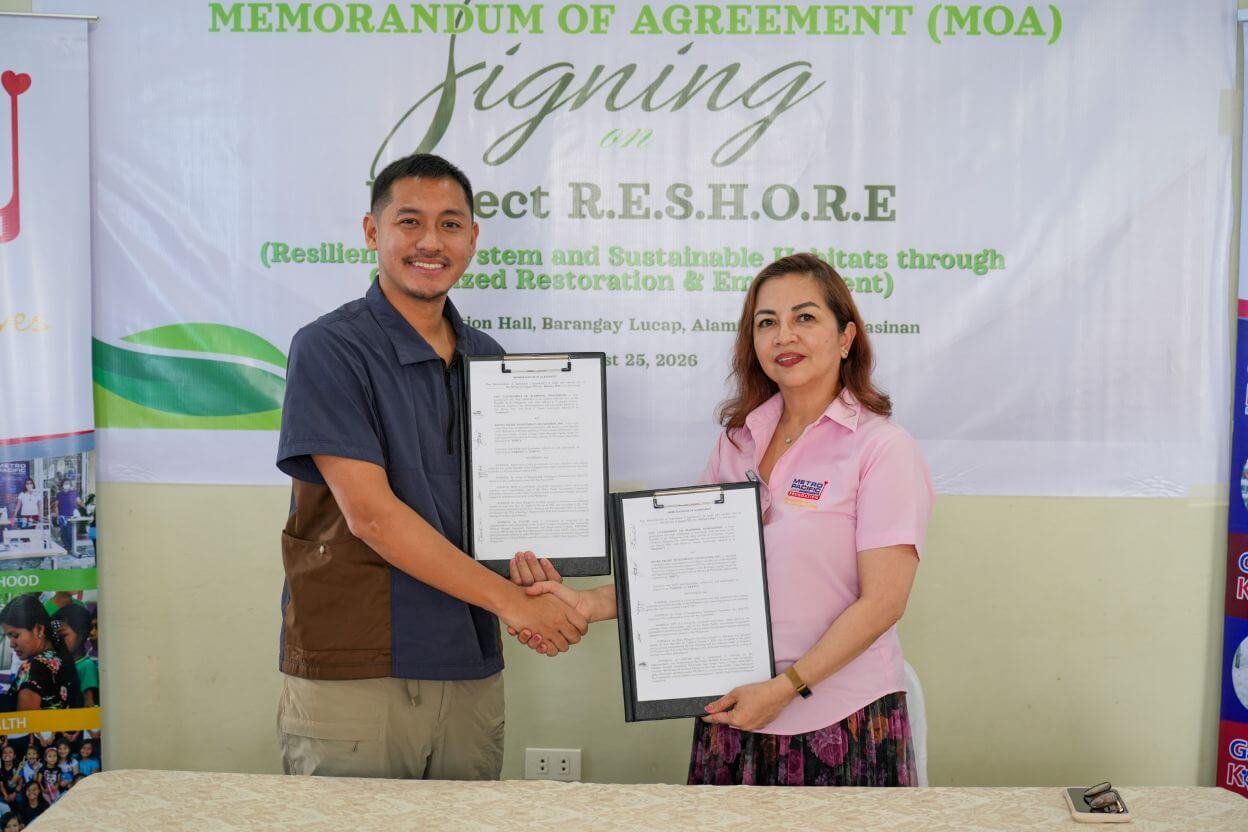
The foundation and the city government formalized their partnership through an agreement signed by Metro Pacific Investments Foundation president Melody del Rosario and Alaminos City Mayor Arth Bryan Celeste.
MPIF also turned over tools, equipment and safety gear for the participants, who underwent capacity-building and training on Aug. 26 ahead of the restoration work.
“The communities will give life to the commitments outlined in the MOA. The real work starts after the signing, when everything falls into place, and we begin putting these plans into action,” del Rosario said.
Coastal partnership
Celeste said the city remained committed to protecting its coastal resources and mangroves with support from MPIF.
“Lagi niyo po kaming kasama, especially in taking care of our coastal resources and mangroves. This is a team-up, a partnership to make sure that we are doing the right thing for the environment,” Celeste said.
Project RESHORE builds on MPIF and Alaminos City's existing collaboration through the foundation's Shore It Up environmental program.
Their previous initiatives include the Mangrove Information Center and its nursery, which serve as platforms for environmental education and mangrove conservation.
Alaminos City was also previously recognized by MPIF as its Most Outstanding Partner for Shore It Up for its conservation efforts.
Local stewards
The foundation said the city's mangrove eco-guides play an important role in sustaining these programs by welcoming visitors and explaining the ecological importance of mangroves.
“They are truly the face of our Mangrove Information Center. Without them, it would simply remain a building. Because of them, it has a story that they can share with visitors and with people who want to learn more about the importance and benefits of mangroves,” del Rosario said.
She said Project RESHORE could also provide a model for expanding similar livelihood and mangrove restoration initiatives to other parts of Pangasinan.
By putting coastal residents directly to work restoring the ecosystem on which their communities depend, MPIF and the Alaminos City government hope to address two challenges at once: providing families with additional income today while rebuilding natural defenses against future coastal threats. —Ed: Corrie S. Narisma




