Insider Spotlight
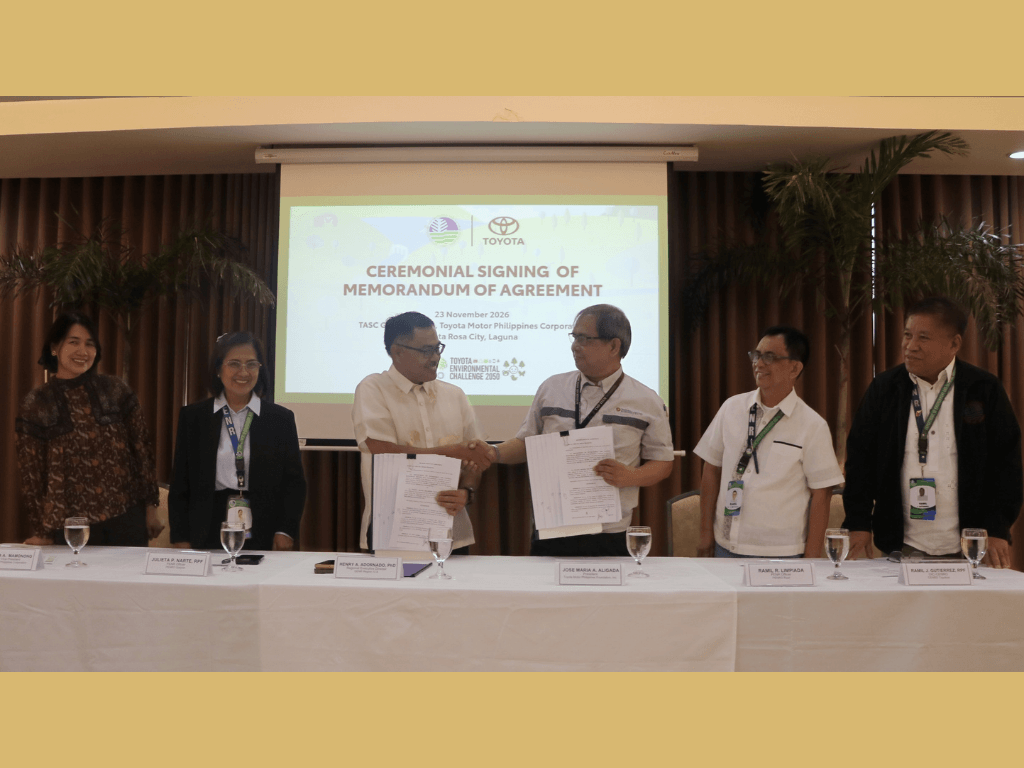
Through its social and humanitarian arm, Toyota Motor Philippines Foundation, the automaker formalized the adoption of two National Greening Program sites through agreements with the Department of Environment and Natural Resources (DENR)-Calabarzon.
The agreements cover a 50-hectare upland reforestation site in Tanay, Rizal, and a 20-hectare mangrove rehabilitation site in Unisan, Quezon, along Tayabas Bay, a key biodiversity area.
Since 2023, the foundation has planted 33,500 seedlings in Tanay, exceeding its initial commitment of 31,250 seedlings. In Unisan, 28,000 mangrove seedlings have been planted since 2024, progressing toward its five-year target of 50,000 seedlings.
‘Healthier ecosystems’
The expansion follows the completion of Toyota’s five-year adoption of reforestation sites in Siniloan, Laguna, and Calatagan, Batangas, where a combined 60,000 seedlings were planted, recording an overall survivability rate of 85 percent.
“Our commitment goes beyond the number of trees we plant. It is about ensuring that our efforts contribute to healthier ecosystems, preserve natural habitats, and create lasting environmental impact for future generations,” TMP Foundation president Jose Maria Aligada said in a press statement.
All Toyota Green Wave Project
Introduced in 2015, the All Toyota Green Wave Project supports the Toyota Environmental Challenge 2050 through reforestation, aquatic ecosystem conservation, biodiversity protection and plastic reduction.
The initiative has expanded through the participation of Toyota’s subsidiaries, dealers and suppliers. Its dealer network alone has planted more than 321,000 trees nationwide.
Toyota’s Philippine network has planted over 113,000 trees and mangrove seedlings in 2026, bringing its cumulative total to more than 600,000.
The company estimates that the initiative has sequestered 12,408 metric tons of carbon dioxide, equivalent to the annual emissions of approximately 2,700 conventional passenger cars.
Beyond Zero strategy
Toyota plans to expand its conservation activities in the coming years, leveraging its corporate network and public-private partnerships to support long-term ecosystem restoration.
The initiative forms part of Toyota’s global Beyond Zero strategy, which seeks to extend its sustainability commitments beyond reducing the environmental impact of its operations. —Vanessa Hidalgo | Ed: Corrie S. Narisma