Having turned around ABS-CBN’s fortunes following its reopening in 1986, Garcia was certainly leaving big shoes to fill. His departure couldn’t have come at a more critical time: GMA 7, the closest rival of the “Philippines’ largest network,” was fast closing the gap in television ratings.
Meanwhile, ABS-CBN’s finances were on shaky ground, with drastic cost-cutting measures being implemented across the board, pitting the bean counters against the creatives.
Without Garcia at the helm—the man who had steered the network through the best and worst of times—the organization was feeling rudderless.
An outsider, Luis F. Alejandrino, chief operating officer of Heinz UFC Philippines and a veteran of the fast-moving consumer goods (FMCG) industry, was eventually appointed.
Among those said to have been in the running were Charo Santos-Concio, executive vice president; Nic Gabunada, sales and marketing chief; and Monchet Olives, then head of special events.
An original Kapamilya
That Monchet, or Jose Ramon Diokno Olives, who died unexpectedly at 62 on September 29, just before his birthday, was being considered for the top post was a testament to decades of hard work, perseverance and loyal service as a capable lieutenant.
As an original Kapamilya, Monchet’s rise paralleled that of ABS-CBN—taking us back to September 1986, just months after the EDSA revolt.
Fresh out of UP Diliman, where he graduated magna cum laude with a B.A. in Communication Research in 1986, Monchet found himself on Bohol Avenue, home to the network’s decrepit Broadcast Center.
Working as a production assistant in ABS-CBN’s Public Affairs Department, headed by Cheche Lazaro, he found himself “transcribing interviews, photocopying materials, dubbing tapes.”
The newsroom then, as Monchet himself described it, was a makeshift plywood barong-barong, or shanty. Space was cramped and resources were scarce. Editing had to be outsourced because editing machines were few, as were the available cameras.
Yet the general feeling, as recalled in the book Kapitan: Geny Lopez and the Making of ABS-CBN, was that “it was a golden moment in the life of the network.”
Monchet recalled: “Those were the good old days, the fun days. Everyone was gung-ho.”
Eventually growing weary of those early, scrappy years, Monchet was ready to throw in the towel. Following a brief hiatus in 1988 and 1989, during which he received study grants in Australia and the United States, he declared, “Pagod na ako sa news.”
It was the gods of ABS-CBN — Rolly Cruz and Freddie Garcia, assistant general manager and general manager, respectively — who would change his fate, assigning him to a post where he’d arguably make his biggest impact: director for international ventures, a precursor to ABS-CBN Global.
Birthing The Filipino Channel
It was in 1992, just as ABS-CBN became a publicly listed company, that international operations were launched in Daly City, California — following Eugenio “Geny” Lopez Jr.’s dictum that “wherever there’s a Filipino, ABS-CBN must be there.”
“We had no template for going international,” recalled Monchet. “We didn’t know how to do these things, so it was really trial and error. But my feeling was, whatever Kapitan [Geny Lopez] asked for, it was never too difficult — even if it was.”
Working alongside Geny’s son Gabby, then ABS-CBN president, and Raffy, the former’s younger brother who had come from an IT firm, Monchet helped spearhead ABS-CBN’s international push, which began in the early 1990s in Saipan, followed by San Francisco, where the Bay Area was home to a sizeable concentration of Filipino-Americans.
It was hardly an easy start.
“But we couldn’t get on the cable operators. It was impossible,” Gabby recalled of that period.
Still, Monchet, who moved to the Bay Area in 1992 and stayed at the ABS-CBN staff house at 315 Paramount, was undaunted.
“In 1993, I had to find a way to be able to carry TFC [The Filipino Channel] on cable. That was the long hard struggle of trying to find cable operators to carry our channel.”
With Monchet “being persistent, being makulit,” an hour-long audience with Tele-Communications Inc. (TCI) CEO John Malone was eventually secured in Denver — “we found a connection to somebody, who knew somebody, who got us to Denver.”
Attended by Geny and Gabby, that meeting helped seal the deal, with Malone saying, “Let’s put the Filipino Channel on.”
Finding initial success in Daly City, and bucking skeptics including Freddie Garcia himself, TFC “started rolling out in cable system after cable system.”
At the same time, the switch from taped telecasts to live international feeds straight from Manila was made possible by a landmark lease agreement with PanAmSat in 1994.
“It was such a moving moment. It was probably like that during the first days of television,” recalled an emotional Monchet.
By 1995, TFC, with Monchet as managing director and chief operating officer (COO), had 25,000 Filipino subscribers across the United States, including Hawaii. A new three-story headquarters on Cowan Road would become TFC’s permanent home.
That same year, a direct-to-home satellite service, The Filipino Channel Direct, was launched, further expanding its reach to more than 100,000 Filipino households. “[This] is an indication of our serious commitment to reach each and every Filipino in the US by any means,” said Monchet.
By then, Monchet had been joined by Manuel “Beaver” Lopez Jr., Manolo’s son and later Erap’s son-in-law, who oversaw marketing.
“Monchet…you have done something no one else could,” Geny remarked during a garden barbecue in 1995 attended by network bosses. “TFC will be big, look out for it.”
Coming home
With his successful decade-long tour of duty behind him, Monchet was recalled to Manila in the early aughts, taking on a succession of posts.
He first served as Gabby’s chief of staff, a period marked by their shared love of gastronomy: “A lot of our ‘aha moments’ were made during the enjoyment of food and drink…The best ideas for innovation were spoken over a meal.”
He subsequently served as senior vice president for business development and special projects; senior vice president and head of the cable channels and print media group; and finally, senior vice president for corporate social responsibility and environmental advocacy, concurrently serving as a trustee of the ABS-CBN Lingkod Kapamilya Foundation.
Among his notable involvements were Kapit Bisig Para sa Ilog Pasig and the Run for the Pasig River.
Rebooting Casa Mercedes
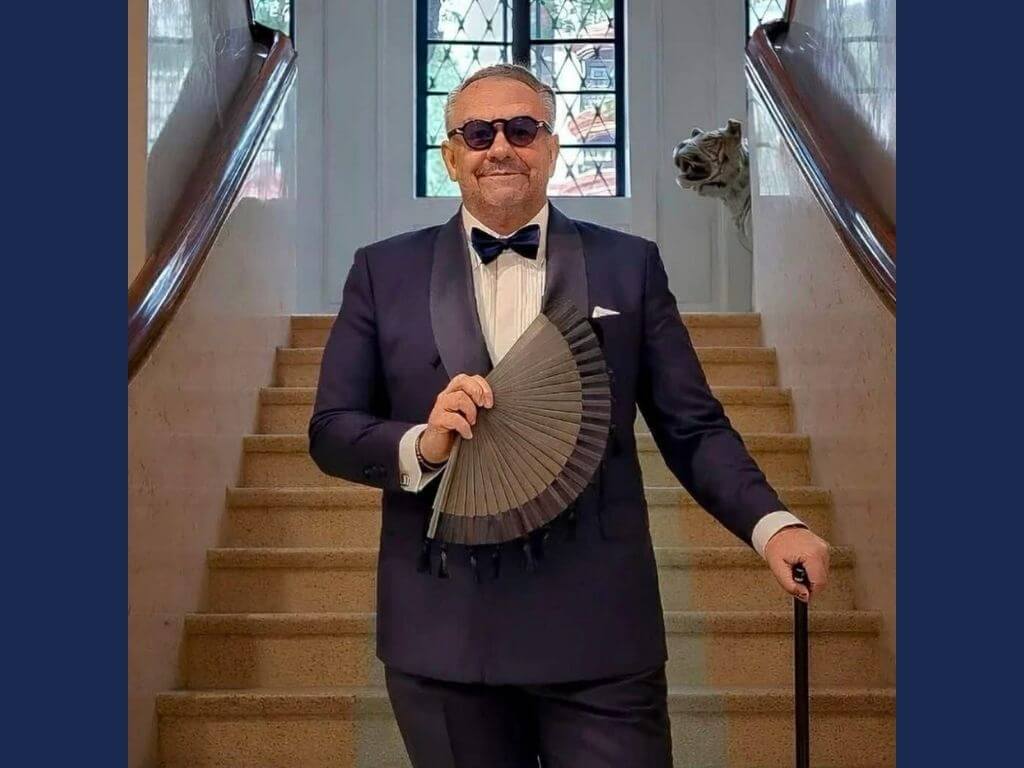
After suffering a stroke at 52 — “till, again, I had another judgement error,” he would cryptically write — Monchet left ABS-CBN and the media industry for good, reinventing himself in his final act as the dapper and stylish “Fanman.”
“After retirement, I found myself returning to another story — Casa Mercedes, the heritage fan atelier founded by my mother and aunts in 1951,” Monchet, chief creative and brand director, told the Daily Tribune in July of this year. “Life has a funny way of bringing you home.”
An aunt, Mercedes Diokno Rovira, an accountant connected with Philippine Airlines, was often asked by friends to buy Spanish fans for them whenever she traveled to Spain. Sensing a business opportunity, Rovira, together with her sisters Angelita (Mrs. Olives) and Leonor (Mrs. Casas), traveled to Madrid to learn the finer points of fanmaking.
Thus, Casa Mercedes was born, with Angelita eventually acquiring full control of the business as her sisters became less involved.
Now the country's oldest fanmaker, Casa Mercedes counted Imelda Marcos among its prominent clients. She used its fans as fashion accessories to complement her Filipiniana outfits and as gifts during her frequent overseas travels, preferring embroidered piña fans for the latter purpose.
This was despite the fact that the Diokno sisters' brother was Sen. Jose W. Diokno, an opposition leader who was among those arrested during martial law.
Said Monchet two years ago: “This is really a pamana because it’s like I’ve inherited this. So my story was ‘how do you not make it your grandmother’s fan’?”
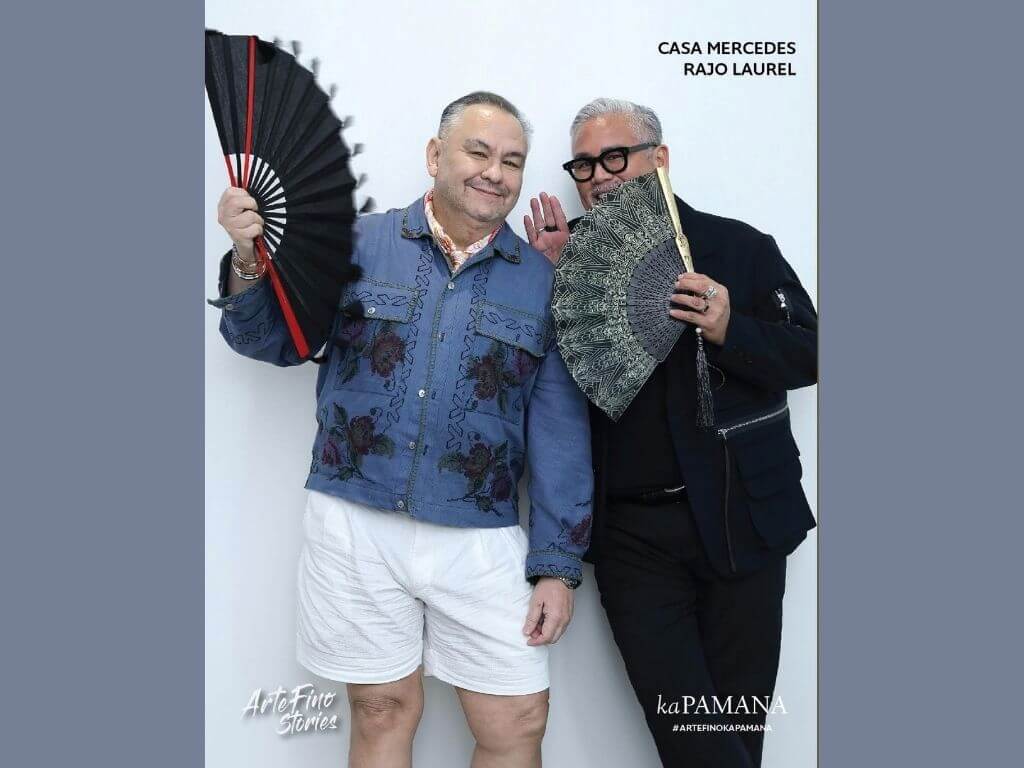
Having stayed away from Casa Mercedes while knee-deep in his corporate responsibilities, Monchet eventually received the necessary push and encouragement from fashion designer Rajo Laurel.
“Rajo sat me down and said that my family are stewards of heritage and it needs to keep going.”
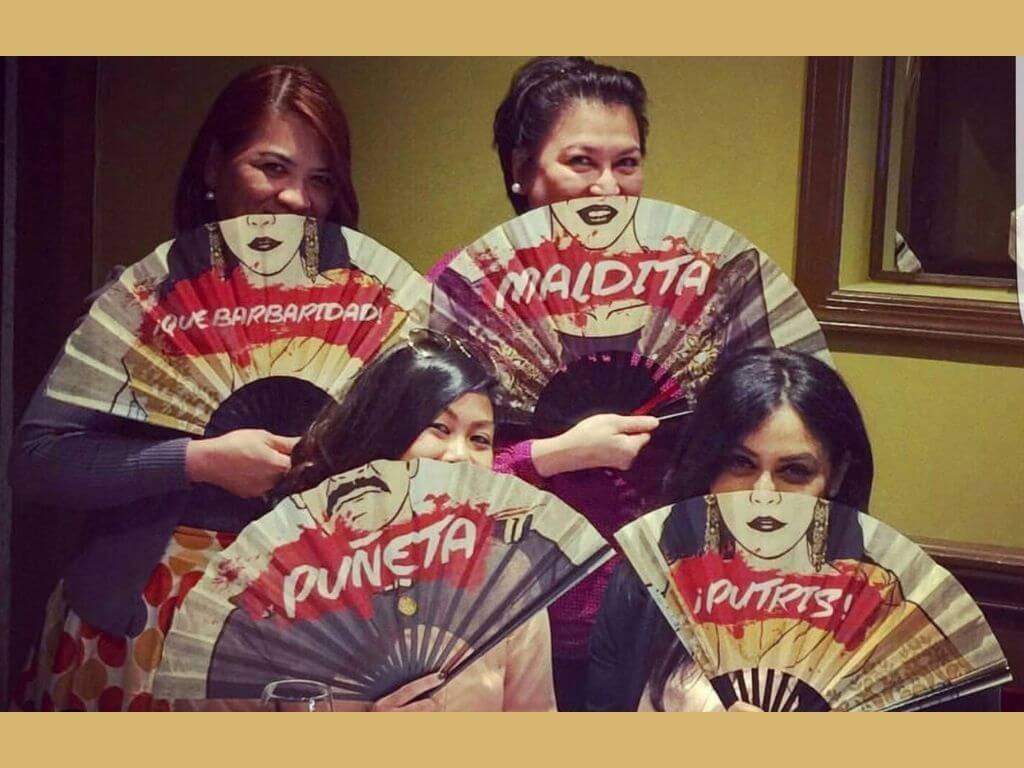
While Monchet’s personal gift to Queen Sofia of Spain during her 2012 visit—a 13-inch Spanish-style abanico adorned with sterling silver and mother-of-pearl—led to more commissions for state gifts, including those intended for first ladies, it was the Icoño series, inspired by the film Heneral Luna, that brought his fans wider appeal.
The Puñeta, Susmaryosep and Que Horror fans became instant hits among younger customers. Produced under the bespoke label Monchet y Compañia, they were enthusiastically sold by Tesoro’s, even as other retailers found them too provocative.
“He knew how to make the past feel at home in the present,” Tesoro’s said in a statement. “Behind his playful creations was a man who believed our traditional crafts still had new stories to tell.”
When asked by Rico Hizon if these types of fans were still relevant in an age of rechargeable pocket fans, Monchet replied:
“What makes it relevant is that it’s a novelty…it’s very entertaining to have. It’s also a very easy gift.”
A man of style
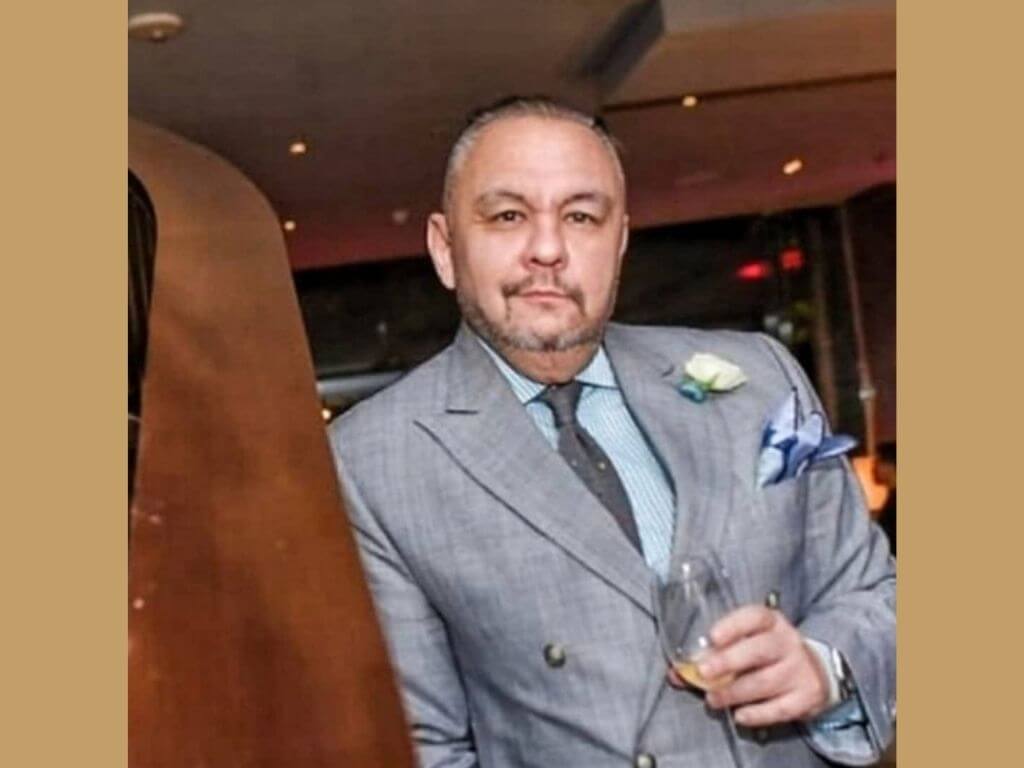
Always sartorially elegant, Monchet was also known for his distinct sense of style and impeccable taste.
“Always stylish, you graced the pages of Metro Society with an effortless sense of je ne sais quoi that will be deeply missed,” wrote former editor-in-chief Raul Manzano, whose cousin Margie was married to Monchet.
“You know [what was] my first glimpse of Monchet — when to me, as a newbie at ABS-CBN, he was just a power name floating around the offices?” recalled another former editor.
“I was waiting for a ride outside the entrance when an SUV pulls up and he gets out, struts like he owns Mother Ignacia — in his pink polo shirt, upturned collar, I think may caravat, and then I thought — oh my, POWER.”
In an Instagram post last June, Monchet, turning reflective and introspective, offered words that now seem particularly poignant in light of his passing.
“A colorful life is not built on highlights alone.
“It is built on detours, second chances, unexpected friendships, lessons learned the hard way, and quiet grace of carrying on.
“I’m grateful for it. The journey continues.” —Ed: Corrie S. Narisma

Features Reporter