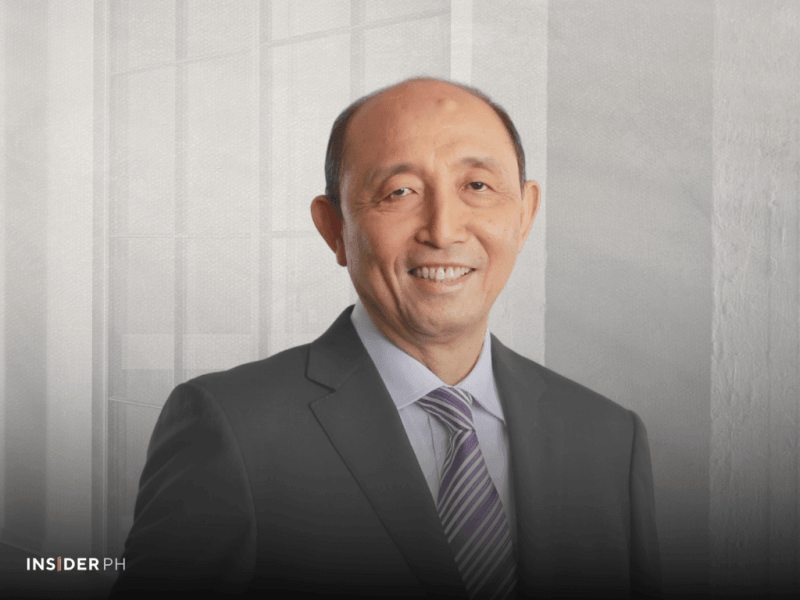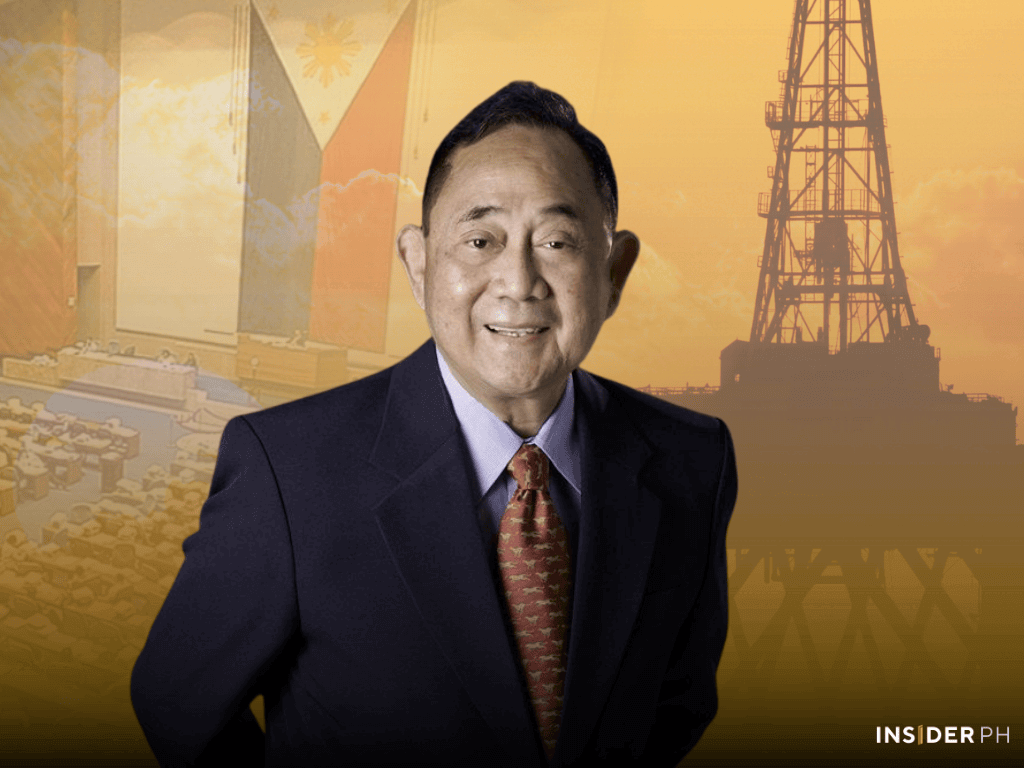
Since leaving the political limelight, where he had long served as a key unifying figure, JDV led a largely private life. Interviews were rare; public appearances few and far between.
And yet, with his passing, tributes poured in from across the political spectrum—from the center and right to the progressive left, from the majority to the opposition—much like the “rainbow coalition” he successfully built as House Speaker, a post he held a record five times.
In death, JDV was in the news again.

In his eulogy, Manuel “Mar” Roxas—who served as Capiz’s first district representative from 1993 to 2000 and was, for a time, majority floor leader—described de Venecia as “a shepherd, a mechanic, a visionary, a leader.”
“JDV,” he continued, “put the bones, meat, and sinew to Philippines 2000,” Fidel V. Ramos’ flagship socio-development program during his presidency. Extolling the legislation passed under de Venecia’s watch—all tied to liberalization, privatization, deregulation, and devolution—Roxas added:
“From monopolies, we got competition; from price controls, market pricing; from capital entry restrictions, private and foreign investment; from the sick man of Asia to a Philippines with a better future. The legislation he led and enabled unleashed the energies of our people and gave our country a better and even chance at modernity,” he added.
In short, de Venecia pushed bills that fostered economic growth and the rise of business and industry. But this should not come as a surprise: Jose de Venecia Jr.—a fact not widely remembered—was a businessman before plunging into politics, where he made his name and forged his legacy.
“I was probably born more to be an entrepreneur than a politician,” de Venecia said in his authorized biography, “Global Filipino.”
JDV—The Intrepid entrepreneur
He did become an entrepreneur, following an early dalliance with journalism—his college major—and politics as a young, fledgling congressman. Through the Landoil Group, he built one of the country’s pioneering Filipino-owned oil exploration firms—an enterprise that brought commercial success, business reversals, and controversy.
After tasting political victory at age 36—winning as representative of Pangasinan’s Second Congressional District in 1969 following an earlier defeat—de Venecia was later offered by President Ferdinand Marcos the chance to run in the Interim Batasang Pambansa, but he declined.
As stated in Global Filipino, de Venecia expressed disagreement with one-man rule and said he was “leery with the direction the Marcos administration had taken.” Instead, he chose to "create his fortune elsewhere," confident that being a thriving entrepreneur was the way forward.
Organizing Landoil Resources Corp.
Setting his sights overseas—on the United Arab Emirates and the Middle East at large—JDV, with little hint of modesty, said: “I was determined to be a pioneer, and to be bigger and better than any Filipino who had ventured out to build his fortune abroad.”
Focusing on construction and oil exploration activities—“the era of oil as a hot political commodity was just beginning”—he formed Landoil Resources Corp., the nucleus of the Landoil Group, reportedly the first Philippine conglomerate engaged in offshore drilling, with Alejandro Melchor, Luis Villafuerte, and Christian Monson on its board.
A major Landoil undertaking at this time—said to have helped spur the Filipino labor export market and recruitment long before the term OFW existed—was its port operations project in Jeddah and the decongestion of its facilities.
After winning the bid, the project required an initial workforce of 3,000 in Jeddah and an additional 300 in Jubail, including stevedores and port managers, all Filipino males aged 20 to 30.
“The deployment from Manila to the Saudi ports took all of two months.”
Construction and electrification projects in Kuwait, Jordan, and Iraq soon followed. As Landoil expanded across the Middle East and into Europe, it grew into a conglomerate with 10 affiliates and 30 offices worldwide.
Encouraged by early success, it diversified into agriculture, fisheries, and construction projects in North and West Africa.
While details of how de Venecia secured the necessary capital to form Landoil remain hazy—no clear mention is made in Global Filipino or elsewhere—records indicate the company relied heavily on borrowings from international banks to drive its rapid expansion.
“From 1977 to 1982, big international and regional banks were chasing Landoil because of our terrific performance,” JDV said, adding that the company maintained strong credit standing. The company also tapped a loan from PCIBank, whose president then, Placido Mapa Jr., was JDV’s classmate.
At its height, Landoil employed up to 51,000 skilled Filipino workers—engineers, technicians, port workers, oil drillers, nurses, and agriculturists—and was reportedly the 19th largest offshore contractor in the world.
A reversal of fortune
With Landoil by then a major industry player—with older firms like Engineering Equipment Inc. (EEI) also getting in on the action—de Venecia later revealed that “Marcos cronies forcibly took over 45 percent of its capital stocks,” with land used as partial payment.
“The raid turned off Landoil Group’s foreign and local investors.”
But JDV‘s and Landoil’s troubles did not end there.
At the start of the 1980s, Landoil secured major construction projects in Basra and Baghdad, both in Iraq. With work well underway, the unexpected happened: the Iran-Iraq War.
In the aftermath of the conflict, Landoil suffered major losses—$50 million in equipment and $300 million in job contracts. Worse still, the Iraqi government moved to take over Landoil’s advance payment cash bonds.
Compounding the crisis, oil prices plummeted to $8 to $9 per barrel from a high of $38. JDV also bore the heavy responsibility of extracting and repatriating Filipino workers back home.
As company funds ran dry and its balance sheet deteriorated, Landoil’s only recourse was to seek a Philippine government guarantee—“after many years of operating without it.”
With mounting losses, uncollected receivables from Iraq, Libya, and Saudi Arabia, unpaid insurance claims from Lloyd’s of London, and debt amounting to some $100 million, Landoil was forced to liquidate company assets, while JDV sold personal holdings.
No behest loans, not a crony enterprise
As the Landoil Group’s swashbuckling story came to an untimely end, de Venecia returned to Congress in 1987 as representative of Pangasinan’s Fourth District.
There, under a new administration, he devoted considerable time refuting claims that Landoil’s borrowings were behest loans or that the company had been a crony enterprise, while emphasizing its contributions to overseas employment and “the infusion of dollars into the economy.”
JDV, the Speaker of the House, was still five years away.
Jose de Venecia Jr. was born on Dec. 26, 1936, in Dagupan, Pangasinan. Although he described his family as being of “middle means,” they were, by most indications, more comfortable than many: his ancestors owned large fish farms, and the de Venecias kept a Lincoln sedan.
His father, Jose Ravago de Venecia, was a lawyer and the eldest son of Dagupan Mayor Guillermo de Venecia. His mother was Casimira Villamil Clavería.
After completing his studies at Dagupan Elementary School during the war, he was sent to De La Salle College in Manila for high school.
Thereafter, believing that “if you finish there, you have better chances to get a job after graduation,” the elder de Venecia encouraged his son to enroll at Ateneo de Manila, where he majored in journalism.
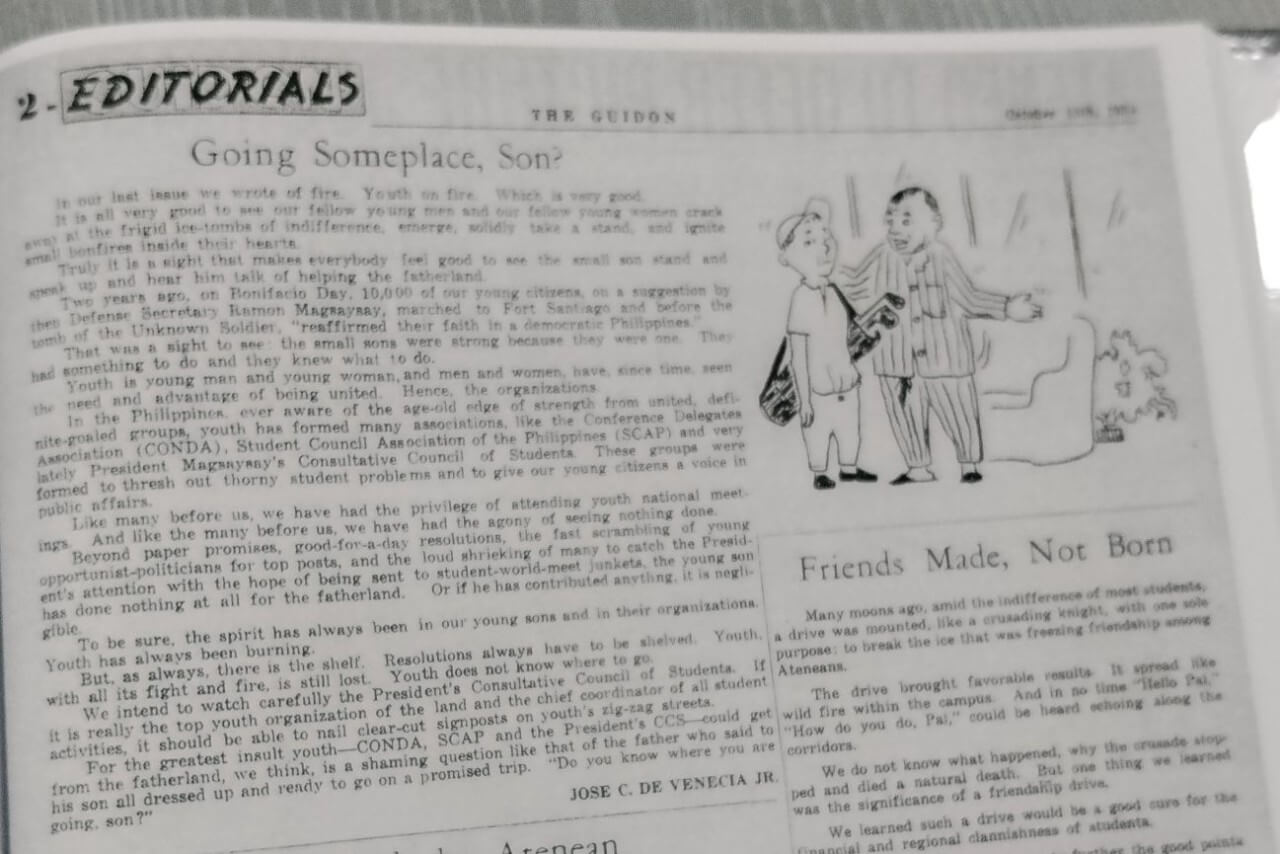
At Ateneo, de Venecia was active in numerous student organizations, many religious in nature. Most notable, however, was his involvement in The Guidon, where he served as associate editor from first to fourth year. He later became editor in chief of Aegis 4, the official yearbook.
In a Dec. 18, 1954 profile in The Guidon, it was written that as a student journalist, “most veteran professional reporters covering the National Defense beat respect his ability.” His reportage on the ambush of Hukbalahap member Mariano Balgos in Bicol—hopping on the plane that carried other reporters and Defense chief Sotero Cabahug—the paper noted, “was flashed through Asia.”
Although early expectations that JDV—whose first job was bureau chief of the Pan-Asia Newspaper Alliance and who later maintained a regular opinion column in the Philippines Herald—would one day publish his own newspaper in Dagupan did not materialize.
Instead, he went on to co-found Radio Philippines Network (RPN), helping spearhead radio broadcasting in Northern Luzon in Baguio, Laoag, and Tuguegarao before RPN merged with the Kanlaon Broadcasting System of the Benedictos.
De Venecia was first married to Vicky Perez, daughter of House Speaker Eugenio Perez, with whom he had four children: Sandra, Leslie, Vivian, and Joey.
In 1988, he married Georgina “Gina” Vera-Perez, whose grandfather, Senator Jose O. Vera founded the movie outfit Sampaguita Pictures. They had two children, Toff and KC; KC tragically perished in a fire that struck their home in 2004.
“The journey will be long. But the rewards at journey’s end more than justify every tear, every hurt, every fall,” de Venecia once said, words that succinctly encapsulate his remarkable life.

Features Reporter