Insider Spotlight
The study, conducted with local research firm The Fourth Wall, surveyed 207 education practitioners across higher education and technical-vocational institutions in Metro Manila, Metro Cebu and Metro Davao. It found the emerging AI divide is increasingly between learners who receive institutional support and those navigating the technology independently.
Barriers to lifelong learning
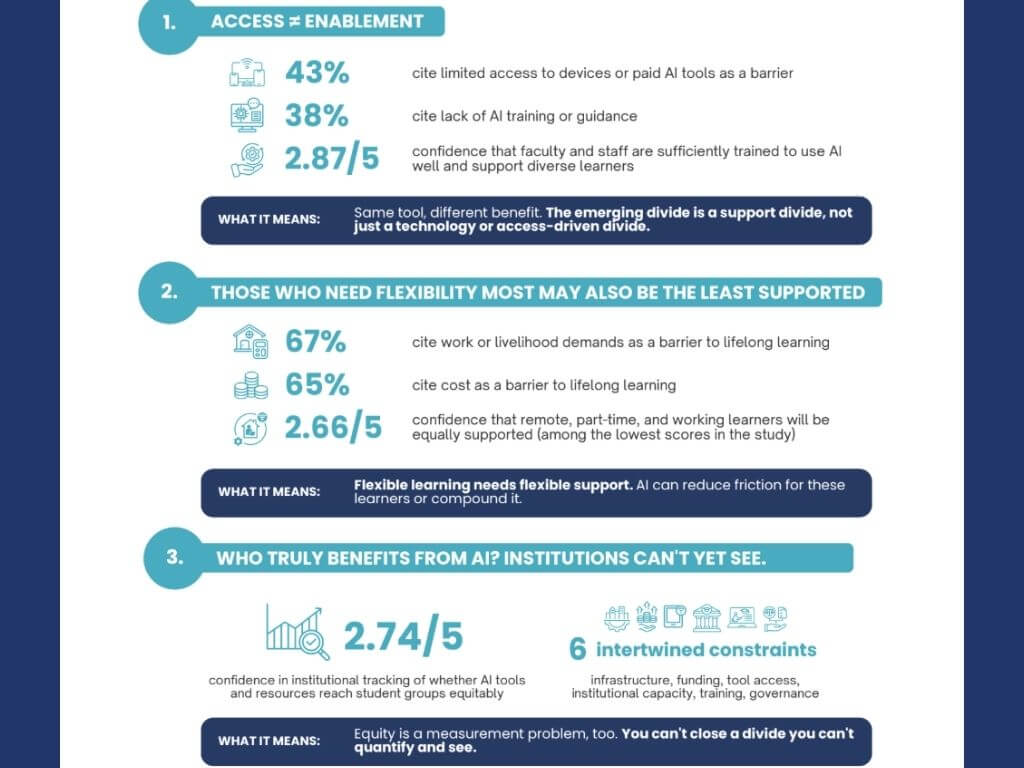
Educators gave a 2.66 out of 5 rating when asked how confident they were that remote, part-time and working learners would receive equal support as AI reshapes education. Work and livelihood responsibilities were cited by 67 percent as barriers to lifelong learning, while 65 percent pointed to cost constraints.
“AI adoption is already underway, but institutionalization has yet to catch up. Encouragement isn't the same as structure, clarity, and guidance. If AI isn't connected to a coherent learning strategy, both learners and educators will be left floundering, creating a clear divide between supported and unsupported learners,” Instructure managing director APAC Darren Read said in a press statement.
Beyond experimentation
AI adoption is already moving beyond experimentation. Half of surveyed institutions offer AI literacy or digital-skills programs, while 41 percent deploy staff-facing AI systems, 40 percent integrate AI into course delivery and 38 percent use AI-powered tutoring assistants.
But readiness remains uneven. Confidence in faculty and staff training scored 2.87 out of 5, while institutions' tracking of equitable resource distribution received 2.74.
“Equity is not only an access problem; it is also a measurement problem. Institutions cannot meaningfully address an AI divide if they cannot see who has access, who is participating, and who is actually benefiting,” The Fourth Wall research director John Brylle L. Bae said.
Equity tracking
The report calls for expanded access to devices and tools, clearer ethical-use rules, stronger AI capabilities among faculty and learners, curriculum integration and equity tracking.
Those priorities come as the Commission on Higher Education pushes responsible AI use and stronger human oversight in areas including grading, admissions, scholarships and student progression.
The researchers cautioned that the findings reflect practitioners' perceptions and are indicative rather than nationally representative of Philippine educational institutions. —Vanessa Hidalgo | Ed: Corrie S. Narisma