
The drop came amid broader market volatility, with the Middle East war disrupting global energy markets and weighing on the Philippines’ growth prospects for 2026.
One market participant said Ayala Land bore the brunt of the selloff as institutional funds liquidated positions across the Philippine market without meaningful counterpart buying.
“This led to heavy selling on the open market,” said the market participant, who requested anonymity.
“That’s liquidity for you—or the lack of it,” another stock market analyst said.
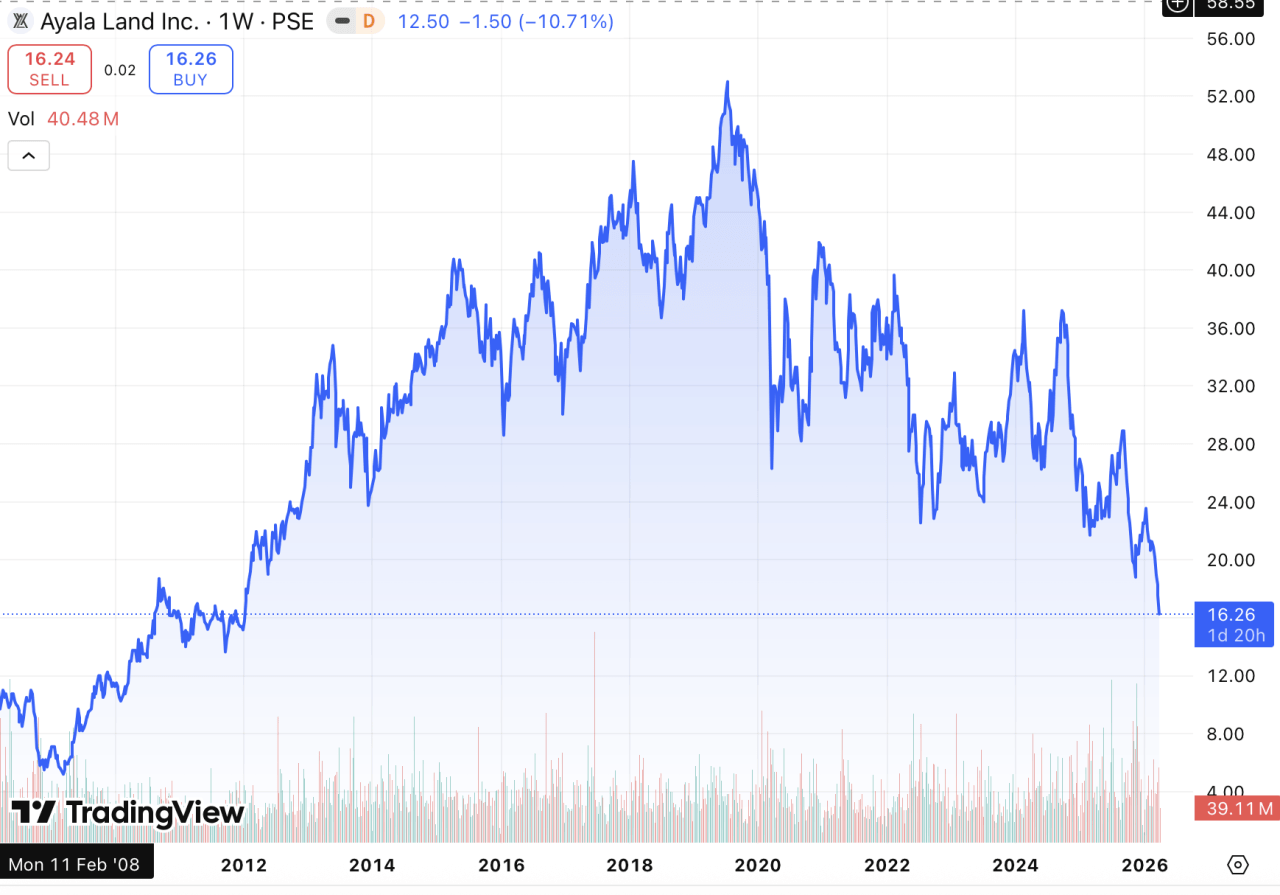
Ayala Land—which finished at P16.26 per share for its lowest close since 2012—recorded the second-largest net foreign selling at P224 million, behind BDO Unibank’s P317 million, according to AB Capital Securities.
Overall, foreigners were net sellers to the tune of about P1.55 billion on Monday, while the broader Philippine Stock Exchange index slumped 1.73 percent to 5,869.49, its lowest close this year, data from the stock exchange showed.
Ayala Land's performance stood in contrast with other property giants such as SM Prime Holdings, which rose 0.72 percent to P19.54 per share and was seen as a more resilient name in the industry, while Robinsons Land Corp. shed 0.12 percent to P16.93 per share.
Christopher San Pedro, Unicapital Securities technical analyst, said in a webinar last March 26 that Ayala Land remained in a “downtrend” and could retest P15–16 levels.
Negative sentiments are also being driven by interest rate expectations.
The Manila Bulletin reported that economists expect the Bangko Sentral ng Pilipinas to raise rates to temper inflation risks driven by rising oil prices.
Wendy B. Estacio-Cruz, head of research at Unicapital Securities, said during the March 26 webinar that real estate and consumer remain at risk.
On the hand, she said that “power sector, water, as well as possibly telco and mining could outperform" in 2026.

Miguel R. Camus has been a reporter covering various domestic business topics since 2009.