Office leasing jumped 71.5 percent, retail space continued to expand, hotel occupancy held firm, residential sales improved, and logistics warehouse supply grew significantly.
In its year-end market analysis, JLL said the capital region demonstrated strong underlying fundamentals despite evolving supply and demand dynamics.
Office leasing up 71.5%
The Metro Manila office market recorded a 71.5-percent year-on-year increase in full-year gross leasing volume in 2025, marking its strongest performance since 2022.
The Business Process Outsourcing (BPO) sector remained the primary driver of demand, accounting for 64 percent of total leasing transactions, while corporate occupiers made up the remaining 36 percent.
Taguig City emerged as the top-performing location, with Bonifacio Global City (BGC) serving as a key contributor. Makati City followed, posting the highest annual growth rate at 92.2 percent year-on-year.
“The office market showed sustained positive leasing activity in the fourth quarter of last year,” Janlo de los Reyes, head of research and strategic consulting at JLL Philippines, said in a statement.
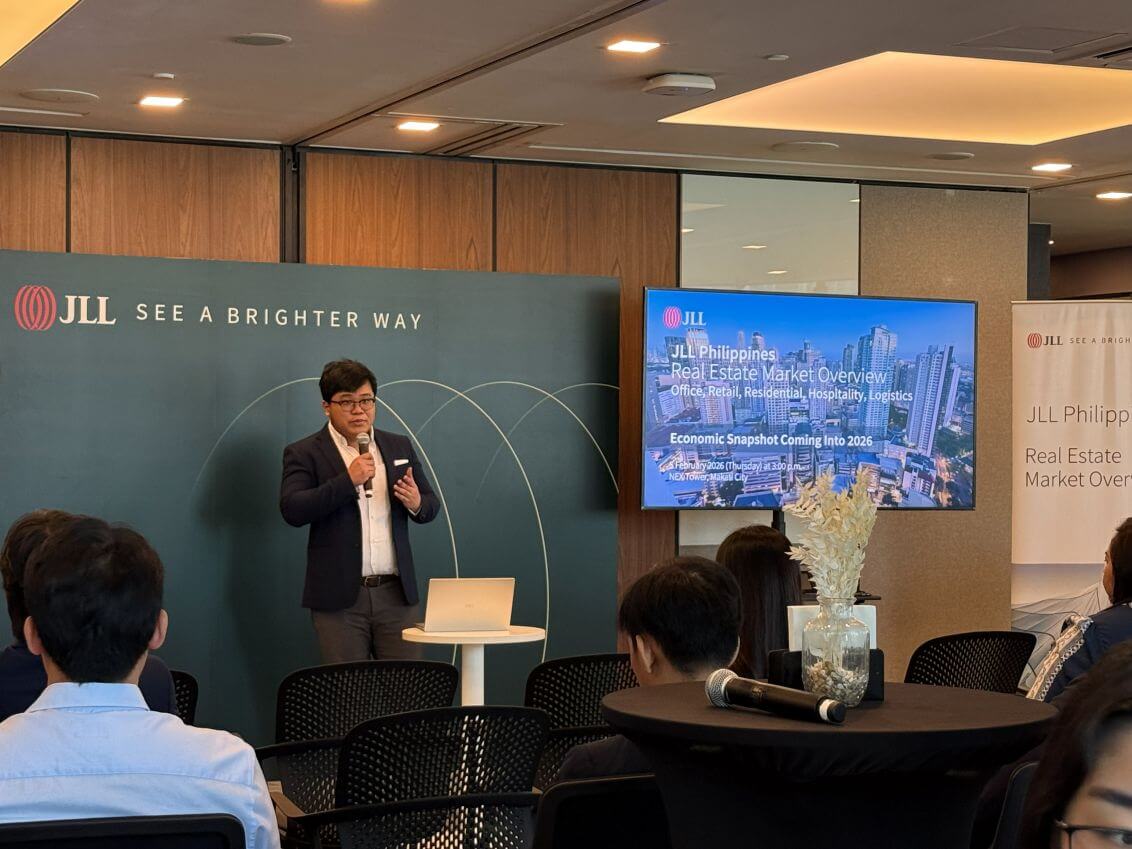
“If you look at the full-year number, it’s close to around one million square meters of office transactions. This marks the highest volume since 2022, maintaining the upward trajectory of leasing demand over the same time period.”
Despite the strong leasing activity, annual vacated spaces doubled year-on-year as tenants continued to rightsize operations and relocate to sustainable, green-certified office buildings.
The vacancy rate stood at 18.6 percent in the fourth quarter, reflecting new supply deliveries during the year.
Retail and residential gain ground
The retail market staged a decisive turnaround in the fourth quarter of 2025. Store openings increased by 34 percent while closures declined by 60.8 percent, signaling renewed expansion confidence among retailers.
Food and beverage led new openings, accounting for 27.1 percent of total additions. Clothing and apparel followed at 14.8 percent, while general retail comprised 11 percent.
Rental rates remained stable, posting a modest 1.3 percent year-on-year increase with no quarter-on-quarter change. Total retail supply reached 7.9 million square meters, up 1.8 percent from the previous year.
Meanwhile, the residential condominium market showed improved sales momentum in the fourth quarter, particularly in the midscale and upscale/luxury segments.
Pre-selling take-up rates rose to 78.6 percent for midscale units and 85.2 percent for upscale and luxury developments, even as broader price indices softened.
JLL noted that overseas Filipino worker (OFW) remittances continued to support demand. Cash remittances grew 3.3 percent year-on-year in the third quarter of 2025, reinforcing the condominium market where OFWs represent a significant buyer segment.
Hospitality steady, logistics expands
Metro Manila’s hospitality sector maintained solid performance, closing 2025 with an average occupancy rate of 82 percent, slightly below 2024’s 83 percent but indicative of sustained resilience.
Growth was supported by balanced leisure and business travel, staycations, and events such as weddings and corporate functions.
International arrivals reached about 6.5 million in 2025, up from 5.9 million in 2024. Although arrivals from South Korea declined by 18.5 percent, increases from the United States, up 6.7 percent, and recoveries in Japan, Australia, Canada, and China helped drive overall growth.
Luxury and upscale hotels outperformed, posting occupancy rates of 87 percent and 84 percent, respectively. Prime locations in Makati CBD and Bonifacio Global City achieved occupancy levels between 86 percent and 88 percent.
The logistics and industrial sector also recorded significant expansion. Total warehouse inventory grew year-on-year, led largely by speculative developments.
Speculative warehouse stock surged 34.2 percent annually, while built-to-suit facilities posted modest 2.2 percent growth. JLL said this reflects developers’ confidence in sustained demand and tenant preference for ready-built space.
Vacancy rates in key logistics hubs—including Metro Manila, Cebu, Pampanga, Batangas, and Laguna—remained below 4 percent, signaling strong absorption.
Outlook for 2026
JLL Philippines maintains a cautiously optimistic outlook for 2026, expecting steady growth across sectors while closely monitoring supply absorption and macroeconomic conditions.
Infrastructure development is seen as a key catalyst for continued real estate expansion. Projects scheduled for completion in 2026—including the Cavite-Laguna Expressway, C5 South Link Expressway, and NLEX-SLEX Connector Road—are expected to enhance connectivity and unlock growth corridors.
According to de los Reyes, Metro Manila’s development pipeline through 2030 underscores sustained market confidence, with new office, retail, residential, hotel, and logistics projects underway across multiple provinces.
“Metro Manila’s real estate market demonstrated strong underlying fundamentals throughout 2025, with office, retail, and logistics sectors delivering particularly solid performance,” he said. —Ed: Corrie S. Narisma