By Joey Sarte Salceda
The legal basis echoes the 1990 invasion of Panama that delivered Noriega to the same fate.
I am not here to defend Maduro. But the manner of his removal should concentrate the minds of every Filipino strategist. When American interests demand it, sovereignty is a paper shield.
The charges are a legal costume draped over a geopolitical decision. Everyone understands this. Washington does not pretend otherwise.
The operative lesson
This is not a moral judgment. It is a strategic observation. Great powers act on interest. The United States always has, from the annexation of the Philippines in 1898 to the base negotiations of the 1990s.
What Maduro's capture clarifies is that the Trump administration eschews even the rhetorical niceties of the rules-based international order.
For the Philippines, the lesson is that America is not sentimental. Its presence in our waters, its commitments under the Mutual Defense Treaty: these serve American strategic purposes first.
They may align with our interests. They may not. Is it in Washington's interest to fight China over our islands? Or might there come a grand bargain over Taiwan where freedom of navigation is secured without defending our territorial claims? We do not know. Our doctrine cannot assume.
Which brings me to signals from Beijing that deserve closer reading. Over the past week, the Chinese Embassy engaged Commodore Jay Tarriela in an unusually direct exchange. The content was combative. But the framing was notable.
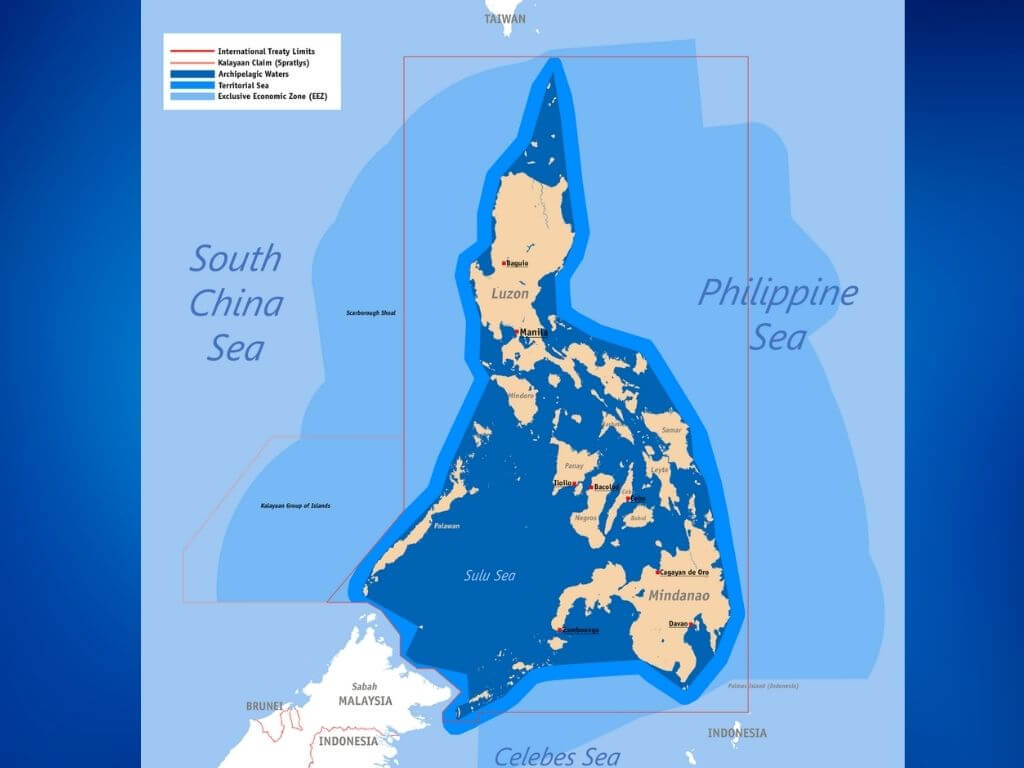
Deputy Spokesperson Guo Wei did not invoke the nine-dash line or China's "indisputable sovereignty." Instead, he cited UNCLOS, the very convention the 2016 Arbitral Tribunal used to rule against China. He spoke of "overlapping claims of EEZ." He argued that both sides can exercise rights in disputed waters.
How to respond
This is a shift. China's traditional position rests on historic rights that UNCLOS does not recognize. To frame the dispute as overlapping EEZ claims is to accept, at least rhetorically, a legal framework Beijing has spent years rejecting. Nothing in Chinese diplomatic communication is accidental. This is a signal.
Let us be realistic about what to do with it. China will never accept the arbitral ruling. Not this year, not ever. Waiting for Beijing to acknowledge the award is not a strategy. But we do not need China to accept it. We need them to understand that certain behaviors will meet resistance regardless of their stated legal position.
The arbitral award should function as our red line, not our negotiating demand. We do not require Beijing to say the words. We require them to respect the boundaries.
What behaviors cross the line? Building structures on features within our EEZ. Interference with Philippine vessels in Philippine waters. Exclusion of Filipino fishermen from traditional grounds. Unauthorized surveys.
These are non-negotiable. Within those limits, there is room for practical engagement: incident protocols, communication channels, even fisheries arrangements if structured correctly.
This is where Indonesia went wrong. When Prabowo met Xi Jinping in Beijing in November 2024, the joint declaration included agreement on joint development in areas of "overlapping claims."
Three weeks into his presidency, Prabowo handed China a paper trail it will cite for decades as proof that ASEAN claimants recognize their position. The Indonesian Foreign Ministry scrambled to clarify that Jakarta still rejects the nine-dash line. It does not matter. The document exists. Beijing will use it.
A better way
If practical arrangements must be made, there is a better way. Structure them with explicit "without prejudice" clauses to national positions and established international law. Better yet, keep the states out of it entirely.
Let state-corporate entities do the work: PNOC and CNOOC can explore together while Manila and Beijing say nothing. The arrangement exists; the governments do not bless it with declarations that create legal precedent. Joint silence is the farthest we can go.
The test of Beijing's UNCLOS framing is behavior, not rhetoric. If Chinese vessels continue to harass our fishermen and obstruct our resupply missions, the signal was merely tactical. We should be open to the possibility that it means something, while clear-eyed about the probability that it does not.
Credit where credit is due. The Marcos administration's pivot from counterinsurgency to maritime defense is the most significant reorientation of Philippine security posture in a generation.
The AFP Modernization Program is acquiring capabilities that matter: coastal missiles, radar systems, patrol vessels, surveillance aircraft. After decades in the hinterlands, our defense establishment is finally oriented toward the actual geography of our vulnerability.
But hardware is not enough. We need doctrine built on three pillars. First, fund modernization at the scale Defense Secretary Gilbert Teodoro has proposed.
Re-Horizon 3, at P2 trillion over 10 years, is correct in its ambition. The Philippines currently spends roughly one percent of GDP on defense. Taiwan spends 2.6 percent. Singapore, 1.8 percent. Even Vietnam, with a smaller economy, spends 1.2 percent. We can do better with more fiscal space.
The money question
Where does the fiscal space come from? Two places, at minimum. I tried to get them across the finish line when I was in Congress as Ways and Means Chair.
First, we must settle once and for all the MUP pension issue. The military and uniformed personnel pension system is a recurring fiscal shock that crowds out capability spending. I have proposed a grand compromise: a guaranteed three percent annual increase in MUP salaries, nothing more, nothing less.
Predictability is the point. The enemy of fiscal space is surprise. Lock in the obligation, end the annual political battle, and free the budget for hardware and capability.
Second, we must reform the ODA law. The current requirement of a 25-percent grant element locks us out of financing that Europeans and others are willing to provide at 15 percent grant element with blended finance arrangements.
Defense procurement, infrastructure, technology transfer: these require capital we do not have and financing we are currently prohibited from accepting. The restrictions made sense in a different era. They do not make sense now.
Capability beyond hardware
And we should not only buy equipment. We should invest in defense research and development, build technical capacity in our universities and defense industries, and reduce our dependence on foreign suppliers for maintenance and upgrades. Sovereignty requires not just weapons but the knowledge to sustain them.
Beyond the hardware, we must diversify security partnerships beyond the United States. Japan, Australia, India, Vietnam share our interest in a rules-based maritime order. If Washington wavers, we cannot be without options.
Third, engage China's signals strategically. Read the UNCLOS framing as an opening worth testing. Probe it. But hold the red lines. Practical coexistence where possible. Legal concession never.
Maduro is in a jail cell because Venezuela was weak and isolated. The lesson for Manila is not to pick a side and hope. It is to build a position strong enough that neither great power finds it convenient to treat us as Caracas was treated, or as a chip to be traded when the calculus shifts.
We have started. We cannot afford to stop.
Joey Sarte Salceda is a former member of the House of Representatives, where he served as chair of the Committee on Ways and Means. He is currently the chair of Salceda Research, a policy and research organization focused on economic, fiscal, and strategic issues.