
Insider Spotlight
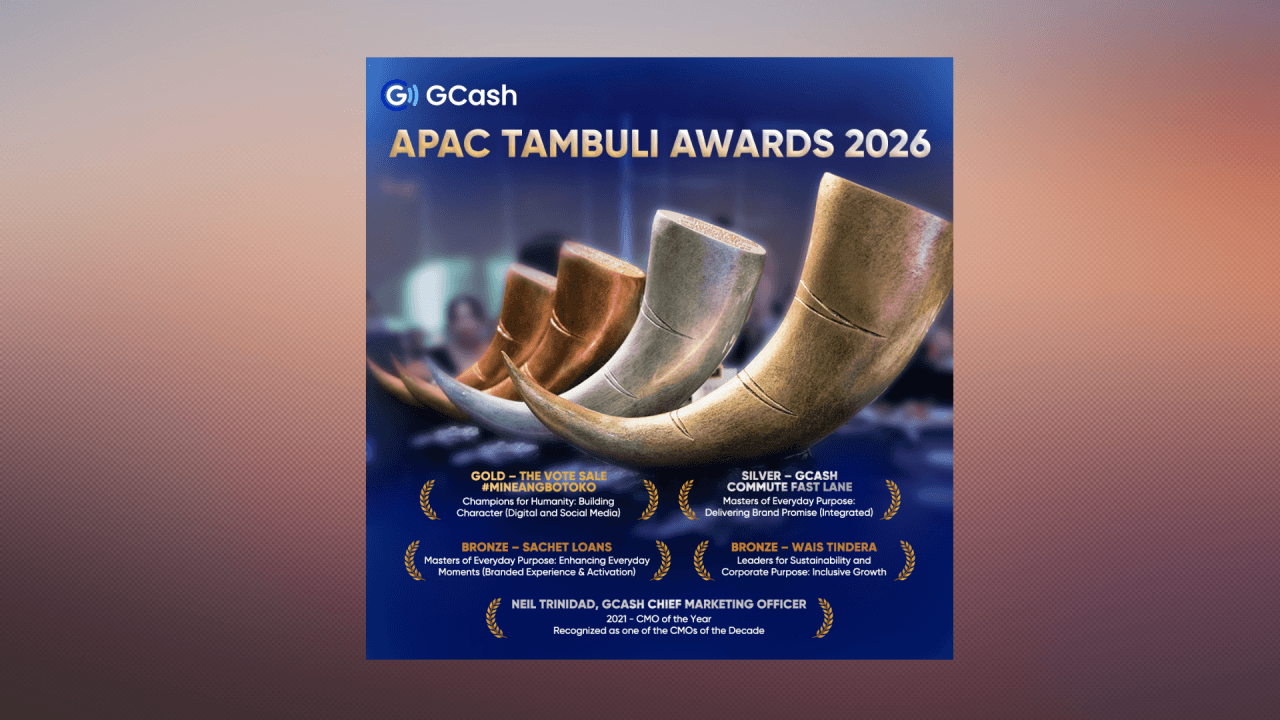
That broader strategy earned GCash four major accolades at the 2026 APAC Tambuli Awards, which recognize brands for combining business growth with measurable social impact. The awards are organized by the University of Asia and the Pacific.
Driving accountability
GCash won Gold under Champions for Humanity: Building Character (Digital and Social Media) for #MineAngBotoKo, which worked with independent media and the Commission on Elections.
The campaign adapted social media live-selling to challenge vote-buying while GCash strengthened security monitoring and transaction guardrails during critical election periods.
Making commuting easier
The Commute Fast Lane initiative received Silver under Masters of Everyday Purpose: Delivering Brand Promise (Integrated).
Developed with the Department of Transportation, it introduced cashless payment options at Metro Rail Transit Line 3. GCash plans to extend the infrastructure to other major Philippine transit networks.
At the grassroots
Two Bronze Tambuli awards highlighted the company's push toward financial inclusion. “Sachet Loans” offers nano-financing from P100 to P300 as an alternative to informal lending.
“Wais Tindera,” meanwhile, brings financial literacy, digital tools and cash-management skills to sari-sari store owners through a nationwide caravan.
Leadership lens
GCash chief marketing officer Neil Trinidad was also named one of the CMOs of the Decade, following his CMO of the Year recognition in 2021.
"The 2026 APAC Tambuli Awards affirm that digital tools create the greatest impact when they serve a clear human purpose. At GCash, we build solutions that matter—from making daily commutes easier and supporting neighborhood stores to promoting accountability and inclusion," said Trinidad.
The big picture
The initiatives show GCash positioning digital finance as infrastructure that reaches beyond payments—into mobility, civic life and neighborhood businesses. Together, they reinforce its push to make financial services more accessible to Filipinos across income levels and communities. —Ramon C. Nocon | Ed: Corrie S. Narisma