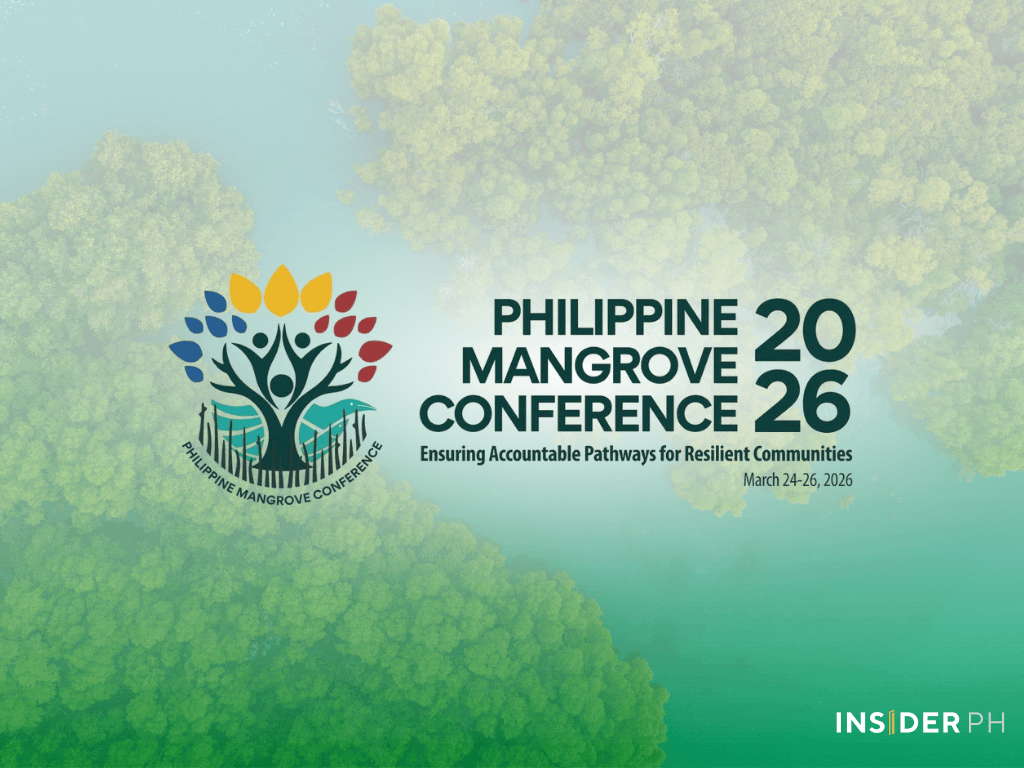
This was underscored at the Philippine Mangrove Conference 2026, convened by the Global Mangrove Alliance Philippines and the Department of Environment and Natural Resources – Biodiversity Management Bureau (DENR-BMB), held from March 24 to 26 in Quezon City.
Bringing together representatives from the government, academe, civil society, local communities, and the private sector, the conference focused on aligning science, policy, and financing to accelerate mangrove conservation—supporting the country’s climate and biodiversity commitments.

Aligning policies and commitments
“Protecting mangroves has become a development priority for a country as vulnerable to climate impacts as the Philippines,” said Dr. Annadel Cabanban, country manager of Wetlands International Philippines and lead convenor of the Global Mangrove Alliance Philippines.
Discussions focused on aligning mangrove initiatives with the Philippine Biodiversity Strategy and Action Plan (PBSAP) and the country’s Nationally Determined Contributions (NDCs), while advancing targets under the broader 2030 Sustainable Development Agenda.
Highlighting the conference was the launch of the National State of the Coasts (NSOC), a new tool to track progress in coastal and blue economy efforts—areas where mangroves are key to resilience and sustainability.
Gains achieved yet challenges remain
Data presented during the conference showed that mangrove forests in the Philippines have expanded from about 240,824 hectares in 2010 to around 311,400 hectares in 2020, reflecting the impact of rehabilitation and conservation efforts.
According to Dr. Ariel Blanco of the Philippine Space Agency, satellite-based monitoring is helping identify priority areas for intervention, enabling coordination across agencies such as DENR, BFAR, and economic planners integrating nature-based solutions into infrastructure.
Still, speakers emphasized that progress must be scaled and sustained—particularly as climate risks intensify.
Communities at the core
Beyond national programs, stakeholders stressed the importance of grounding conservation efforts in local realities.
“Restoring mangroves is about helping communities live sustainably alongside them,” said Atty. Julie Bedrio, Provincial Environment Management officer of Negros Occidental.
The conference highlighted contributions from grassroots and sectoral groups—including Indigenous communities, women’s organizations, and youth networks—reinforcing the role of local stewardship in ensuring long-term ecological outcomes.
Companies are taking notice
Meanwhile, outside the conference, companies are doing their share.
As policy alignment and scientific coordination advance, the private sector, including major corporations, is increasingly integrating mangrove conservation into its core sustainability and climate strategies.
Globe Telecom has partnered with the Zoological Society of London on long-term mangrove protection initiatives, while Cebu Pacific, working with the Aboitiz ecosystem and local partners, has funded mangrove restoration projects in multiple coastal areas
For its part, Jollibee Group Foundation has supported mangrove planting across several provinces and Haribon counts Manulife Philippines as one of its corporate allies. Not to be left behind are digital platforms such as GCash that have enabled large-scale tree-growing efforts, including mangroves, through partnerships with implementing organizations
Why coordination matters
For policymakers, the challenge now is less about readiness and more about alignment.
“Our array of programs and policies shows that we are already equipped and ready to act,” said Mariglo Laririt, assistant director of DENR-BMB. “The next step is to work together—collaborate, coordinate, and align across sectors.”
To make this happen, it is critical that government policy and funding are backed by scientific data and monitoring. At the same time, community-led implementation should be ensured as corporate capital and ESG commitments are mobilized.
A convergence moment
The Philippine Mangrove Conference 2026 signals a broader convergence across stakeholders, seeing the alignment of environmental protection, economic strategy, and private sector participation..
As climate pressures intensify, mangroves are no longer seen solely as ecosystems to conserve but as assets that underpin resilience, livelihoods, and future investment pathways. —Ed: Corrie S. Narisma

Features Reporter