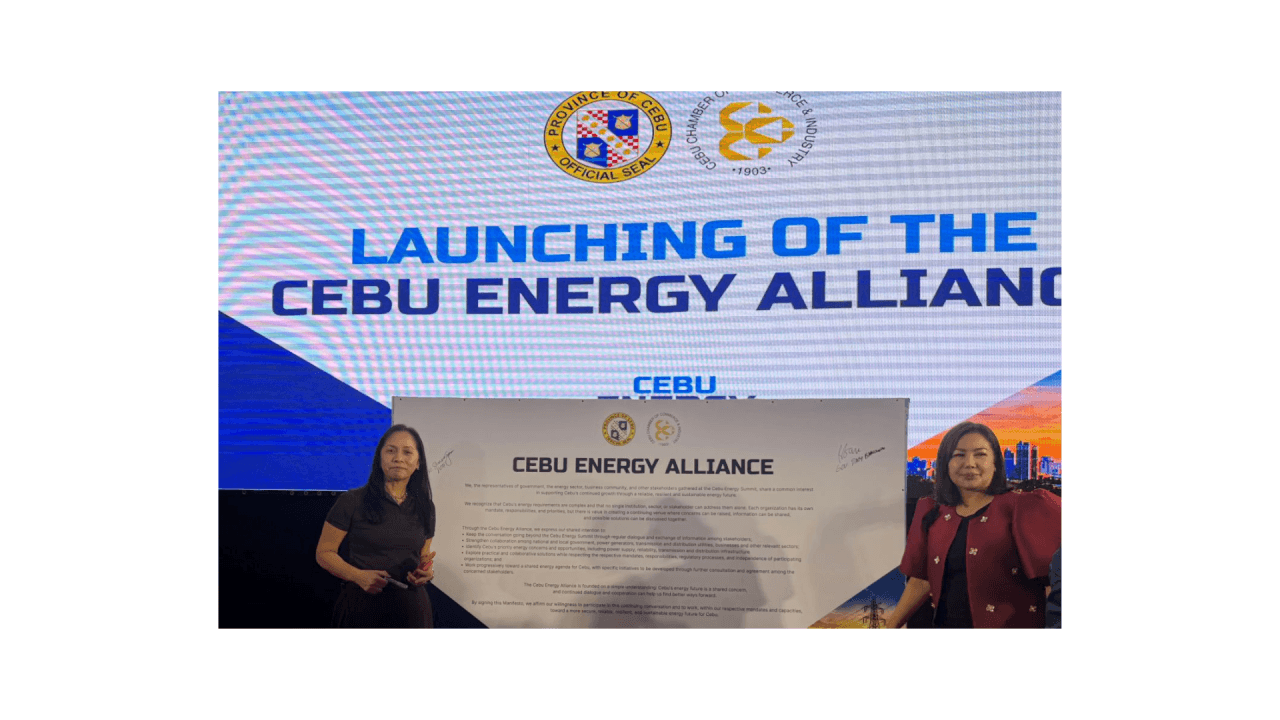
The Cebu Energy Alliance was formalized through the signing of a commitment manifesto led by Cebu Gov. Pamela Baricuatro during the Cebu Energy Summit organized by the Cebu Chamber of Commerce and Industry (CCCI) and the provincial government on Oct. 12.
The alliance seeks to strengthen coordination among government agencies, power industry stakeholders and the business community in addressing supply constraints and meeting Cebu’s growing electricity demand.
Its formation comes as Cebu continues to grapple with tight power supply, which has resulted in rotational brownouts and heightened concerns among businesses over operating costs and the reliability of electricity services.
Baricuatro stressed that reliable electricity was essential not only to economic growth but also to the uninterrupted delivery of essential services, particularly healthcare.
“Reliable power is also essential to the Cebu we are working to build—a province with more jobs, stronger businesses and economy, better healthcare, thriving tourism, and opportunities reaching every community. That is why it matters that the government, the energy sector, and our stakeholders are here together,” she said.
The governor assured stakeholders that the provincial government would help coordinate with local government units and bring concerns raised during the summit to the appropriate national agencies.
“Buhaton namo ang among bahin (We will do our part). And we look forward to working with every partner here in fulfilling our shared responsibility to the people we serve,” she added.
Shared commitment
Through the manifesto, government agencies, energy industry players, business groups and other stakeholders committed to sustained dialogue, information sharing and closer coordination in addressing Cebu’s energy challenges.
The agreement lays the groundwork for developing a common energy agenda for Cebu, with specific initiatives and courses of action to be identified through further consultations.
However, the manifesto does not identify specific projects, implementation timelines or funding commitments.
Among the signatories were Energy Secretary Sharon Garin and representatives of National Grid Corporation of the Philippines (NGCP), Energy Regulatory Commission (ERC), Aboitiz Power, Acciona Energia Philippines Inc., Visayan Electric, Cebu Electric Cooperative, Mactan Electric Company, various business chambers, provincial officials and local government units.
Energy priorities
The Cebu Energy Alliance will serve as a continuing platform for cooperation among government agencies, power generators, transmission and distribution utilities, business groups and other stakeholders.
The signatories acknowledged that Cebu’s energy challenges were too complex for any single institution or sector to address alone, underscoring the need for sustained coordination.
The alliance aims to identify priority concerns involving power supply, electricity reliability, and transmission and distribution infrastructure while exploring practical solutions within the respective mandates of participating organizations.
Specific initiatives will be determined through further consultations and agreements among stakeholders.
“Cebu’s energy future is a shared concern, and continued dialogue and cooperation can help us find better ways forward,” the manifesto stated.

Government participation
CCCI vice president for business mobilization Bernard Sia said that while similar power summits had been held in the past, this was the first time an alliance had been formed with broader participation extending beyond the private sector to include national government agencies, provincial officials and other energy stakeholders.
He said the chamber’s board of trustees would meet again to determine the alliance’s next steps and specific deliverables, including the preparation of a position paper outlining proposed courses of action and recommendations.
Sia stressed that Cebu’s power problems were contributing to wider economic uncertainty and affecting business confidence at a time when government spending had slowed.
While reliable electricity remains an immediate priority, he said the longer-term goal should be to make power more affordable for businesses and consumers.
He acknowledged that businesses were willing to pay a premium for reliable electricity but cautioned that rising operating expenses could eventually become unsustainable, particularly for smaller enterprises.
Consumer protection
Cebu Electricity Rights Advocates (CERA) lead convenor Nathaniel Chua, one of the manifesto's signatories, said consumer welfare should remain central to energy policy decisions.
“Cebuanos deserve electricity that is fair, affordable, reliable, and dependable—not power that comes with unpredictable costs and recurring threats of supply shortages,” Chua said in a statement.
He stressed that consumers should pay only the reasonable and necessary costs of generating and delivering electricity, with strong regulatory safeguards against excessive market exposure, speculation and operational failures.
Chua said electricity bills should reflect transparent, long-term power contracts and reasonable costs rather than excessive price spikes in the Wholesale Electricity Spot Market (WESM) or unexplained and unannounced pass-through charges.
He added that electricity rates across Cebu should be kept at reasonable and sustainable levels through adequate local baseload capacity, a more diversified generation mix and stronger inter-island grid connections. —Ed: Corrie S. Narisma

Contributor