Mark Ynoc, president of the Mandaue Chamber of Commerce and Industry (MCCI), warned that Cebu’s power supply is already struggling to keep up with surging demand driven by the province’s robust economy.
Supply gap widens
“We have the fastest growing economy in the Philippines, with GDP (gross domestic product) growth at 7.3 percent, but we are also increasing in (power) demand at 150 megawatts per year. And we don't have the capacity to build 150 MW, even in five years,” said Ynoc.
A power consumer advocacy group echoed the warning saying Cebu, a major manufacturing and services hub in the country, is entering a critical energy situation that risks paralyzing the local economy.
The Cebu Electric Rights Advocate (CERA), led by convenor Nathaniel Chua, pointed out that Cebu’s power demand increased by 150 MW every year, exceeding local generation capacity and forcing a “dangerous dependence on imported power from nearby islands.”
Growth under pressure
“Business leaders in manufacturing and export have expressed deep alarm, stating that the frequent ‘Yellow Alerts’ and power-sharing limitation are already increasing costs and delaying production schedules,” said CERA in a statement.
It warned that without new stable power plants on the island, Cebu risks an economic slowdown as early as 2026.
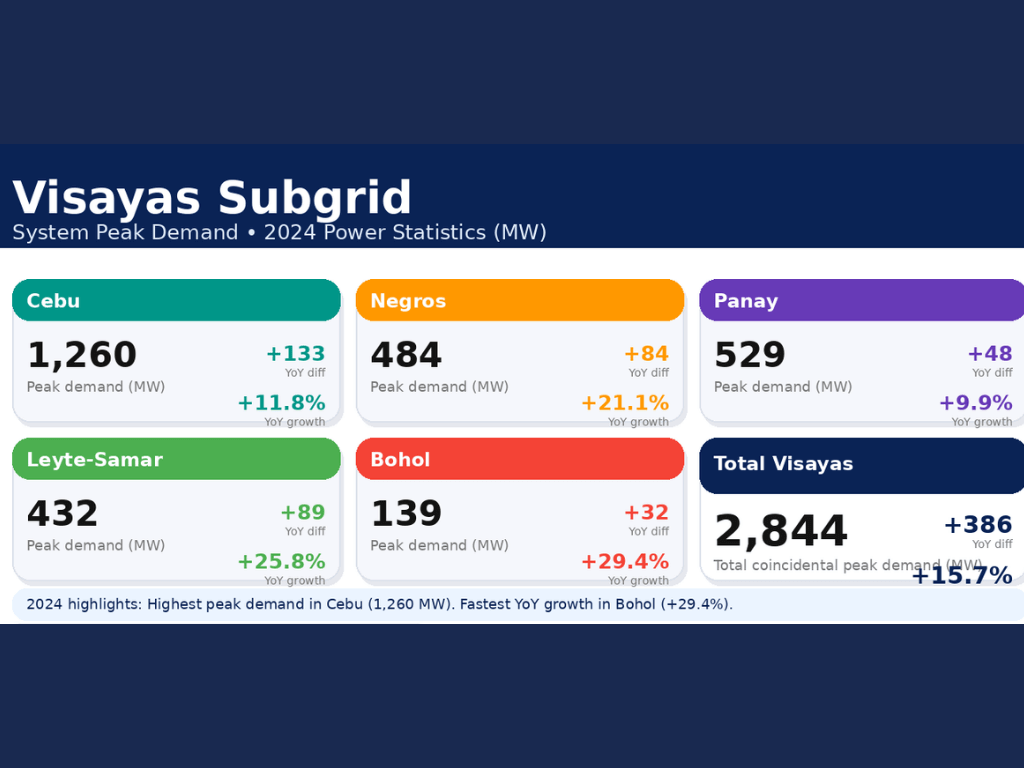
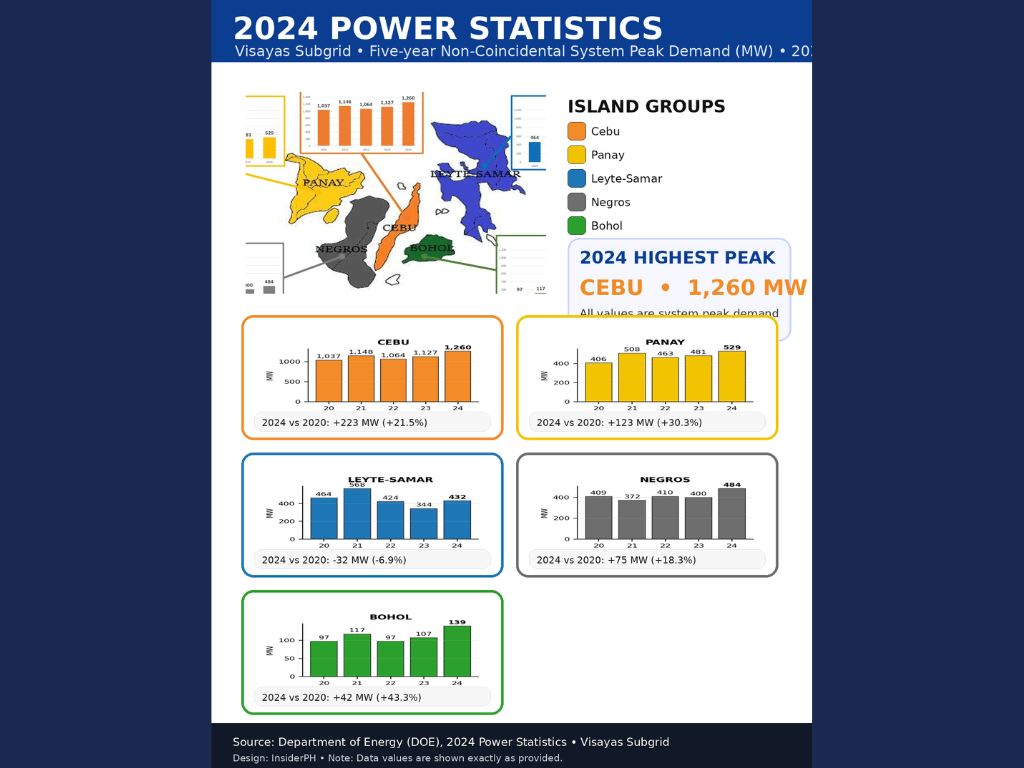
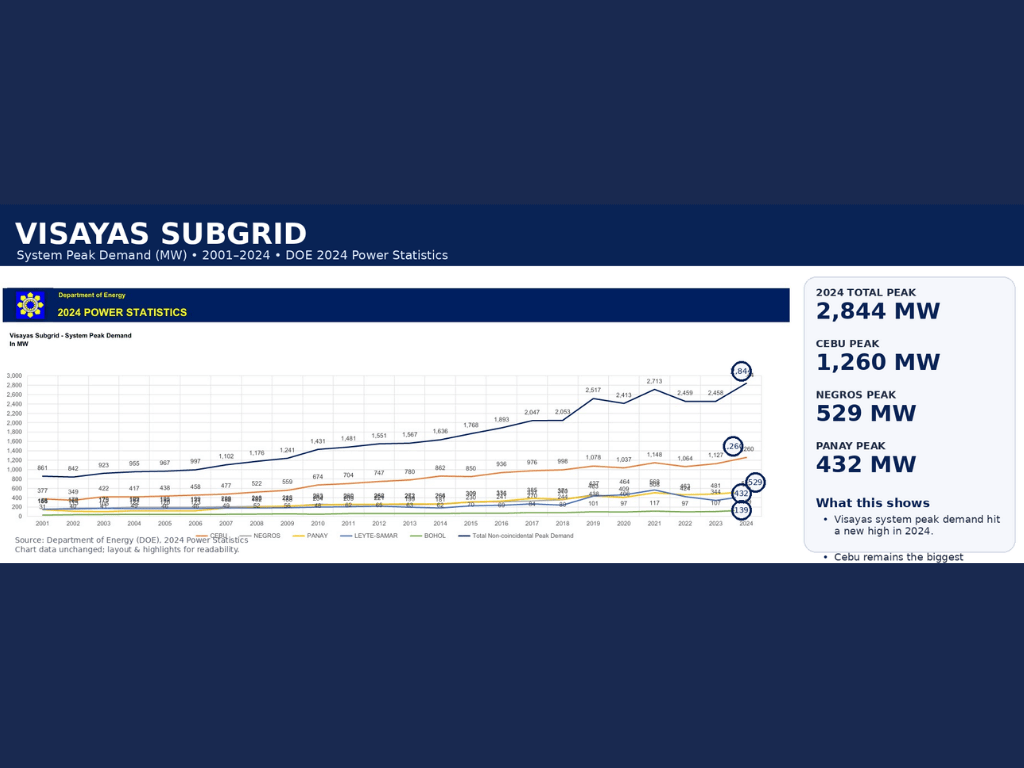
Based on data from the Department of Energy (DOE), Cebu’s peak demand in 2024 was at 1,260 MW, up by 133 MW from 2023’s 1,127 MW – or a growth rate of 11.8 percent.
In the Visayas, the power operating margin was at 238 MW as of Dec. 29, 2025, which may be the reason why the region had always been on yellow alert.
The available generating capacity in the Visayas stood at 2,449 MW, quite close to its system peak demand at 2,211 MW.
Power infrastructure limits
Cebu Island was first interconnected with Negros Island through a 100-megawatt submarine cable on Jan. 26, 1994. A second phase, also with a 100-megawatt capacity, was completed in August 2008.
Cebu and Leyte islands were interconnected in 1997 under Phase 1, which had a capacity of 200 megawatts. Phase 2 followed in 2005, adding another 200 megawatts.
According to Ynoc, Cebu’s unreliable power supply could undermine the province’s attractiveness to investors and cause it to lose potential business opportunities.
One such opportunity is hosting data centers, a fast-growing but highly power-intensive sector.
Ynoc said a data center would require at least 2 MW of power for every 1,000 square meters of floor area.
While solar power plants could help fill the gap, Cebu faces land constraints, with limited flat areas suitable for large-scale facilities.
“It's going to be a very hard challenge to let go of coal. It (coal-fired power plant) is much cheaper, much faster, “ said Ynoc.
Grid bottlenecks persist
Aside from building power plants, another challenge is connecting them to the grid.
Ynoc said he had spoken with solar power developers from Taiwan who were eager to invest in Cebu but later backed out after learning that a long queue of applicants was already waiting to connect to the grid.
He added that the investors were told it would take at least three years to connect to the grid if they build now.
CERA, for its part, called for the immediate construction of island baseload power plants to end “Cebu’s risky reliance” on submarine cables.
The group also urged the DOE and local utilities to present a clear, transparent road map to prevent the “critical” 2026 supply forecasts from becoming a reality marked by daily blackouts.

Contributor