The Department of Energy (DOE) expects power supply in the Visayas to stabilize by Sept. 21, following the scheduled return to service of several major power plants in the Visayas and Mindanao.
Undersecretary Rowena Cristina Guevera told an online news conference on Sept. 7 that the agency hoped yellow and red alerts would no longer be raised once power plants currently offline resume operations by Sept. 20.
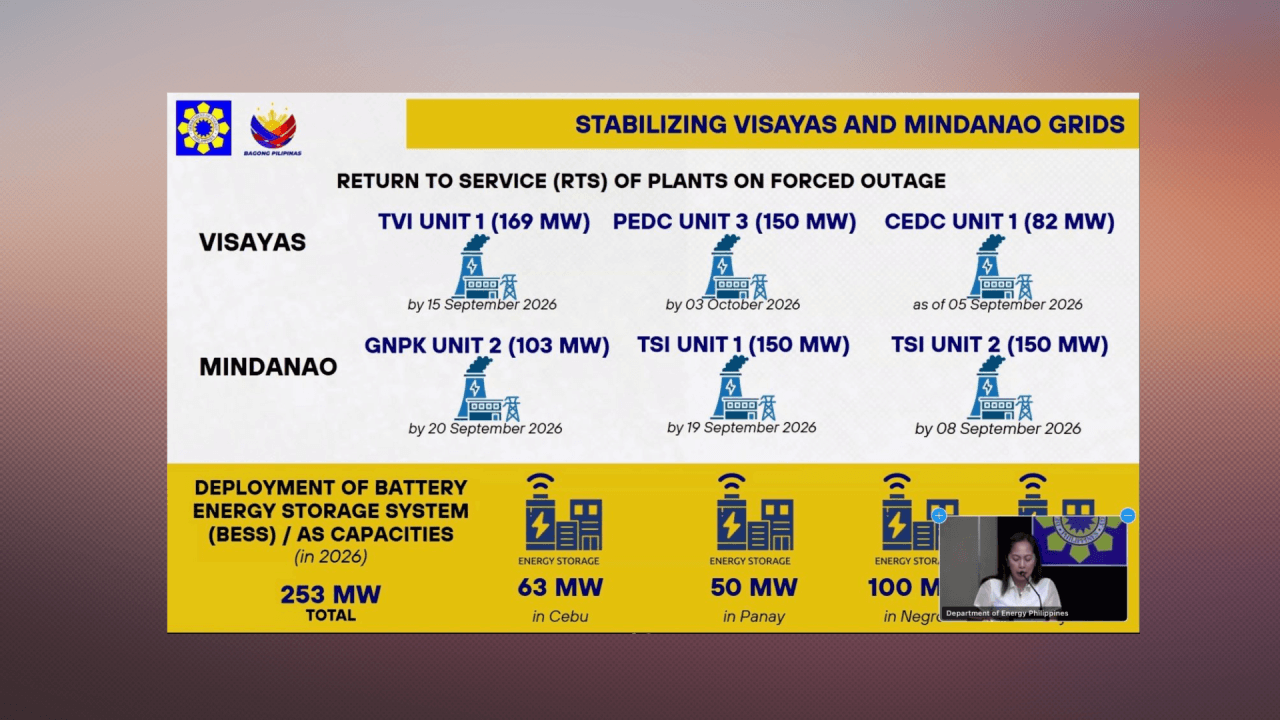
She said the DOE was also hoping that National Grid Corporation of the Philippines (NGCP) could fast-track the procurement of 253 megawatts (MW) of capacity for ancillary services, which would help the Visayas avoid yellow and red alerts.
“But if that situation changes, we will again report to the public,” she added.
Guevera said DOE officials had also been visiting power plants that were offline, speaking with engineers to get a clearer picture of conditions on the ground and helping facilitate the transport of needed spare parts to speed up repairs.
Back in operation
According to Energy Secretary Sharon Garin, three big power plants in the Visayas and three in Mindanao are expected to be online by Sept. 20.
In the Visayas grid, the 82-MW Unit 1 of Cebu Energy Development Corp. returned online on Sept. 5, while the 169-MW Unit 1 of Therma Visayas Inc. was scheduled to resume operations on Sept. 15. The 150-MW Unit 3 of Panay Energy Development Corp. was expected to return by Oct. 3.
A total of 403 MW of capacity in the Mindanao grid is expected to return online this month. This includes the 103-MW Unit 3 of GNPower Kauswagan Ltd. Co., which is scheduled to resume operations by Sept. 20.
Therma South Inc.’s 150-MW Unit 1 is expected to return by Sept. 19, while its 150-MW Unit 2 is scheduled to come back online on Sept. 8.
Garin said the DOE has also been working with power companies to deploy 253-MW battery energy storage systems across the islands of Cebu, Panay, Leyte, and Negros—some of which were already prepared to support the Visayas grid immediately.
Rotation brownouts
The Visayas grid has been placed under yellow and red alerts following the forced and planned outages, as well as the derating, of several power plants.
The supply shortage was compounded by limited—or, at times, unavailable—power imports from the Mindanao grid, where several major power plants were also on forced outage. As a result, rotational brownouts became a daily occurrence starting Aug. 24, drawing complaints from various sectors.
The Visayas grid can import up to 250 MW from the Luzon grid and 450 MW from Mindanao.
Based on a Sept. 7 advisory from the NGCP, manual load dropping was implemented due to limited power imports from the Mindanao grid, resulting in rotational brownouts in Panay, Cebu, Bohol, Guimaras, Leyte and Samar from 1 p.m. to 10 p.m.
As of 1 p.m., the Visayas had a power deficit of 186 MW, with peak demand at 2,470 MW against an available capacity of 2,284 MW.
Key priorities
At the news conference, Garin assured the public that the DOE was treating the power situation in the Visayas with “utmost concern.”
She said the agency’s key priorities were restoring supply to the grid, strengthening battery reserves, investigating power plants with repeated breakdowns and enforcing accountability, strengthening transmission to ensure power can be delivered where it is needed, and building enough supply to meet future demand.
“But right now, this time ang panahon na to is para ayusin muna. Wag muna tayong mag magturuan (Let us fix the problem first. Let us not point fingers yet). We want it fixed before we get to the part on accountability.”
Garin said the DOE had directed the NGCP to execute outstanding ancillary services contracts needed by the Visayas grid, including those involving battery capacity. She said tapping additional battery storage could help prevent red alerts.
The NGCP committed to complete these within the month following the DOE’s issuance of a show-cause order.
While the immediate priority was to bring the affected power plants back online, Garin said authorities also needed to determine why the plants went offline and address any underlying problems.
“Was the plant properly maintained? Why did the same problem happen again? How long was it unavailable? What is being done to make sure consumers do not experience the same problem again?”
Audit
The DOE was also auditing power plants’ compliance with maintenance schedules, requiring corrective action plans, issuing show-cause orders when warranted and pursuing sanctions for confirmed violations.
Garin said the DOE was giving the same urgency to transmission issues, as having enough electricity available in the system was not enough if it could not be delivered where needed.
“The grid must be able to move that electricity to where people need it. This is why we are assessing transmission constraints across the Visayas including Leyte, Samar corridor to identify what can be fixed now and what infrastructure needs to be strengthened,” she added. —Ed: Corrie S. Narisma

Contributor