The facility served the LT Group of Companies’ fleet of rotary aircraft, the preferred mode of transport of taipan Dr. Lucio C. Tan, aka Kapitan, who controls the building. From street level, the whirr of helicopter engines was a familiar sound, and the sight of choppers coming and going became part of the building’s identity in busy Makati.
While those days are gone, the PNB Makati Center remains a valued asset among his many properties
A proof, perhaps, is how PNB Holdings Corp. — the company formed to hold Philippine National Bank’s spun-off prime real-estate assets, including the PNB Financial Center in Pasay, the bank’s HQ, and that 8,000-sqm vacant lot on Buendia that Ramon Jacinto once fought for ownership of — has chosen to give the building a makeover instead of demolishing it, a fate many old buildings in Makati have faced and are facing.
Rising in Makati
The history of the PNB Makati Center dates back to 1977, when the assets of the now-defunct General Bank and Trust Company, whose former presidents included Christian S. Monsod, were organized into Allied Banking Corp.
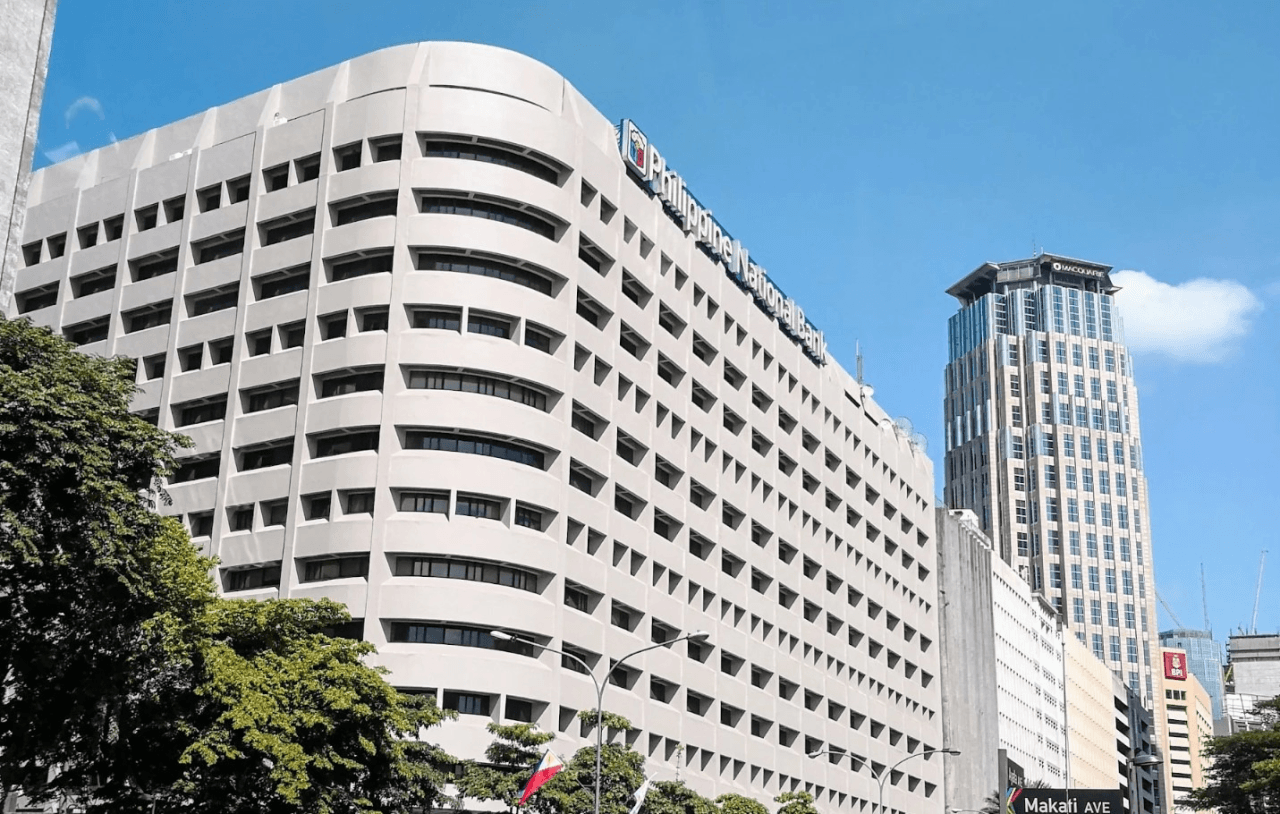
Aiming to cement its presence in bustling Makati, Allied Bank inaugurated the over 12-story Allied Bank Center at 6754 Ayala Avenue in 1980.
Designed by Carlos D. Arguelles — whose works include the Philam Life Building and the Manila Hilton — Allied Bank's headquarters embodied the Brutalist architectural style, projecting stability and permanence.
“His work is evident in the building’s clarity, restraint, and responsiveness to purpose,” shared PNB Holdings in a statement to InsiderPH.
The building’s most distinguishing feature, the company further states, is its curved facade that “breaks the rigid linearity of Ayala Avenue” while “introducing movement and subtle dynamism.”
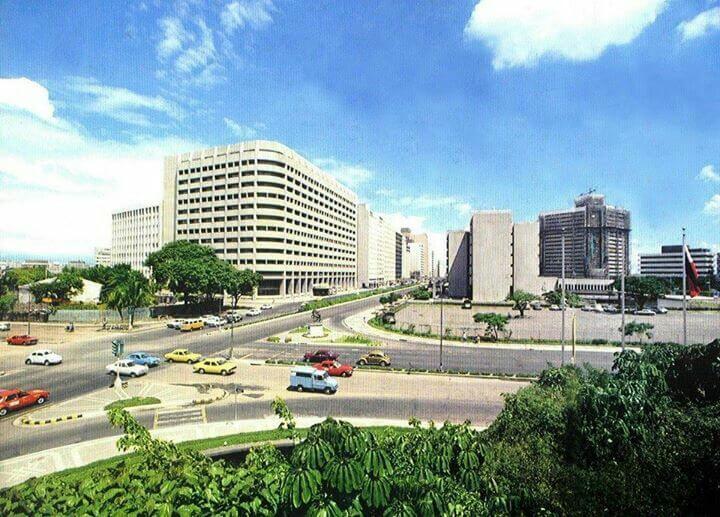
Other notable aesthetic features are the grid facade system, whose repetitive windows establish order while reflecting the bank’s internal efficiency. Meanwhile, the building’s use of concrete-based modernism — its solid, stable appearance — communicates strength.
All these attributes rang true as Allied Bank was ranked the 13th largest bank in the country, with P167.73 billion in assets. In 2013, however, with the LT Group acquiring Philippine National Bank, the two financial institutions merged, with PNB as the surviving entity.
Smart adaptive reuse
As the PNB Makati Center entered its fourth decade in 2022, PNB Holdings saw the need to maintain the building’s relevance — addressing the needs of the times in an ever-changing metropolis — while retaining its distinct architectural identity.
A smart adaptive reuse approach was therefore initiated by management, focusing on selective upgrades rather than full redevelopment. This saw the reconfiguration of interior spaces for flexible tenancy, the modernization of building facilities and systems, and the refurbishment of common areas and lobbies.
All this, as PNB Holdings points out, was to preserve the building’s form while improving function.
New tenant mix
Now home to a mix of corporate, business process outsourcing (BPO) tenants, plus a co-working space— Spaces, occupying the penthouse — the PNB Makati Center boasts a gross leasable area of 28,131 sqm, about three-meter ceiling heights, modular floor plates, and a layout designed to facilitate easy movement throughout the building.
Supported by a dedicated parking structure, the property accommodates the building’s estimated population of more than 4,500 occupants.
“Managing property is only one facet of our role. Our current focus is on how our employees, our tenants, and the community experience the work environment over time,” said PNB Holdings interim chief operating officer Atty. Michael Leslie D. Delos Reyes.
“By ensuring our office and retail spaces support both daily activity and long-term goals, we create enduring environments that define a legacy far beyond the physical assets themselves.”
In line with this, the company is focused on elevating asset performance, sharpening leasing initiatives, and positioning select properties for purposeful development.
A case study worth emulating
If the PNB Makati Center demonstrates anything, it is that with careful, thoughtful intervention, adaptive reuse can be a viable alternative to outright demolition — a compelling case study other major property owners can adapt and emulate. —Ed: Corrie S. Narisma

Features Reporter