The convergence of artificial intelligence and human interaction now defines a key challenge for brands across industries.
Twilio, a cloud communications company, recently commissioned a YouGov survey on digital patience on Aug. 28 to Sept. 4, 2025. The study polled 7,331 adults across seven Asia-Pacific markets—Australia, Hong Kong, India, Indonesia, Japan, the Philippines, and Singapore—and found that 90 percent of respondents believe their societies value patience and politeness in daily interactions.
Yet only 32 percent admitted to being patient when dealing with digital or automated customer service.
What Filipino customers expect from digital service
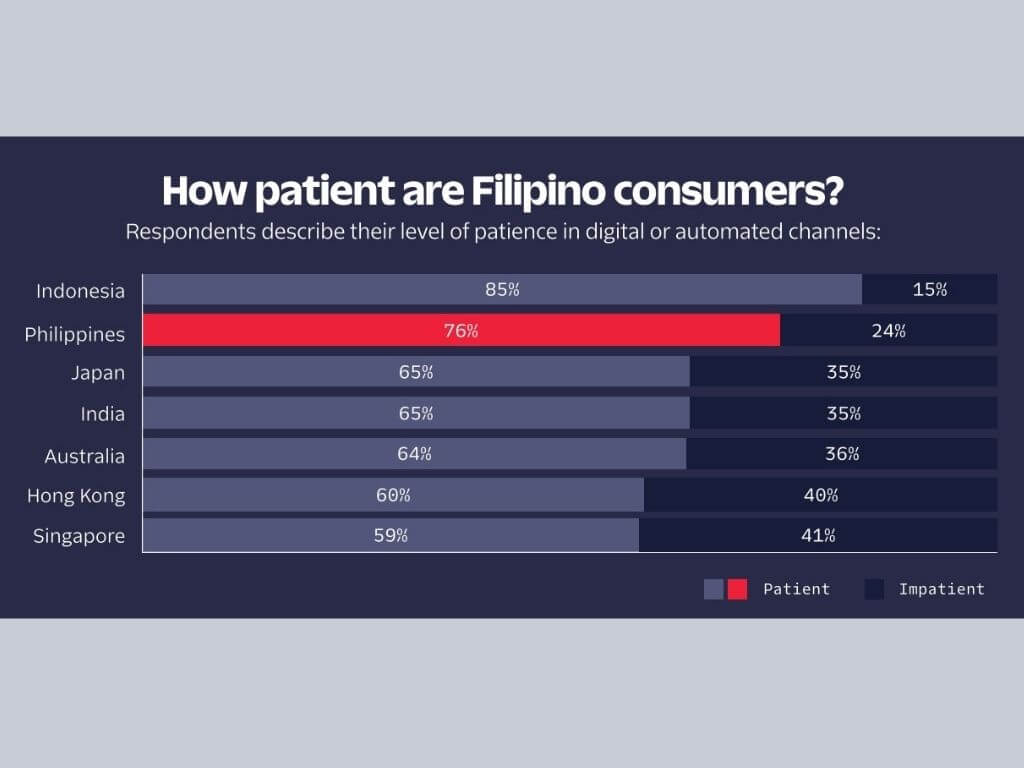
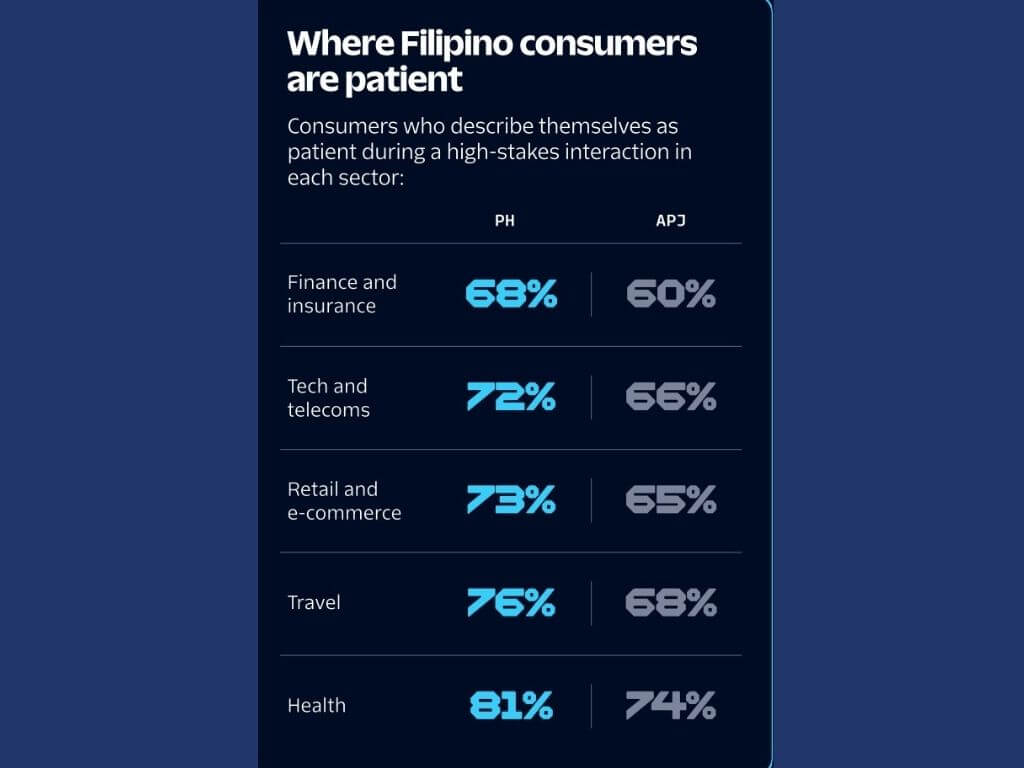
The survey defines digital patience as the time, goodwill, and attention consumers extend to a brand before they switch, complain, or give up entirely—making it a new currency of customer experience.The data also show that digital patience varies across markets. Indonesia (85 percent) and the Philippines (76 percent) ranked as the most patient in the region when engaging in digital interactions with brands, while Singapore ranked as the least patient.
In a webinar hosted by Twilio, Nicholas Kontopoulos, vice president of marketing for Asia-Pacific and Japan, and Mark Anthony Munsayac, vice president and head of customer experience at Philippine Airlines (PAL), shared insights into why technology must evolve with empathy.

Digital patience isn’t infinite
Kontopoulos said that while Filipinos are among the most patient consumers in Asia, that patience is “conditional, not infinite.”
“If you exhaust [their patience], they switch to a competitor, they complain publicly, or they basically just give up entirely on your brand,” he said.
Filipino consumers, the survey found, value clarity, reassurance, and warmth in digital interactions.
While 41 percent prioritize quick response times, they place higher importance on clear instructions (50 percent), security (41 percent) and friendliness (37 percent)—more than their Asia-Pacific peers.
They are also the most self-reliant in the region, with 43 percent preferring to solve problems on their own. Still, they hold brands accountable, with a higher likelihood of complaining or leaving negative reviews.
Kontopoulos added that Filipinos’ cultural values play a key role in how they remain “digitally patient,” describing it as a “quiet strength that has its limits.”
Filipinos are willing to wait an average of 27 minutes for a resolution, yet some brands make them wait for as long as 32 minutes.

Why AI fails when it sounds scripted
The study also found that while consumers remain patient with human agents, their tolerance declines sharply when they interact with automation.
“When talking to live agents, patience is high. But when it comes to AI chatbots, patience drops to 72 percent,” Kontopoulos said.
From an operational standpoint, Munsayac said silence and confusion are among the quickest ways to lose customers in the airline industry.
“Digital patience isn’t cultural—it’s conditional. Filipinos are patient only when there’s clarity, progress and trust,” he said.
Munsayac added that this is why PAL places greater emphasis on clear communication and effective issue resolution. Customer service, he said, is not just about speed but about timely and effective resolution.
However, Kontopoulos warned that when brands focus too much on automation, they risk alienating customers.
Echoing the survey’s findings, he said Filipino consumers prefer AI interactions that feel human, personalized and genuinely helpful. They also become more frustrated than their Asia-Pacific peers when AI systems give scripted or robotic responses.
“Brands should anchor their AI strategy in three pillars: clarity, security and friendliness. If your AI lacks warmth and transparency, it’s just getting in the way,” Kontopoulos said.
How PAL uses AI without losing the human touch
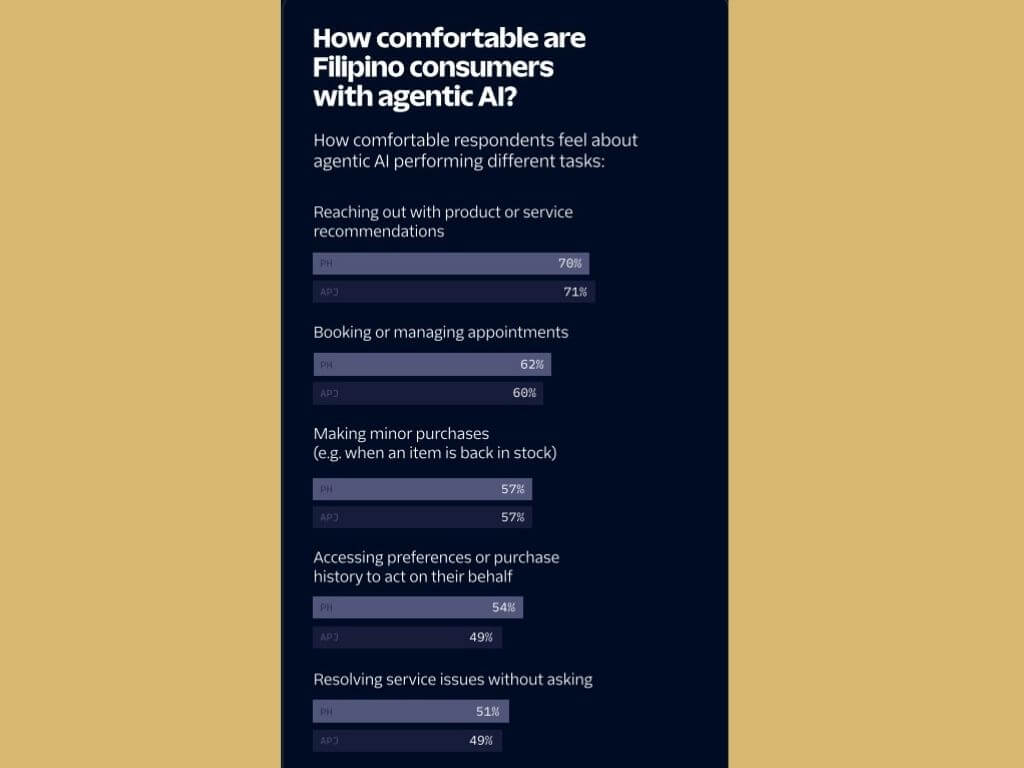
For Munsayac, that philosophy has guided PAL’s own AI deployment. “We implemented agentic AI in mid-2025. We’re able to deflect 40 percent of the interactions, and these were resolved by AI,” he said.
He added that when PAL's AI detects customer frustration, the interaction is handed over to a live agent for better issue resolution.
“We want passengers to use our GenAI service because it’s helpful and easy to use. And if they feel that the AI is not able to fully resolve their concern, then a live agent is on standby,” he said.
He emphasized that AI should complement—not replace—human agents, and that technology should empower them to handle more complex tasks.
Munsayac said the next step for PAL is to enhance customer personalization by scaling data integration and improving data management across all channels.
A customer management tool designed to enable personalization is set to be deployed in the third or fourth quarter of this year.
“We aim to complete 100 percent by the end of [the] year the implementation of a customer data platform,” he said, adding that this is a move “from personalization to individualization,” where every touchpoint feels humanly tailored.

Content Producer