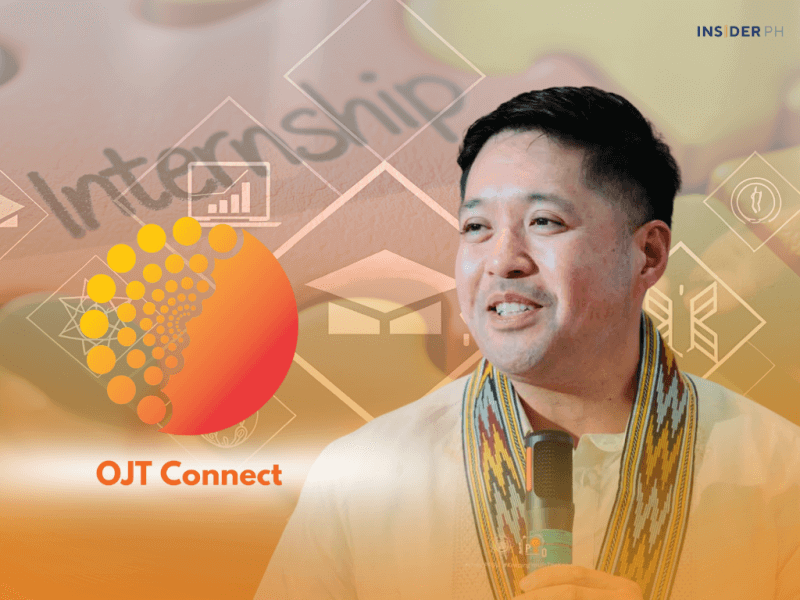
Job mismatch happens when graduates earn degrees that do not align with the work they eventually take on. Growing up around overseas Filipino workers, Romero saw how common it was for Filipinos to hold degrees at home but work in unrelated jobs abroad.
The narrative of sacrifice, he said in an interview with Insider PH, is deeply embedded in the culture. For him, the issue is not simply personal—it is structural, and one that technology can help address.

An idea shaped by the pandemic
The idea of creating a platform to connect Filipino students—particularly those in provincial areas—to remote internships or on-the-job training (OJT) opportunities with companies abroad began to take shape in the early days of the pandemic.
It started when Romero, a US-based tech founder with Filipino roots, collaborated with the Polytechnic University of the Philippines in Unisan, Quezon, to organize a donation drive for used iPads to support students struggling with distance learning.
Through contacts in San Diego, he gathered and donated 40 tablets to the campus. The effort strengthened his relationship with the school. Later, the campus asked if he could accept OJT students.
Publish a platform to create solutions
Instead of assigning routine tasks, Romero restructured the internship. He challenged students to identify problems in their communities and build platforms that deliver real solutions.
Ten information technology students pitched ideas. The selected concept focused on ride-sharing and transportation.
The goal was not to launch a startup, but to give students hands-on experience working with a company abroad and to help them publish a platform they could include on their resumes.
Romero viewed the initiative as proof of concept. As a result, eight of the 10 interns later secured jobs as software developers with tech companies abroad.
The experience reinforced his belief that intervention must begin earlier in a graduate’s career. “I believe the foundation for change is through OJT,” he said.

Building a structured pathway
Launched in March 2024, the San Diego-based OJT Connect operates similarly to established job portals such as JobStreet or Indeed. Students, alumni, and career shifters can create profiles and apply for remote internship opportunities.
The platform connects interns with global and local companies and is evolving into a one-stop system that manages the entire internship lifecycle—from application to certification.
Its aim is to make internships a clear pathway to full-time employment and help close the experience gap.
To ensure quality and accountability, OJT Connect is in consultation with the Commission on Higher Education to align its framework with national standards.
It is also working with the Philippine Association of Colleges and Universities Commission on Accreditation, particularly on advancing internationalization efforts by bringing global opportunities directly to local institutions.
The platform implements a screening process for partner companies, requiring corporate identification and interviews to help prevent exploitation and ensure proper mentorship.
While many partners are technology firms, companies such as the cruise holding company Royal Caribbean have also expressed interest in sourcing interns for roles beyond hospitality, including accounting and software engineering.

Preparing students for the workplace
Beyond job listings, the team conducts free preparatory workshops, including resume writing sessions and interview coaching.
OJT Connect is also developing tools to track graduate outcomes, allowing universities and government agencies to monitor how many interns transition into full-time roles.
The platform is partnering with the Department of Information and Communications Technology under the “Trabahong Digital” initiative, which would enable endorsements across local government units, starting with the Zamboanga Peninsula, and support the expansion of its internship management system.
“We prioritize schools in more rural areas because we want to highlight them and give their students access to opportunities first. The platform is open to everyone—including students from institutions such as La Salle or University of the Philippines—but in terms of outreach and regional focus, the emphasis is currently on more geographically distant communities,” he said.
Staying rooted while moving forward
Romero said creativity and independent thinking set strong interns apart, particularly in the technology sector. He encourages interns to visualize what they intend to execute and to move past insecurity. Once that barrier is broken, he said, confidence follows.
In the end, Romero hopes Filipino graduates can pursue meaningful careers and grow professionally without having to leave their families behind.

Content Producer