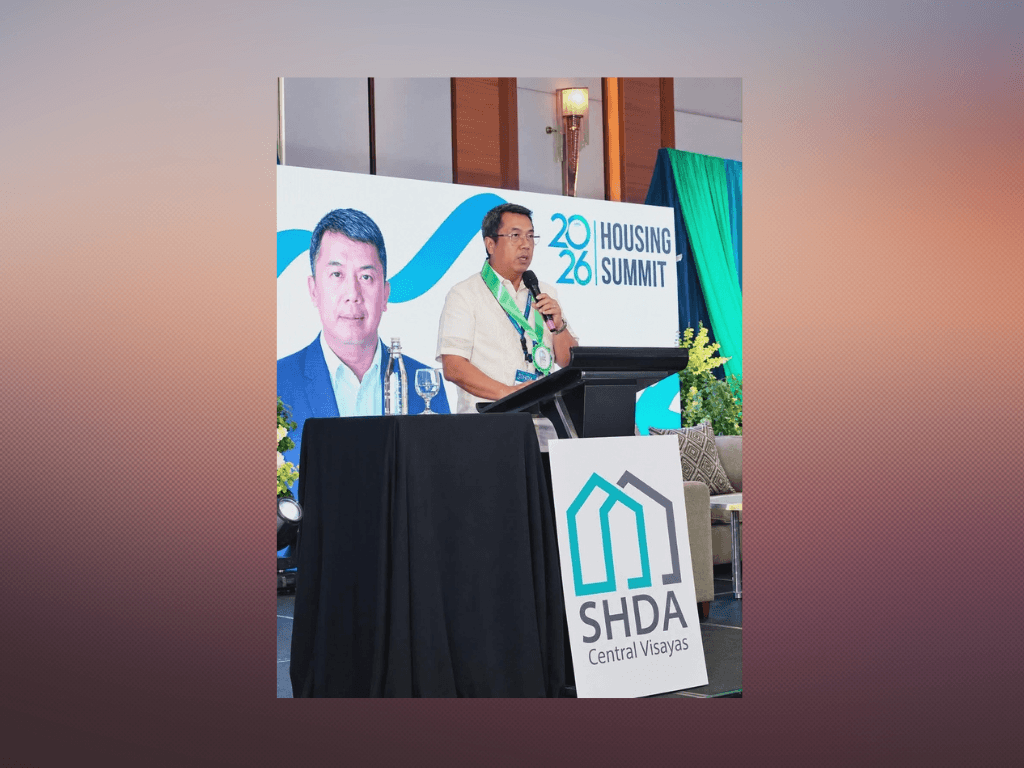
Subdivision and Housing Developers Association–Central Visayas (SHDA-CV) president Ken Salimbangon said the region’s continued economic and urban growth offered significant opportunities for the housing industry.
“Our cities are expanding, new growth areas are emerging, businesses are investing, and more Filipino families aspire to own homes,” he said during the 2026 SHDA-CV Housing Summit on Sept. 11.
But Salimbangon said housing development had become increasingly complex amid regulatory and environmental requirements, taxation, financing constraints, rising construction costs and limited access to water, electricity, roads and other infrastructure.
“These issues are interconnected. A delay in approval can delay a project. An increase in development costs eventually affects affordability,” he said.
Concerns
Salimbangon warned that the lack of basic utilities and infrastructure could restrict urban expansion, while policies meant to address one concern could have unintended consequences elsewhere in the housing value chain.
He said the summit, themed “Breaking Barriers, Building Forward,” sought to bring government officials and private-sector representatives together to identify practical solutions to the industry’s challenges.
Among the issues discussed were taxation and the implementation of the Real Property Valuation and Assessment Reform Act, which seeks to establish updated and uniform property valuation standards.
Salimbangon said the government’s need to collect fair revenues must be balanced against the impact of taxation on development costs, housing prices and homebuyers.
“The objective should therefore be to find the right balance,” he said.
Utilities
Developers are also paying greater attention to water and power availability when evaluating potential project sites, according to Salimbangon.
While land price, location, accessibility and market demand remain important, he said developers must now also assess whether an area has sufficient water and power to support new communities.
“In some of our rapidly growing cities, water availability is already becoming a constraint to development,” he said.
Salimbangon stressed that urban growth must also be pursued responsibly to ensure that development does not compromise resources needed by future generations.
Keeping prices low
Another major challenge is keeping homes affordable as fuel, construction material, logistics and labor costs continue to rise. Financing and regulatory compliance also add to housing development costs.
Salimbangon said developers should explore smarter design, more efficient construction methods and other innovations to balance affordability, quality and project viability.
“If the industry cannot produce housing sustainably, we cannot solve the housing shortage. And if Filipino families cannot afford what we produce, then we have not solved the problem either,” he said.
Another major challenge is keeping homes affordable as fuel, construction material, logistics and labor costs continue to rise. Financing and regulatory compliance also add to housing development costs.
Salimbangon said developers should explore smarter design, more efficient construction methods and other innovations to balance affordability, quality and project viability.
He also called for faster processing of housing permits and licenses to sell, noting that prolonged approvals delayed projects, tied up capital and increased development costs.
“For developers, time is a cost,” he said.
Clear policies
Salimbangon stressed that developers supported regulation and consumer protection but wanted government procedures to be clear, predictable, efficient and responsive.
“Good regulation and faster housing delivery should not be opposing objectives. We believe we can achieve both,” he said.
Salimbangon identified five priorities for the housing sector: faster and more predictable regulation; fair and sustainable taxation and policies; reliable water, power and infrastructure; innovations that keep housing affordable and development viable; and stronger collaboration between the government and private sector.
“The housing challenge cannot be solved by developers alone. It cannot be solved by the national government alone, and it cannot be solved by our local government units alone,” he said. “We have to build a solution together.” —Ed: Corrie S. Narisma

Contributor