Broad multisector partnership
The initiative brings together the Department of the Interior and Local Government (DILG), the Municipality of Tanay, the Bureau of Corrections (BuCor), A Brown Company, Inc., the University of Rizal System (URS), and the National Commission on Indigenous Peoples (NCIP).
The collaboration is being implemented under the DENR’s Project TRANSFORM (Transdisciplinary Approach for Resilience and Environmental Sustainability through Multistakeholder Engagement).
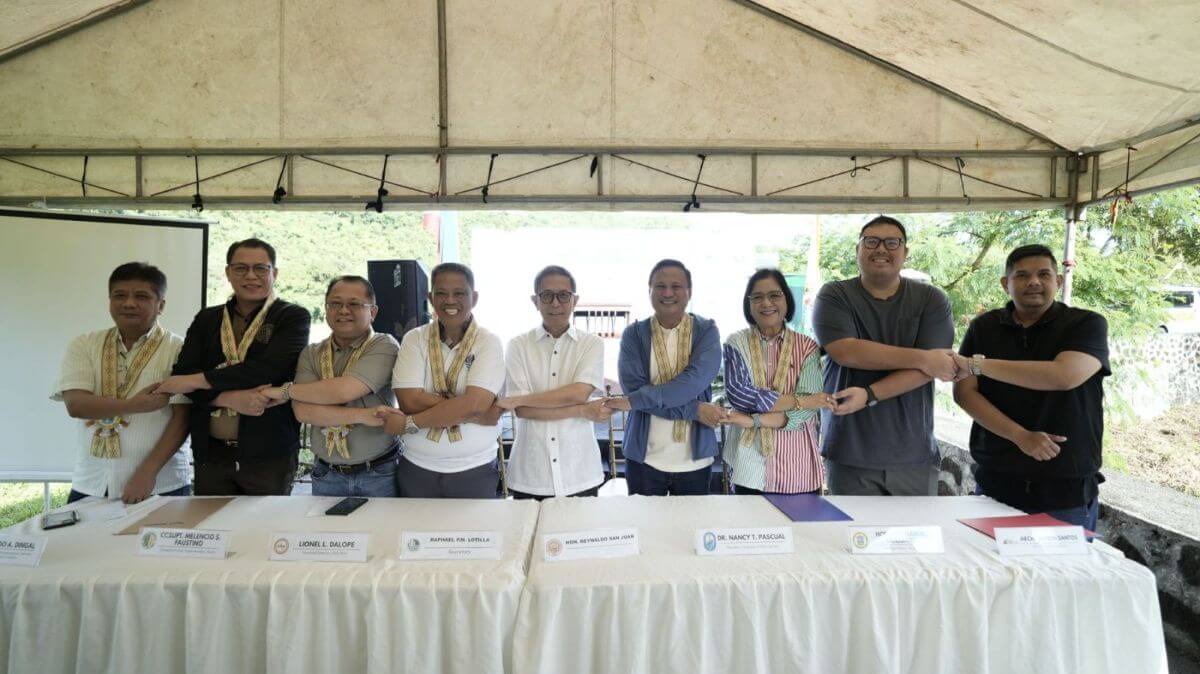
The partnership was formalized through the signing of a memorandum of agreement (MOA) led by Environment and Natural Resources Secretary Raphael P. M. Lotilla, alongside regional and local government officials, private sector representatives, academe, and indigenous peoples’ leaders.
A ceremonial tree planting followed the MOA signing, symbolizing the partners’ collective commitment to sustainable development, climate resilience, and inclusive environmental governance.
Balancing development and conservation
In his keynote address, Lotilla highlighted Tanay’s unique ecological context, noting that large portions of the municipality fall within protected areas.
“This is a partnership among you. This is your project. We are here to facilitate and support, but at the end of the day, it is you who will sustain this project and benefit from it,” Lotilla said.
He added that the DENR remains committed to working with local stakeholders to ensure that future generations in Rizal and Tanay can thrive while living in harmony with nature.
From sustainability to regeneration
Project TRANSFORM emphasizes co-creation and collaboration, ensuring that local realities, scientific knowledge, and community insights shape project interventions.
Under the Tanay initiative, the goal is to advance regenerative tourism—an approach that goes beyond minimizing harm and instead seeks to restore ecosystems while strengthening social and cultural well-being.
The project area will be selected from existing National Greening Program (NGP) sites established between 2011 and 2015, located within the Kaliwa River Forest Reserve and areas covered by Presidential Proclamation 1636.
Key objectives and activities
Under the MOA, partners aim to promote sustainable practices such as waste reduction, energy efficiency, and habitat conservation to mitigate tourism’s environmental impact.
Educational programs will be rolled out for tourists and residents, while tourism management strategies will be guided by the area’s carrying capacity.
Planned activities include science-based resource management, conservation and reforestation efforts, and urban greening initiatives.
Local people’s organizations are expected to play an active role in implementation, ensuring community ownership and inclusive development.
Pilot area for resilience
Rizal Province, particularly Tanay, was selected as a pilot site due to its ecological significance and its mix of upland and lowland environments.
The area hosts critical protected landscapes, including the Upper Marikina River Basin Protected Landscape and the Kaliwa River Forest Reserve, which provide vital ecosystem services to both CALABARZON and Metro Manila. —Ed: Corrie S. Narisma