
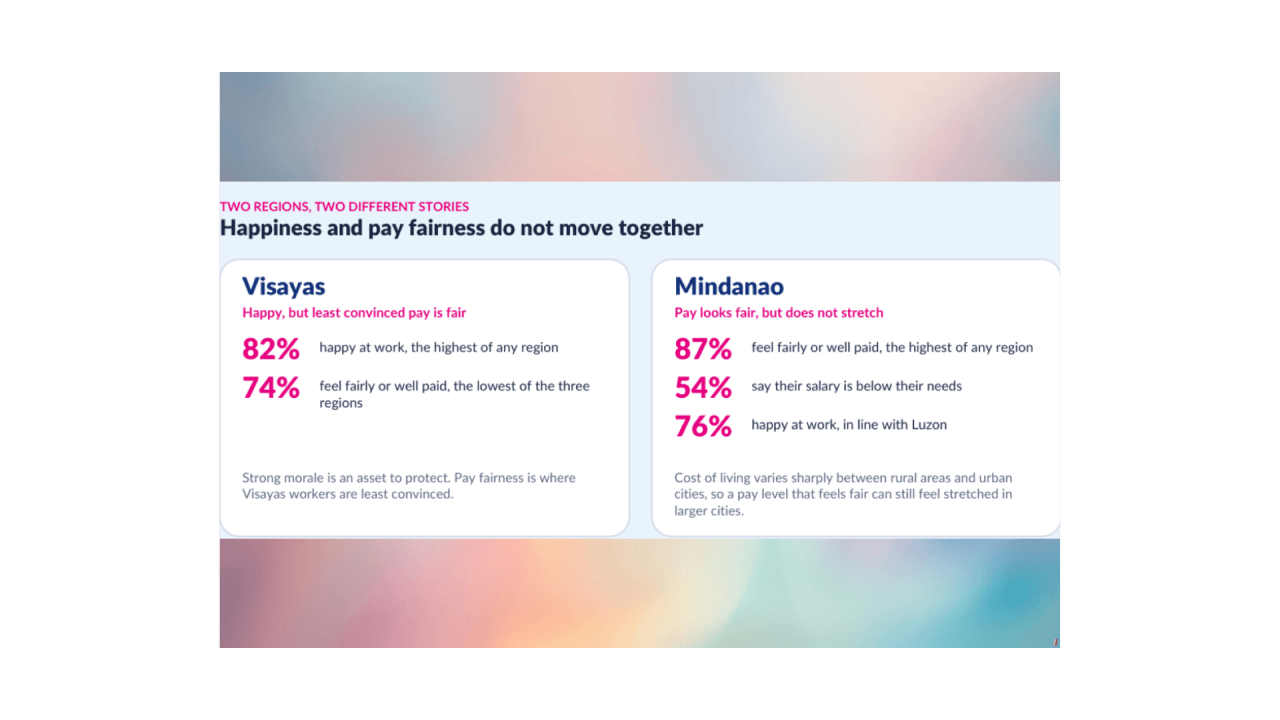
New regional insights from Jobstreet by SEEK showed that 82 percent of workers in the Visayas reported being happy at work, surpassing Mindanao at 79 percent, the National Capital Region at 77 percent, Luzon at 76 percent and the national average of 77 percent.
However, only 74 percent of Visayas workers consider themselves fairly or well paid, the lowest among all regions and below the national benchmark of 80 percent.
The findings, drawn from Jobstreet by SEEK’s Workplace Happiness Index: Philippines 2025 and Salary Pulse: Philippines 2026, underscore how positive workplace experiences do not necessarily translate into financial satisfaction.
Regional divide
Mindanao presents a contrasting picture, with 87 percent of workers saying they are fairly or well compensated, the highest in the country.
Despite this, 54 percent said their salaries fall short of their actual cost-of-living requirements, illustrating how compensation perceived as competitive relative to industry standards may still be insufficient to cover household expenses.
Jobstreet by SEEK noted that differences in living costs between urban centers and provincial areas in Mindanao could leave workers financially stretched despite receiving market-aligned salaries.
For employers in the Visayas, meanwhile, strong workplace morale provides a foundation for employee engagement, although concerns over pay fairness highlight the need for more transparent compensation structures.
Financial pressures
The 2026 Salary Pulse study surveyed 1,009 employed Filipinos aged 18 to 64 in February, while the Workplace Happiness Index covered approximately 1,000 workers nationwide.
Nationally, while 80 percent of Filipino workers believe they are fairly or well paid, only 59 percent are happy with their salaries, and 45 percent say their earnings are insufficient to meet daily living expenses.
The findings suggest that perceived pay fairness alone may not guarantee financial well-being or long-term employee satisfaction.
Retention risks
Compensation satisfaction also has implications for workforce productivity and employee retention.
Workers satisfied with their salaries are 2.2 times more likely to go above and beyond at work, while those unhappy with their compensation are 2.9 times more likely to consider changing jobs.
When salary adjustments fall short of expectations, employees tend to negotiate with management, seek additional benefits, remain in their roles with diminished motivation or explore other employment opportunities.
Some 28 percent of workers would consider relocating to another city or country for a 10-percent salary increase.
Beyond compensation
With salary increases and their sizes remaining largely similar across regions, Jobstreet by SEEK said employers could strengthen their competitiveness through flexible work arrangements, clear career advancement pathways and professional development opportunities, particularly when budget constraints limit immediate pay adjustments.
“Across Visayas and Mindanao, talent priorities differ but the imperative is clear: compensation must reflect local realities,” said Jobstreet by SEEK Philippines managing director Dannah Majarocon said in a statement.
“Employers may use these findings as a useful reference point as they assess their compensation strategies and consider how competitive pay, meaningful benefits and positive work environments can contribute to a more engaged and satisfied workforce,” she added. — Ed: Corrie S. Narisma