
Insider Spotlight
But that's exactly how life turned out for the firecracker Filipina from Concepcion, Tarlac, who once worked at Jollibee and Shakey’s branches back home before arriving in Japan in search of better opportunities.
These days, she oversees the sprawling Karaoke-kan chain alongside her husband, Noriharu Watabe.
The group has 13,000 employees and 311 branches. It’s part of the family’s B&V Holdings., whose business interests span restaurants and hotels.
The woman behind the empire
Speaking to visiting Filipino journalists at a Karaoke-kan branch in Roppongi, Tokyo, her roots as a young entertainer in Japan are unmistakable, with her stories punctuated by animated hand gestures and bursts of laughter.
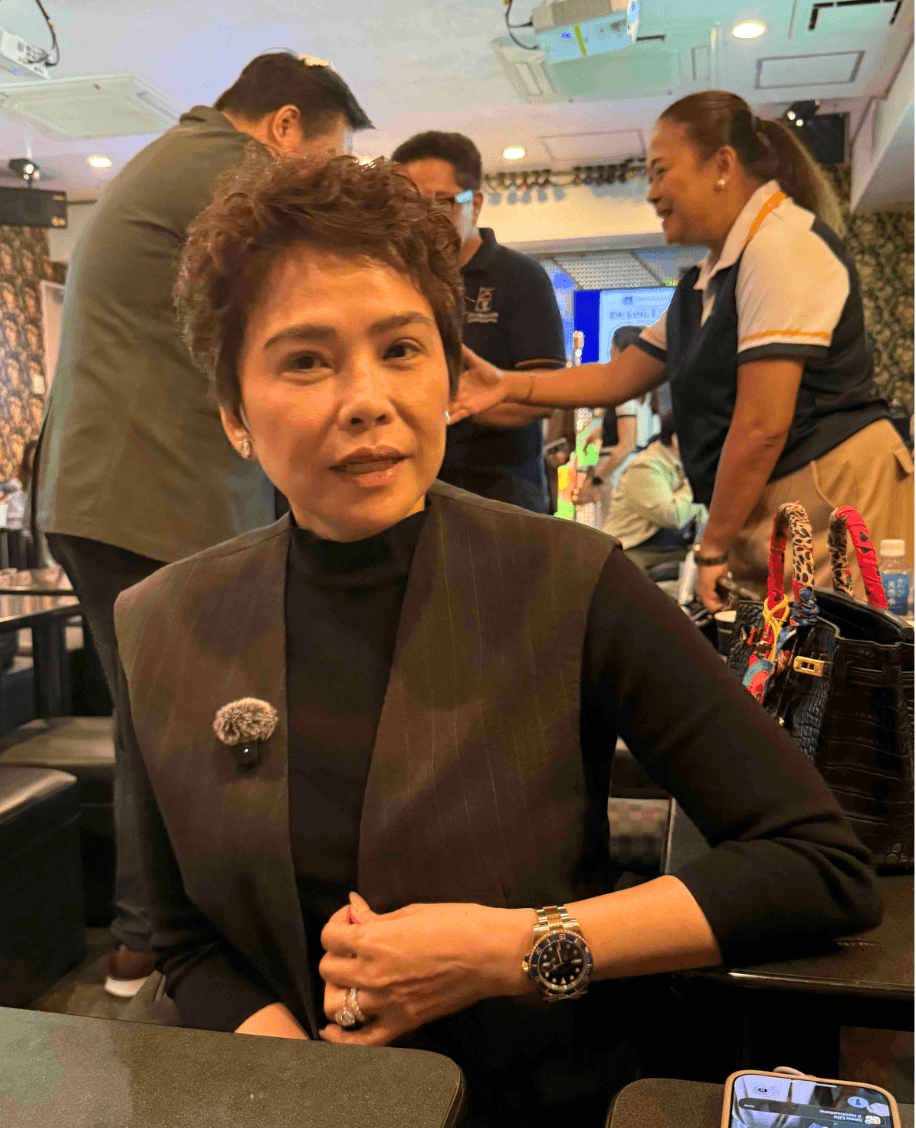
She looks confident and every bit the successful karaoke tycoon, dressed in a dark tailored tunic with a heavy Rolex on her wrist.
One her arm was a black exotic-leather Birkin, one of the most sought-after handbags, made by French luxury house Hermès.
Not for show
But for someone who clearly enjoys the finer things in life, Watabe would rather stay out of the spotlight.
She recalled once turning down an interview request from a prominent journalist who wanted to showcase her expensive possessions.
“Hindi kasi ako gano’n. Hindi ko personality yung gano’n. I mean, gusto ko yung simple lang na tahimik,” she said on the sidelines of the free legal clinic event she helped organize with DivinaLaw.
(That’s just not who I am. It’s not my personality. I prefer a quiet, low-key life.)
Showing a better side of Filipinos
When she does grant interviews, Watabe wants her story to uplift fellow Filipinos.
“Kailangan ipakita mo yung magandang image ng Pilipino,” she said.
(We need to show the good side of Filipinos.)
“So dapat huwag kang magkuwento ng bad image ng Pinoy. Kasi tayo rin naman eh. Kaya ako, hindi, no,” she added.
(So you shouldn't say things that give Filipinos a bad image, because it reflects on all of us. That's why I don't do that.)

An elevator encounter
This philosophy also shaped her marriage to Noriharu, whom she met in the early 2000s when he was still establishing Karaoke-kan, which at the time was less than a third of its current footprint with 77 branches.
“Nakilala ko siya sa elevator. Palagi ko siyang nakakasakay,” she said, recalling her years as an entertainer.
(I met my husband in an elevator. We kept riding the same elevator.)
Adjusting to married life was not always easy, but she takes pride in the mutual respect they have since built.
“Dito kasi sa Japan, pag babae, as in, powerless, gano’n. No, ako, hindi. Pero ipagtunayan mo na may worth ka,” she said.
(Here in Japan, women can sometimes feel powerless. But not me. You have to prove your worth.)
Outside her successful business ventures, Watabe is celebrating another win after finally earning her Bachelor of Science in Hospitality Management from Holy Cross College, which she completed online.
“Kasi dream ko talaga yun. Dahil lahat ng pamangkin ko, pinaaral ko. Sabi ko, this time ako naman,” she said, adding that she was inspired by former Vice President Leni Robredo while helping lead her 2022 presidential campaign among Filipinos in Japan.
(Because that was always my dream. I helped put all my nieces and nephews through school. I told myself, this time, it’s my turn.)
College dream fulfilled
Watabe said her goal was to graduate before her 50th birthday.
“I’m turning 50 soon, so I really made sure to finish my degree,” she said in Filipino, adding that a master’s degree might soon follow if she can get into the University of the Philippines.
Most people go to college hoping to land a good job and build a successful career, but Watabe appears to have gone about things the opposite way.
She was already in business when her group acquired an 81 percent stake in rival Shidax for ¥5 billion in 2018.
Buying out the competition
At the time, Shidax had a much bigger karaoke outlet footprint. But it was also facing deep financial distress and debts, creating an opportunity that Watabe’s group seized.
“Worth siya. Kasi lagi kami tinatabihan. Ang problem kasi namin before, wala kami sa mga province, yung baryo, wala kami. Sila meron, kaya nakapasok kami,” Watabe said.
(The buyout was worth it. They kept opening branches beside ours. Our problem before was that we had no presence in the provinces or smaller towns. Shidax did, and the acquisition allowed us to enter those markets.)
The company did not lay off a single employee during the pandemic, even as its karaoke outlets remained closed for about a year and a half.
“Ang mga empleyado namin, wala kaming tinanggal. Before that time, 12,800. Now, I think nasa 13,000,” she said.
(We didn’t lay off any employees. We had 12,800 before the pandemic, and now I think we have around 13,000.)
Giving back in Tokyo
“Sabi ng asawa ko, mahalaga yung buhay ng tao,” she added.
(My husband said people’s lives are important.)
The same concern for others extends to her fellow Filipinos in Japan.
Watabe helped host DivinaLaw’s free legal clinic for overseas workers at their 10-story building in Roppongi, one of Tokyo’s commercial districts.
“Pag ganito yung mga event, okay lang na mag-sponsor ako kasi marami kasing problema ang mga Pilipino,” she said.
“Pero dito kasi, yung batas pantay-pantay. Walang mahirap, walang mayaman dito. Yung realidad sa Pilipinas, yung batas eh para sa mayaman. And that's so sad,” she added.
(I’m happy to sponsor events like this because many Filipinos face problems. But here in Japan, everyone is equal under the law. There is no distinction between rich and poor. The reality in the Philippines, perhaps, is that the law favors the rich. And that's so sad.)
Never forget where you came from
For fellow Filipinos hoping to build a better life, her advice is to believe in themselves, work hard and never forget where they came from.
“Kasi kung hindi ako maniniwala sa sarili ko, walang magtitiwala sa akin. Walang maniniwala sa akin,” she said.
(If I don't believe in myself, nobody else will trust or believe in me.)
“Pag nasa taas ka na, mas dapat magpakumbaba ka. Huwag na huwag mong kakalimutan yan,” she added.
(The more successful you become, the more humble you should be. Never forget where you came from.)

Miguel R. Camus has been a reporter covering various domestic business topics since 2009.