
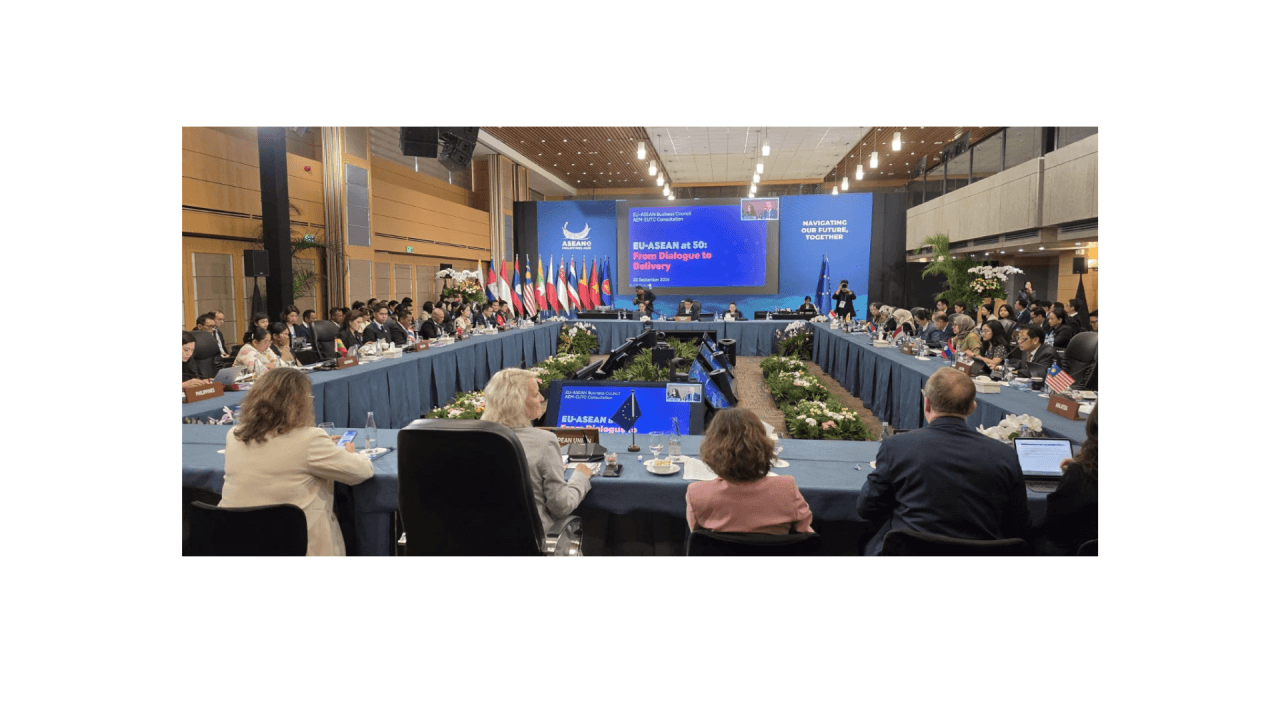
EU-ABC chair Jens Ruebbert made the proposal on Sept. 22 during consultations with ASEAN economic ministers and EU trade officials at the 58th ASEAN Economic Ministers’ Meeting in Manila.
This comes after European Commission President Ursula von der Leyen and Philippine President Ferdinand R. Marcos Jr. welcomed an agreement on the EU-Philippines FTA in a call on Sept. 22, with negotiations set to conclude imminently and the ratification expected in 2027.
A similar deal between the EU and Indonesia has been finalized in Bali, while FTAs with Singapore and Vietnam are already in force. Negotiations with Thailand and Malaysia are seen to conclude by 2027.
Building on bilateral deals
Ruebbert said the progress underscored ASEAN's growing strategic importance to Europe but argued that bilateral agreements should eventually serve as building blocks for a wider regional pact.
The business group said an ASEAN-EU Economic Framework Agreement could be announced next year to mark the 50th anniversary of relations between the two regions.The proposed framework would take a modular approach, establishing baseline economic commitments while allowing both sides to gradually add agreements covering areas such as digital trade and investment protection.
“We strongly believe a regional deal would provide a competitive edge for European and Southeast Asian companies alike, bringing trade and investment to a level that reflects the scale and strategic importance of the ASEAN-EU relationship,” Ruebbert said.
The EU-ABC's latest Business Sentiment Survey showed 74 percent of European business respondents believed an ASEAN-wide FTA would provide greater benefits than separate bilateral agreements with individual Southeast Asian countries.
Another 49 percent favored launching negotiations for a regional FTA in 2027.
Digital trade first
Under the EU-ABC proposal, a region-to-region Digital Trade Agreement would be the first priority under the broader economic framework.
The agreement could establish rules supporting trusted cross-border data flows and digital integration while addressing emerging issues such as artificial intelligence governance and cybersecurity.
Ruebbert said such a pact could build on ASEAN's Digital Economy Framework Agreement and support the region's digital transformation.
An Investment Protection Agreement could follow, aimed at establishing predictable standards and encouraging investors to make longer-term commitments in Southeast Asia.
Power grid
Beyond trade, the EU-ABC proposed a flagship EU-ASEAN partnership supporting the ASEAN Power Grid, which seeks to strengthen electricity interconnections among Southeast Asian countries.
The EU could provide technical and financial assistance based on its experience with interconnected electricity systems and financing mechanisms such as the Global Gateway, according to the council.
The proposal is one of three outcomes the EU-ABC wants pursued for the 2027 anniversary, alongside the economic framework and structured cooperation to deepen ASEAN economic integration.
The latter could direct European resources toward trade facilitation initiatives, including implementation of the upgraded ASEAN Trade in Goods Agreement, ASEAN Customs Transit System, ASEAN Single Window and Digital Economy Framework Agreement.
More engagement
EU-ABC executive director Chris Humphrey said €105 million in grant funding had already been allocated to Team Europe initiatives supporting sustainable connectivity and the green transition.
“The idea is to consolidate this substantial base and organise resources more clearly around tangible outcomes for a more resilient and integrated ASEAN market,” Humphrey said.
The council also called for greater high-level political engagement between ASEAN and the EU, including cooperation in digital technology, finance, energy and health.
Humphrey said the 50th anniversary should focus on concrete economic outcomes rather than serve merely as a symbolic milestone. —Ed: Corrie S. Narisma