
Insider Spotlight
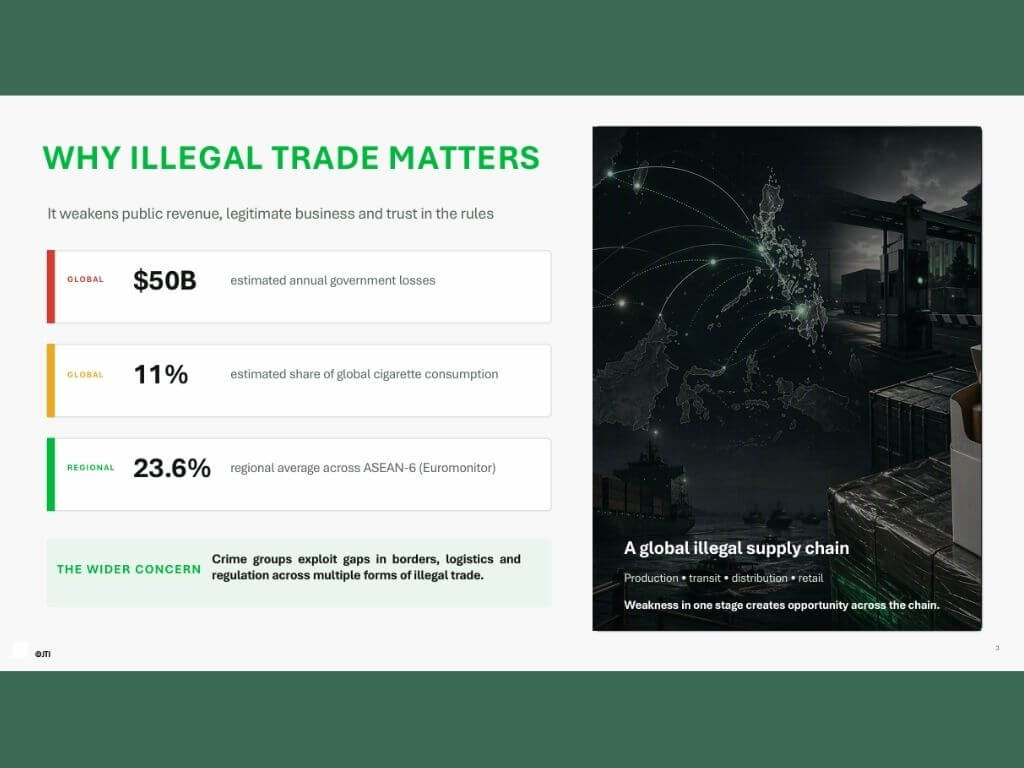
JT International (JTI) Anti-Illicit Trade Operations regional director Valentin Dinca said during a media briefing that the two countries are major destinations for illicit tobacco originating from China, the United Arab Emirates, Vietnam, Indonesia and Cambodia. Malaysia also functions as a transit hub alongside Singapore and Thailand.
“Illegal tobacco trade is usually discussed or referenced as a tobacco industry problem. But in fact, it's much wider than that. It drives governments out of revenue, it undercuts legitimate retailers, obviously undermines our legitimate business, but more importantly, it creates a space for criminal networks to thrive,” Dinca added.
Convergence points
He said Mindanao provinces including Tawi-Tawi, Sarangani and Zamboanga serve as convergence points for illicit tobacco shipped by sea from Malaysia and Indonesia before products are redistributed to other Philippine markets.
“Smuggling networks do not operate within the boundaries of a single country. They take advantage of gaps between jurisdictions, moving products through different markets and shifting routes to avoid detection. This is why stronger regional cooperation is essential,” Dinca said.
The cross-border link came into focus after Philippine police raided a cigarette manufacturing facility in Cebu tied to a Malaysian-based syndicate. Authorities seized about P1.1 billion worth of illicit cigarettes from the facility, which was reportedly intended to supply Malaysia’s illegal tobacco market.
The Philippines, he added, has demonstrated the value of a whole-of-government approach, combining political attention, enforcement action and inter-agency coordination to elevate illicit trade on the national agenda.

$145 billion sticks of illicit cigarettes
Across the ASEAN-6 markets of Indonesia, Malaysia, the Philippines, Singapore, Thailand and Vietnam, industry data showed about 145 billion sticks of illicit cigarettes and e-vapes were sold last year.
Governments lost a combined $13.1 billion in revenues over the past two years. The Philippine government alone lost at least $2.5 billion, or about P141 billion, according to a study cited by JTI from the EU-ASEAN Business Council and Euromonitor International.
“One thing is clear, that no single agency owns the full enforcement chain. Different institutions control borders that not only affect the Philippines but all the other countries worldwide,” Dinca said.
Stronger intelligence sharing
JTI Philippines director for corporate affairs and communications Shaiful Mahpar called for ASEAN governments to align export controls and require exported products to comply with destination-market rules, including tax stamps and graphic health warnings.
“Illicit trade syndicates operate across borders, while enforcement measures often stop at them. To effectively combat illicit tobacco, ASEAN must act collectively and deny criminals the ability to exploit differences between national regulations,” Mahpar said.
JTI also called for stronger intelligence sharing and cooperation among customs, tax, maritime and law enforcement authorities to monitor high-risk routes, verify exports and prevent illicit products from being diverted across the region. —Vanessa Hidalgo | Ed: Corrie S. Narisma