
At least 84 percent of Cebu CEOs are confident about their companies’ revenue growth over the next 12 months, with optimism rising to 87 percent over a three-year horizon, according to the 2026 Cebu CEO Survey.
The survey was conducted by the Cebu Chamber of Commerce and Industry (CCCI) in partnership with PwC Philippines on Jan. 11 to Feb. 10, 2025. It covered 107 respondents.
Collective commitment
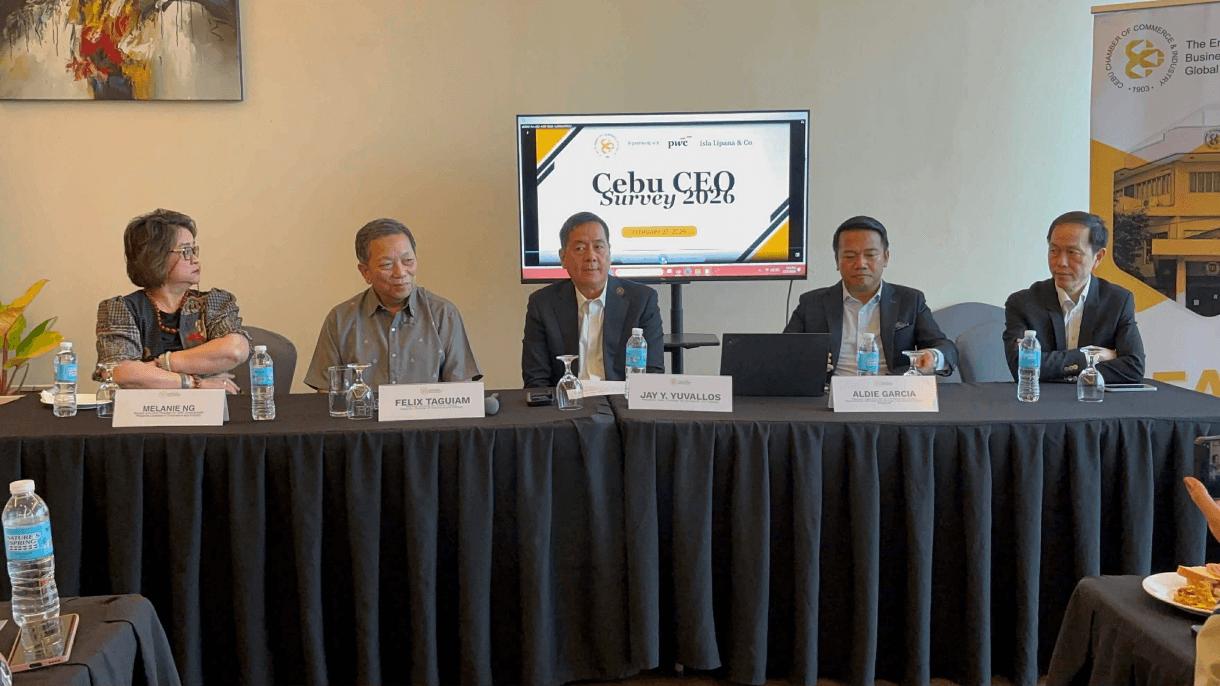
Jay Yuvallos, CCCI president, said the business community's optimism was largely driven by a collective commitment to sustain recovery, following the spate of disasters that hit Cebu province last year.
"Our business leaders want a stronger and more resilient Cebu to emerge from a calamitous year. We aim to drive growth that redounds to our fellow Sugbuanons and the rest of Central Visayas. This is the business community doing its part to uplift our province and our region," Yuvallos said.
The strong optimism was fueled by Cebu’s prominent position in tourism, infrastructure, and the growing IT and business process management (BPM) sectors, as well as a strong commitment to rebuilding public trust, said Roderick Danao, chair and senior partner at Isla Lipana & Co./PwC Philippines.
"Cebu CEOs uphold a buoyant outlook as the wider Visayas pursues tourism recovery, accelerates infrastructure, and deepens its niche in the IT and BPM sectors," Danao noted.
Ease and cost of doing business
The survey results also showed mixed sentiments regarding the ease and cost of doing business
Cebu’s top executives expressed moderate satisfaction with the processes for securing business permits (34 percent) and registering vehicles (33 percent).
Believing there was room for improvement in several key areas, Cebu CEOs hoped to see more transparent decision-making processes for transactions and requests, more professional conduct in dealings with government representatives, and more reasonable and streamlined documentary requirements.
The Department of Trade and Industry (DTI) posted the highest satisfaction rating at 50 percent in the survey on government agency performance.
This was followed by the Securities and Exchange Commission (SEC) at 39 percent, and the Social Security System (SSS) at 36 percent.
The Department of Public Works and Highways (DPWH) and the Bureau of Internal Revenue (BIR) were cited in the survey as needing substantial improvement to ease the overall business experience in Cebu.
Sustainability practices
The survey also showed that 96 percent of Cebu CEOs are implementing sustainable practices, most of which target resource efficiency and cost savings, such as reduced energy use (80 percent), recycling and reusing materials (76 percent), and improved waste collection systems (51 percent).
Despite the widespread adoption of sustainability measures, only 52 percent measure their financial impact. Among those who do, 95 percent use cost reduction or savings as the primary metric.
Financial constraints remain the top barrier to sustainability, with upfront investments and high transition costs delaying its integration into business strategy.
Momentum
Aldie Garcia, CCCI treasurer and trustee, said Cebu's optimism is rooted in its collective ambition to move forward and adapt.
But Garcia, who serves as vice chair and assurance managing partner at PwC Philippines, added that enhancing public-private partnerships is crucial for accelerating shared progress.
"For Cebu to be truly competitive, government institutions must be strengthened so that they can transform regulations and policy directions from barriers into enablers," he said.
"Cebu has a community of business leaders committed to rise and embrace change. As businesses scale innovation and invest in the future, stronger government institutions will help drive sustainable growth for the region," he added.

Contributor