Energy Secretary Sharon Garin said the Department of Energy (DOE) was seeking arrangements that would allow the Philippines to access petroleum products stored abroad while the government develops its own storage infrastructure.
The move aims to address the country's limited fuel storage capacity and ensure access to additional petroleum supplies in case of disruptions in the international oil market.
"The limitation is the storage capacity ng Pilipinas. So the solution na nahanap namin eh ipastore natin siya sa ibang bansa (The limitation is the Philippines' storage capacity. So the solution we found is to store it in other countries)," Garin said during a press briefing on Oct. 26.
Garin said the government was moving to secure these arrangements as soon as possible rather than waiting for the Middle East conflict to worsen.
"We should move and make sure that there's available stock at any time for the Philippines," she said.
Fuel supply outlook
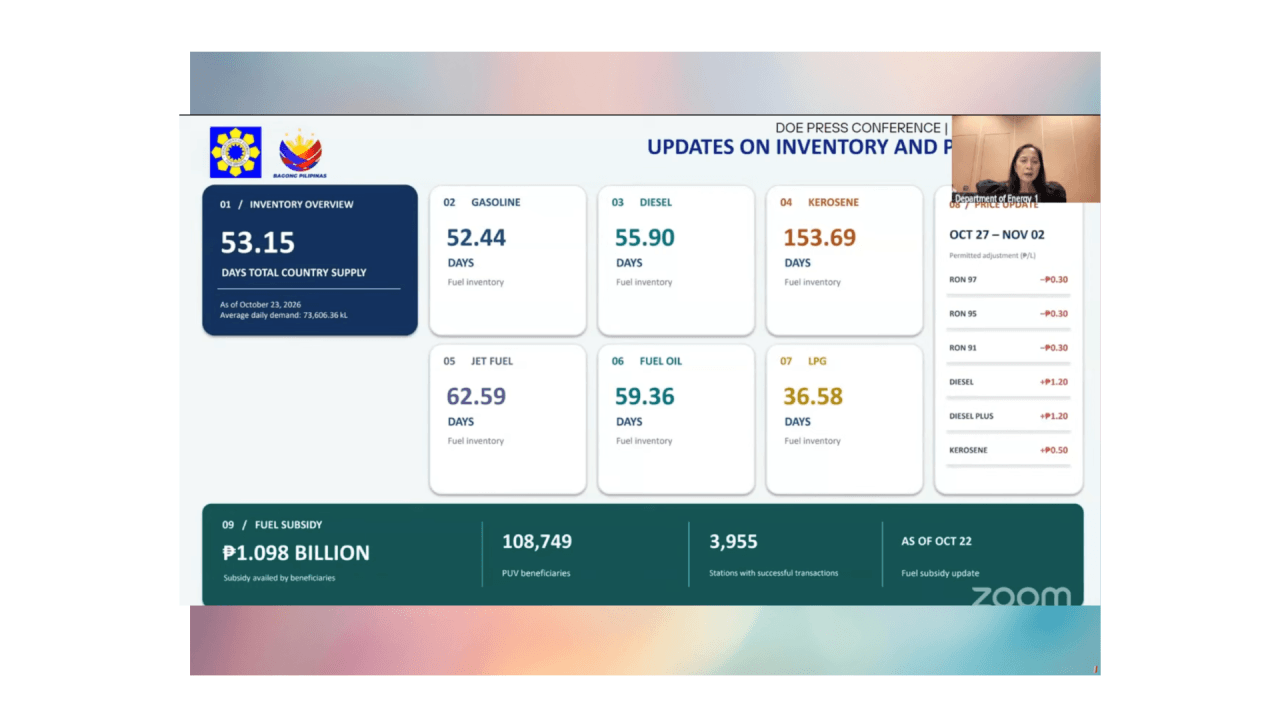
The Philippines currently has sufficient petroleum inventory to cover approximately 53 days, but Garin warned that instability in the Middle East could persist into 2027.
She said the DOE had been discussing possible fuel supply arrangements with Australia, the United States, Canada, Russia and countries in South America, as well as members of the Association of Southeast Asian Nations (ASEAN).
The discussions include potential arrangements to supply petroleum products to the Philippines when needed.
Overseas fuel reserves
Energy Undersecretary Alessandro Sales said the government, through the Philippine National Oil Company Exploration Corp. (PNOC EC), was engaging with two private companies to begin negotiations on an offshore fuel reservation arrangement known as ticketing.
Under this system, the Philippines could reserve petroleum products or crude oil held in existing overseas storage facilities without immediately purchasing the fuel.
"We are now pursuing engagements with two private companies through the PNOC EC to begin negotiations on the ticketing, para makareserve po tayo ng offshore supplies (so we can reserve offshore supplies)," Sales said.
Garin said the arrangement would allow the government to build up access to additional fuel supplies despite limited domestic storage capacity.
The government could proceed once contracts were finalized and the necessary approvals from government agencies were secured.
"We make reservations and it gives us the right to have it sent to the Philippines at any time," Garin said.
She explained that the government would pay a reservation fee to secure access to the petroleum products but would purchase the fuel itself only when the products were released for delivery to the Philippines.
The arrangement could be considerably less expensive than immediately purchasing additional petroleum stocks, which Garin said could cost around P20 billion.
Sales said the reservation fee would depend on the volume of petroleum products involved and would be calculated on a per-barrel basis, with an indicative cost of less than $1 per barrel annually.
He clarified that the amount was only a preliminary estimate and not a finalized rate.
Regional oil reserve
Garin said the Philippines was also continuing discussions with ASEAN member countries on a proposed joint petroleum stockpiling arrangement to strengthen regional energy security.
The government was likewise discussing plans involving Japan, Saudi Arabia and the United Arab Emirates to establish a regional petroleum reserve, which could potentially be located in the Philippines.
In the meantime, Garin said she had instructed the Philippine National Oil Co. (PNOC) to stop selling its existing petroleum stocks to preserve the government's fuel reserves.
Domestic storage plans
Sales said PNOC had also started developing a petroleum storage facility on its property in Bataan, initially targeting a capacity of one million barrels.
The first storage tank is targeted for completion before the end of 2027.
Garin emphasized that the government's initiatives were not intended solely to address the current Middle East conflict but also to prepare the country for future disruptions in global petroleum supply.
She said the government could not simply assume that the conflict would end soon and must ensure that the Philippines has access to adequate petroleum supplies regardless of whether international conditions improve or deteriorate. —Ed: Corrie S. Narisma

Contributor