Insider Spotlight
The issue took center stage at the “Healthy Workforce, Stronger Business: Insights from the EpiCOb-PH Study” forum organized by Novo Nordisk Philippines and the European Chamber of Commerce of the Philippines.
The event gathered business leaders, healthcare professionals, researchers, and policymakers to discuss the findings of the Epidemiological Burden and Cost of Obesity in the Philippines (EpiCOb-PH) study, one of the country’s most comprehensive assessments of obesity’s health and economic consequences.
Why it matters
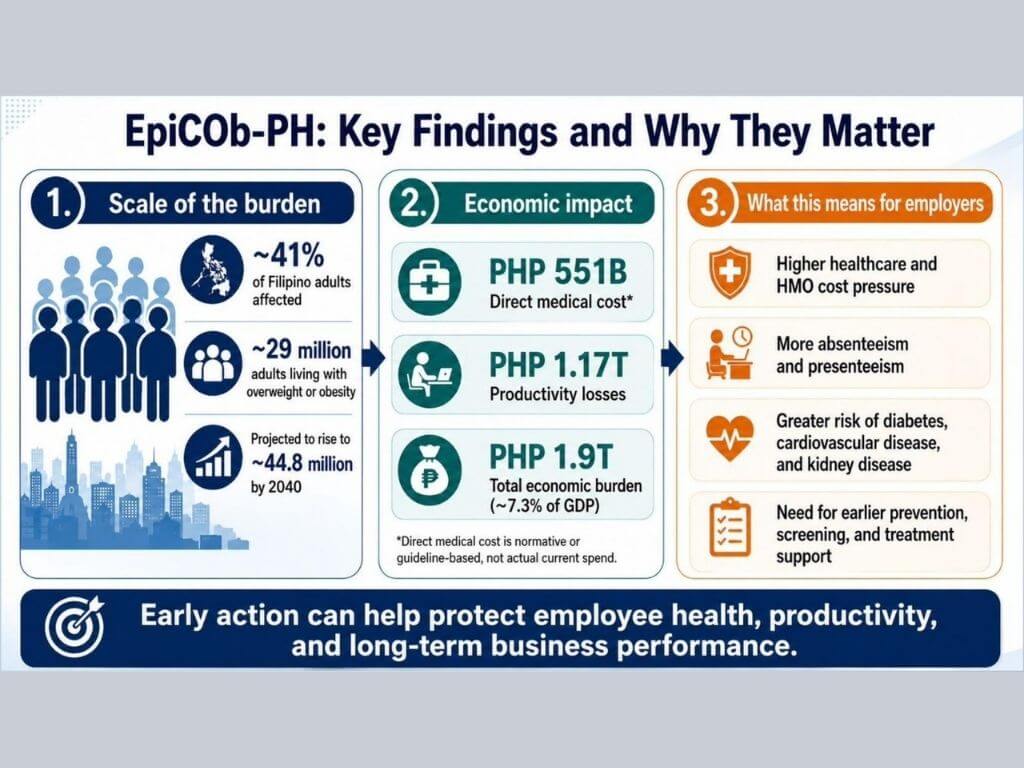
Researchers found that obesity and overweight conditions affect an estimated 29 million Filipino adults, equivalent to about 41 percent of the country’s adult population. The figure is projected to climb to 44.8 million by 2040.
“The study shows that obesity and overweight are affecting an estimated 29 million Filipino adults, or about 41 percent of the adult population, and this number is projected to increase to 44.8 million by 2040,” EpiCOb-PH study principal investigator and primary author Dr. Madeleine Valera said in a press statement.
“These findings highlight the urgent need for stronger prevention, early intervention, and long-term management strategies to address the growing burden of obesity in the country,” Valera added.
The big picture
Health economist Dr. John Paul Caesar Delos Trinos said obesity’s economic toll reaches about P1.9 trillion annually, including P551 billion in direct medical costs and P1.17 trillion in productivity losses.

“Obesity is not only a health issue but also an economic one,” Delos Trinos said. “Our analysis estimates a total economic burden of approximately P1.9 trillion annually, including P551 billion in direct medical costs and P1.17 trillion in productivity losses. These costs have significant implications for employers, healthcare systems, and the broader economy.”
Experts noted that productivity losses represent the largest share of the burden, driven by absenteeism, presenteeism, and reduced workforce participation. Obesity also increases the risk of diabetes, cardiovascular disease, and chronic kidney disease, placing additional pressure on employers and healthcare systems.
What’s next
The forum highlighted workplace wellness programs, healthcare partnerships, and expanded treatment options as potential solutions.
Novo Nordisk Philippines general manager Wei Sun emphasized collaboration among employers, healthcare providers, and policymakers to improve awareness and access to care, helping create a healthier and more productive workforce. —Vanessa Hidalgo| Ed: Corrie S. Narisma