Insider Spotlight
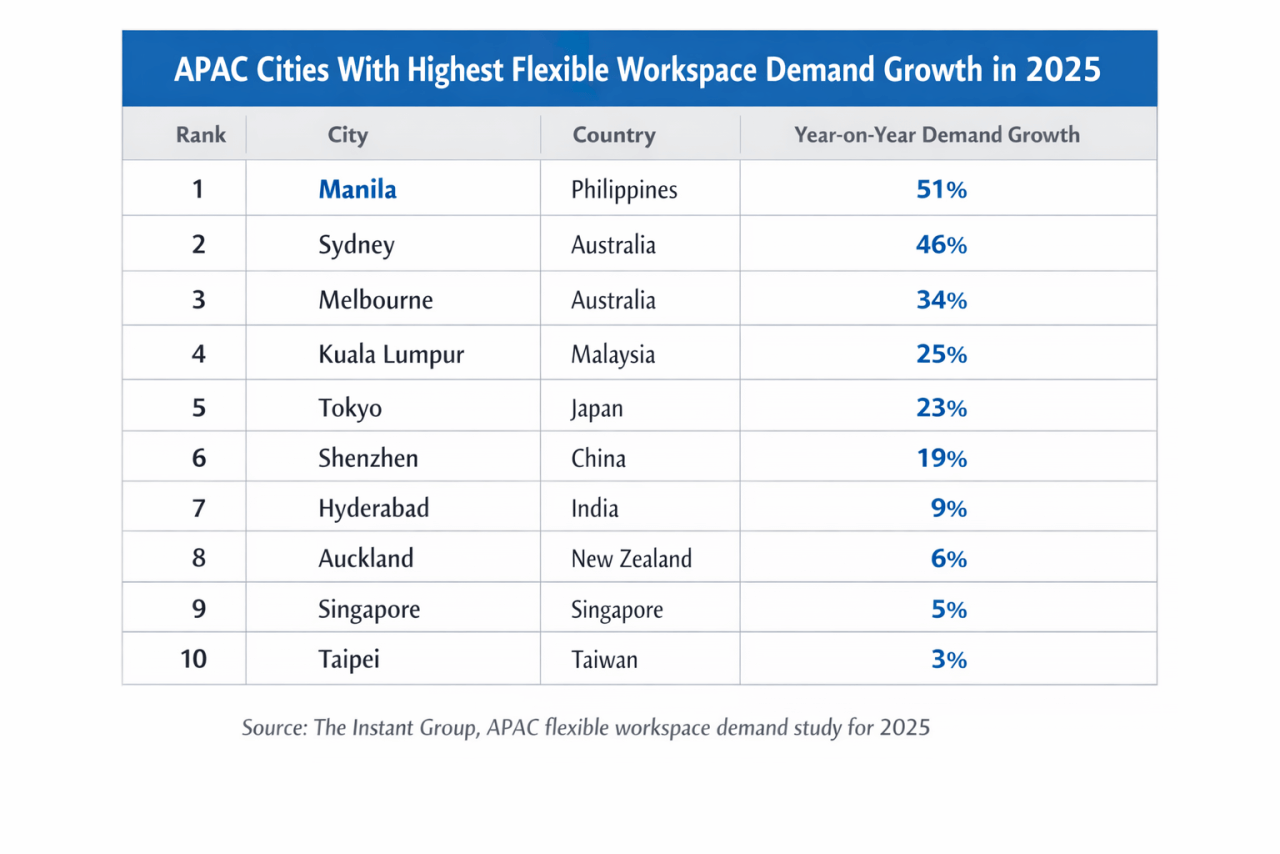
Demand for flexible workspace in Manila surged 51 percent year-on-year, making it the fastest-growing market in the region, according to data from The Instant Group.
The findings were detailed in a press release from the global flexible workspace marketplace, which tracks occupier demand across enterprise, corporate and small business segments.
The Instant Group is a global marketplace and advisory firm specializing in flexible workspace, helping occupiers and landlords access, manage and scale flexible office solutions across major cities worldwide.
The company operates an international platform that connects businesses of all sizes with serviced offices, coworking spaces and hybrid workplace strategies, while also providing data, insights and managed solutions to corporate clients across Europe, the Americas and Asia-Pacific.
Why it matters
Manila’s rise highlights how hybrid work has reshaped corporate location strategies, allowing emerging business centers to outperform long-established commercial capitals.
Flexible workspace is no longer viewed as a short-term fix but as a core part of long-term real estate planning for companies seeking agility and cost efficiency.
Driving Manila’s lead
The city’s ranking was fueled by strong demand from multinational firms and the business process outsourcing sector. Manila’s deep talent pool, competitive operating environment and expanding commercial districts accelerated the shift toward flexible, scalable office models.
These workspaces enabled companies to grow or adjust their footprints quickly without long-term lease commitments.
The regional shift
Across APAC, flexible workspace adoption accelerated in 2025 as organizations prioritized agility, reduced operational risk and offices designed to support hybrid work, with collaboration and social connection at the heart of office use.
Large enterprises and small businesses reevaluated their real estate portfolios, increasingly turning to flexible solutions to support distributed teams.
One of the most significant trends across the region was the rise of suburban and near-home work hubs, bringing offices closer to where employees live and contributing to demand growth across multiple cities.
By the numbers
Manila led the region with 51 percent growth, followed by Sydney at 46 percent and Melbourne at 34 percent. Kuala Lumpur recorded 25 percent growth, while Tokyo posted a 23 percent increase as long commute times pushed companies toward satellite and near-home workspaces.
What they’re saying
“From Manila to Melbourne, organizations continued to prioritize agility, efficiency and smarter ways of working. Rising flexible workspace demand across APAC’s fastest-growing cities shows how quickly the region shifted toward more dynamic workplace models - and we expect this momentum to accelerate well into 2026,” said Paul Marshall, The Instant Group’s executive director, Managed Asia Pacific.
What’s next
With hybrid work now entrenched, Manila is positioned to sustain its momentum as companies continue to seek flexible, high-quality office solutions to support evolving workforce needs and long-term expansion across the region. — Princess Daisy C. Ominga | Ed: Corrie S. Narisma