
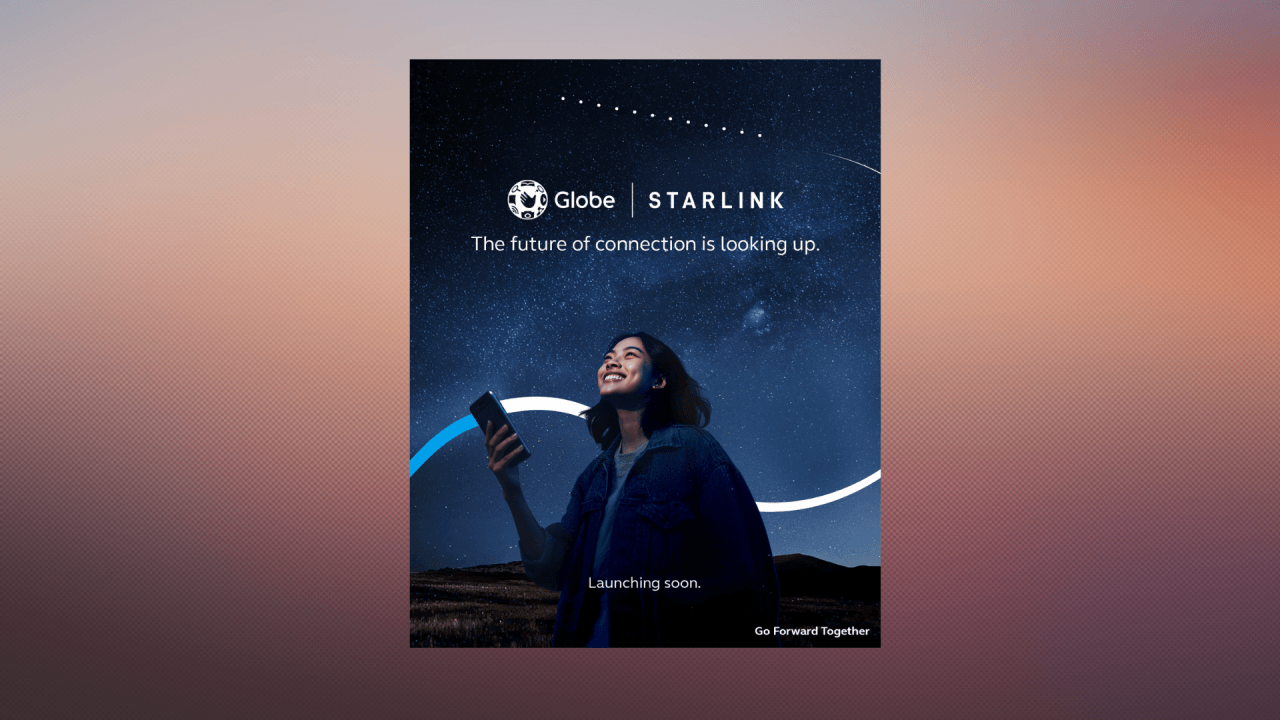
The National Telecommunications Commission (NTC) recently authorized Globe to commercially operate Starlink's satellite-to-mobile service, allowing subscribers to access voice, video and messaging over supported applications, as well as SMS, even in areas where conventional cellular networks are unavailable.
The approval, signed by NTC Commissioner Ella Blanca Lopez, said the permit supports the government's agenda of advancing inclusive digital transformation and helping bridge the country's digital divide.
Digital reach
The Philippines' archipelagic geography of more than 7,000 islands has long posed challenges to building continuous terrestrial telecommunications networks.
Frequent typhoons, earthquakes and other natural disasters also regularly damage communications infrastructure, leaving communities temporarily isolated.
To address these connectivity gaps, Globe partnered with Starlink, whose low-Earth orbit satellite constellation functions as a "cell tower in space," enabling mobile devices to connect directly to satellites when outside the reach of traditional cell sites.
The company said the technology provides nationwide coverage, particularly in remote locations and during emergencies when terrestrial networks are unavailable.
"This new satellite-to-mobile technology enhances digital inclusion and accessibility," Globe president and CEO Carl Cruz said in a statement.
"Given the NTC's approval for commercial launch, Globe can now extend its reach beyond traditional towers, ensuring that even in the most remote or disaster-stricken areas, Filipinos remain connected. This milestone reinforces our commitment to uplift lives, support businesses, and keep the nation connected," he added.
Emergency lifeline
Beyond expanding coverage, Globe said the satellite-to-mobile service is designed to serve as a communications lifeline during disasters.
When power outages, damaged cell towers or other emergencies disrupt conventional networks, compatible devices can connect directly to Starlink satellites, allowing users to send SMS, communicate through supported messaging applications and access navigation services.
The company said maintaining communications during emergencies could help families check on loved ones, enable responders to coordinate relief operations and provide communities with access to critical information.
The technology recently saw its first deployment in the Philippines following the magnitude 7.8 earthquake that struck South Cotabato, Sultan Kudarat and Sarangani.
According to Globe, the emergency deployment supported communications in the hardest-hit areas and benefited more than 150,000 customers, demonstrating the technology's role in disaster response.
How it works
The service requires a compatible LTE smartphone and an active Globe SIM enrolled in a Globe Starlink subscription.
Globe Prepaid and TM subscribers can access the service through a promo starting at P99, while Globe Platinum and Globe Postpaid subscribers with Plan 1499 and higher receive the service at no additional charge. Support for iOS devices is not yet available.
When users move outside Globe's terrestrial coverage and have a clear view of the sky, compatible devices can automatically connect to the satellite network.
Some smartphones may also require data roaming to be enabled, although Globe said customers will not incur additional roaming charges while using the satellite service within the Philippines.
Expanding access
Initially, Globe Starlink supports essential messaging applications, SMS and navigation services, with voice and video communications available through supported apps.
The company said the commercial rollout reflects its broader commitment to expanding digital inclusion while strengthening disaster resilience across the country.
By combining satellite technology with its existing mobile network, Globe aims to provide Filipinos with more reliable connectivity regardless of geography or emergency conditions, ensuring communication remains available when it matters most. —Ed: Corrie S. Narisma