During his presentation on early-grade reading and early childhood development at the Ramon Aboitiz Foundation Inc.’s Early Childhood Care and Development (ECCD) Convergence 2026 in Cebu on Oct. 1, Second Congressional Commission on Education (EDCOM 2) executive director Dr. Karol Mark Yee, in a statement, stressed the need to address this major literacy challenge before children advance to higher grade levels.
Based on the Department of Education’s Comprehensive Rapid Literacy Assessment (CRLA), the Schools Division Office (SDO) of Cebu had the third-highest number of struggling readers among school divisions nationwide.
About 13,300 Key Stage 1 learners under SDO Cebu, or 11 percent, were classified as struggling readers.
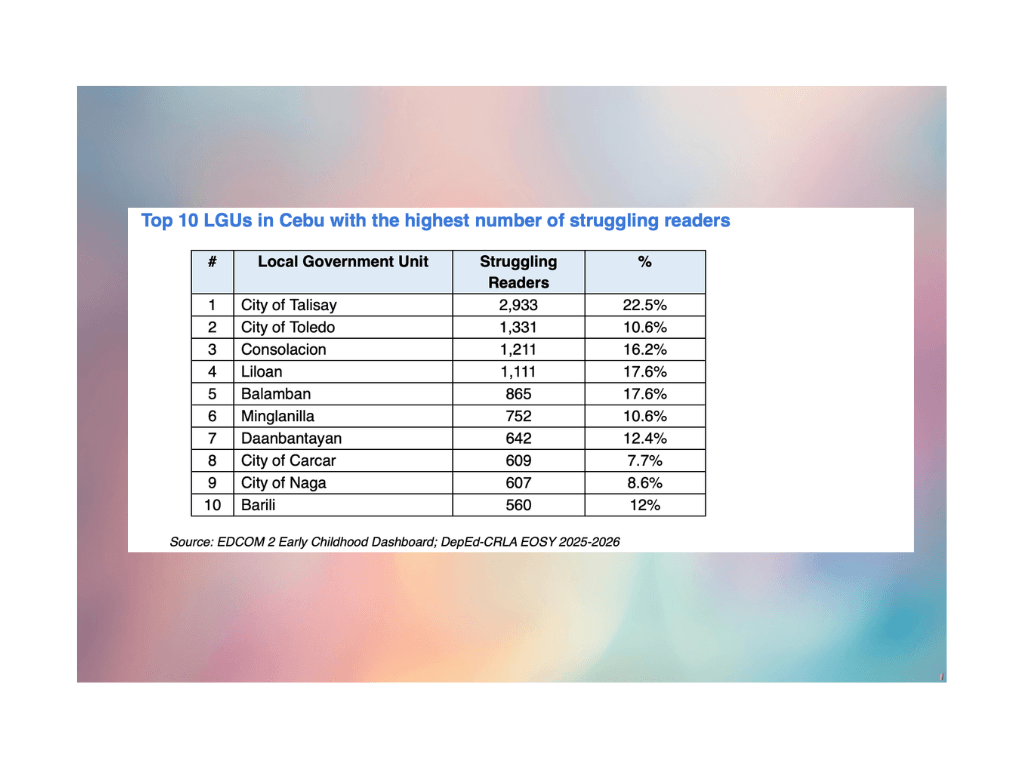
Talisay City had the highest number of struggling readers in the province, followed by Toledo City, the towns of Consolacion, Liloan, Balamban, Minglanilla and Daanbantayan, the cities of Carcar and Naga, and the town of Barili.
The commission said the figures underscore the need for targeted and context-specific interventions to address literacy gaps among young learners.
Intervention
Yee warned that failure to address literacy problems in the early grades could leave children further behind as they progress through the education system.
He said data cited in EDCOM 2’s final report, Turning Point: A Decade of Necessary Reform, showed that learning gaps widen considerably in later grades, with many junior and senior high school students unable to read and comprehend texts expected at their grade level.
Stunted growth
The commission also linked children’s reading performance to their health and development before they enter formal schooling.
About 25,000 children below five years old in Cebu Province are stunted, according to the National Nutrition Council’s 2025 Operation Timbang Plus report.
Research cited by EDCOM 2 showed that stunted children are 16 percent more likely to fail a grade. The commission also stressed the importance of addressing malnutrition during a child’s first two years, when inadequate nutrition can have lasting effects on cognitive development.
Under the National Education Plan 2026-2035, the government aims to increase the proportion of Key Stage 1 learners reading at grade level from 47.74 percent at the end of School Year 2024-2025 to 75 percent by 2028, 90 percent by 2031 and 95 percent by 2035.
Set targets
Yee challenged Cebu to establish its own measurable targets for reducing stunting, expanding access to early childhood education and addressing illiteracy among Grade 3 learners.
“If these are our national targets, what targets will Cebu as a province set in terms of reducing stunting, improving access to early childhood education, and also addressing illiteracy at Grade 3?” Yee asked.
“Is it improving by 5 or 10 percent? Whichever the number is, it is important to quantify so that we know how much effort and resources we all need to bring together, to ensure that no Cebuano child is left behind,” he added.
Yee said Cebu could draw on its universities, civil society organizations and local governments to tackle the interconnected problems of literacy, early childhood development and nutrition.
“With the many universities here in Cebu, the active engagement of civil society organizations such as RAFI, and the determination of the local government, I am sure that Cebu can make significant progress in education and nutrition in the years ahead,” he said. —Ed: Corrie S. Narisma

Contributor