In a statement, the DOE said the projects were either in advanced stages of construction or undergoing final testing and commissioning.
Once fully integrated into the grid, the department said these are expected to provide critical near-term capacity that can reinforce supply margins, support rising electricity demand, and strengthen overall grid reliability in the months ahead.
Boosting supply
The 22 projects form part of the 200 power plants that President Ferdinand R. Marcos Jr. directed the DOE to fast-track over the next three years in his fourth State of the Nation Address, to boost power supply nationwide.
These incoming capacities will come from renewable energy sources:
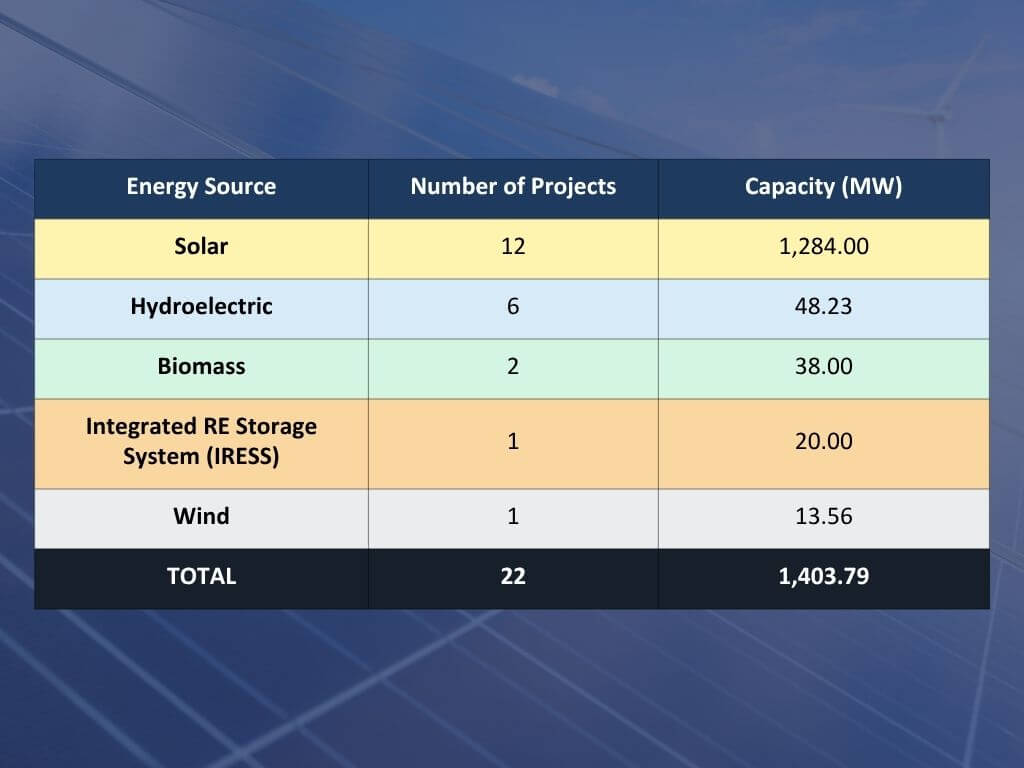
The DOE is working to ensure that these 22 projects will be completed as scheduled by next month.
Steps taken to avoid delays
The DOE is coordinating with the National Grid Corporation of the Philippines (NGCP), the Energy Regulatory Commission (ERC), and the Independent Electricity Market Operator of the Philippines (IEMOP) to address outstanding transmission, interconnection, inspection, registration, and metering requirements, and to prevent avoidable delays in commercial operations.
“Every megawatt that can be safely and lawfully brought into the grid strengthens our ability to meet demand, manage supply risks, and protect consumers. The Department is fully engaged across the entire power value chain—from generation to transmission to market operations—to help ensure that these projects move forward at the soonest possible time,” said Energy Secretary Sharon S. Garin.
Of the 200 committed power projects under DOE monitoring, 24 power generation plants are already in commercial operation, with an aggregate capacity of 1,178.642 MW.
Of these, three solar power plants began commercial operations in March. Seven Battery Energy Storage System (BESS) facilities, with a combined capacity of 190 MW, are also operational.---Connie Fernandez-Brojan | Ed: Corrie S. Narisma