
Economist Ser Percival Peña-Reyes, senior research fellow at Ateneo de Manila University, said the government must provide support to three critical sectors to help stabilize the economy of Central Visayas, particularly Cebu and Bohol.
These sectors include micro, small and medium enterprises (MSMEs), which comprise the majority of businesses in Cebu, as well as the transportation and food sectors.
“If we manage to somehow help these three critical sectors, these pressure points, probably there’s a good chance that our economy will not break,” Peña-Reyes said during an online economic forum organized by the Department of Economy, Planning and Development in Central Visayas (DepDev) on May 12.
Targeted support
He said the government could support MSMEs through affordable financing and credit guarantees, liquidity relief with favorable payment terms, temporary tax relief, and digitalization support, among others.
“The key policy balance here, I think, is that for support to be effective, it has to be targeted rather than broad,” Peña-Reyes said. “But it also has to be time-bound.”
Peña-Reyes warned that discussions about economic stagnation may become more common as inflationary pressures continue to mount.
“We’ll be hearing about stagnation more often because our risk of getting there is mounting. We are not there yet. I would like to reassure people—not yet—but the risk is mounting,” he said.
“So how can policymakers balance inflation control and growth stimulation in this precarious environment? This is a delicate balancing act because the usual tools can pull us in opposite directions,” he added.
Highest in the Philippines
Central Visayas’ inflation rate rose to 10.8 percent in April from 7.4 percent in March and 2 percent in April 2025, according to the latest report released by the Philippine Statistics Office (PSA) on May 13.
Region 7 posted the highest inflation rate among the country’s 18 regions, followed by Caraga at 10.2 percent.
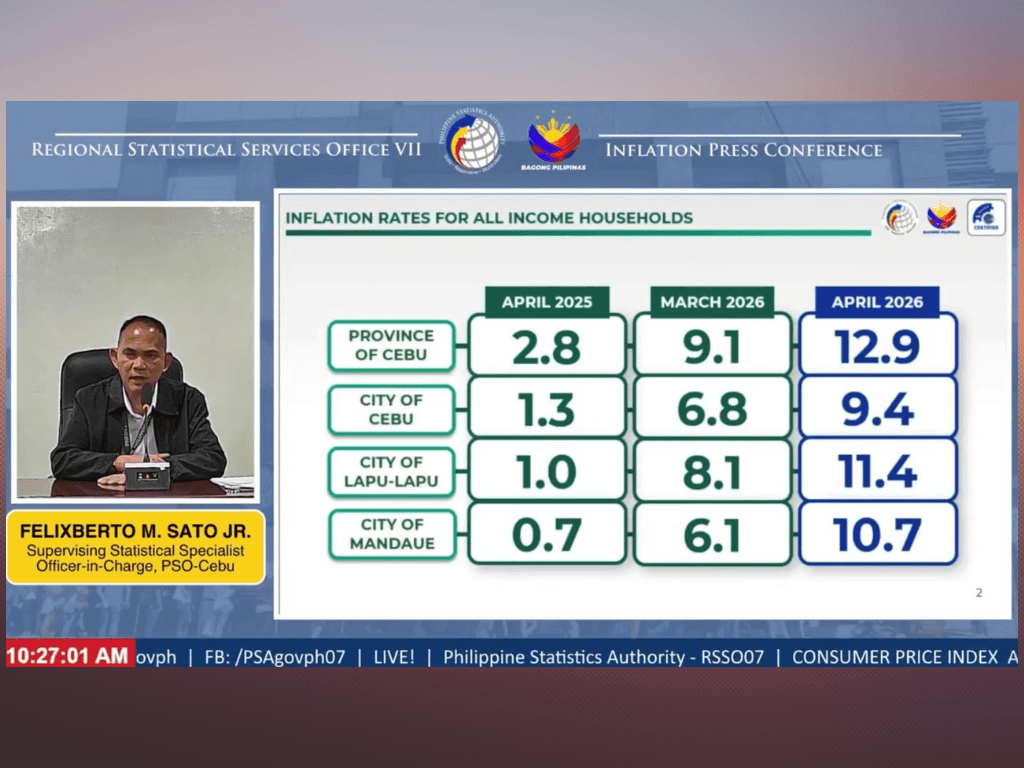
In the region, Cebu province recorded the highest inflation rate at 12.9 percent, followed by Lapu-Lapu City at 11.4 percent, Mandaue City at 10.7 percent, Cebu City at 9.4 percent, and Bohol at 7.2 percent.
The surge in food prices was the primary driver of inflation in the region, accounting for 47.2 percent of the overall increase in April inflation. This was followed by higher transport costs, driven largely by soaring fuel prices, with diesel prices increasing by 109.1 percent and gasoline prices by 56.2 percent.
Inflation in housing, water, electricity, gas, and other fuels also accelerated, rising to 6 percent in April from 4.2 percent in March 2026.
Inflation-prone region
Peña-Reyes said Central Visayas is highly susceptible to inflation because of its geography and economic structure, which amplify the transmission of price increases.
As an island-region economy, Central Visayas is heavily dependent on inter-island logistics and imported fuel. This dependence creates a strong “pass-through effect,” where spikes in global oil prices directly impact local consumers.
When fuel prices rise, the region experiences ripple effects such as higher food prices due to increased shipping costs, rising transportation expenses, and higher electricity rates.
“One, shipping costs quickly affect food prices because this is an inter-island economy. Fuel price increases raise transfer costs. Electricity generation becomes more expensive. Tourism also gets affected because operating costs rise in that industry, and construction materials become costlier as well,” he said.
“This creates a strong pass-through effect from global oil prices to local consumer inflation. We are seeing that the region is quite prone to stagflationary pressure,” he added.
Tourism reliance
While tourism remains a major growth driver in Central Visayas, Peña-Reyes said overreliance on the industry also makes the region vulnerable to external shocks that could weaken tourism demand.
To mitigate these risks, he said Central Visayas must diversify beyond tourism and consumption-led growth by expanding higher-productivity industries such as information technology-business process management (IT-BPM), digital services, advanced manufacturing, and semiconductor and electronics support industries.
“The goal is to shift from cyclical growth toward structurally resilient growth. Economies that rely too heavily on tourism and consumption often struggle during external shocks,” Peña-Reyes said.
To achieve a “soft landing”—where inflation eases without severely hurting economic demand—the region needs a coordinated strategy in which monetary policy anchors inflation, fiscal policy provides targeted relief, and structural reforms address supply constraints.
Steps to fight inflation
Peña-Reyes outlined several strategies to help curb inflation in the region.
One of these is modernizing logistics and supply chains, since the region’s archipelagic geography adds a structural inflation premium to the cost of food, construction materials, and exports.
To reduce costs, the region must modernize ports and inter-island shipping, improve cargo handling efficiency, strengthen cold-chain systems, and digitize logistics and customs processes.
Given the region’s dependence on imported fuel, Peña-Reyes also stressed the need to achieve energy security by expanding renewable energy capacity, modernizing transmission infrastructure, developing distributed solar and battery storage systems, and promoting energy efficiency.
To shield the agricultural sector from climate shocks, priorities must include climate-adaptive agriculture, modernization of irrigation systems, improved watershed and coastal management, and the establishment of resilient fisheries systems.
Peña-Reyes also said many economic bottlenecks that increase the cost of doing business—such as regulatory burdens, slow government processes, and infrastructure delays—are institutional failures.
Improving regional coordination, streamlining permits and business processes, and enhancing data-driven policymaking are essential to ensure that infrastructure projects and investments generate lasting productivity gains and ease inflationary pressures, he said. —Ed: Corrie S. Narisma

Contributor