
According to CBRE's second-quarter Market Monitor, the provincial office market faced a challenging first half, posting a 37-percent drop in office demand compared with the same period last year.
CBRE data showed that Megaworld was the top-performing landlord in the provincial markets during the first half of the year, followed by SM, Innoland, Global Gateway and Limketkai Sons.
Although Cebu took the hardest hit, it still outperformed the other provincial markets in the second quarter, recording 9,200 square meters (sqm) in office demand, ahead of Pampanga with 7,300 sqm, Iloilo with 6,600 sqm, Davao City with 700 sqm and Bacolod City with 600 sqm.
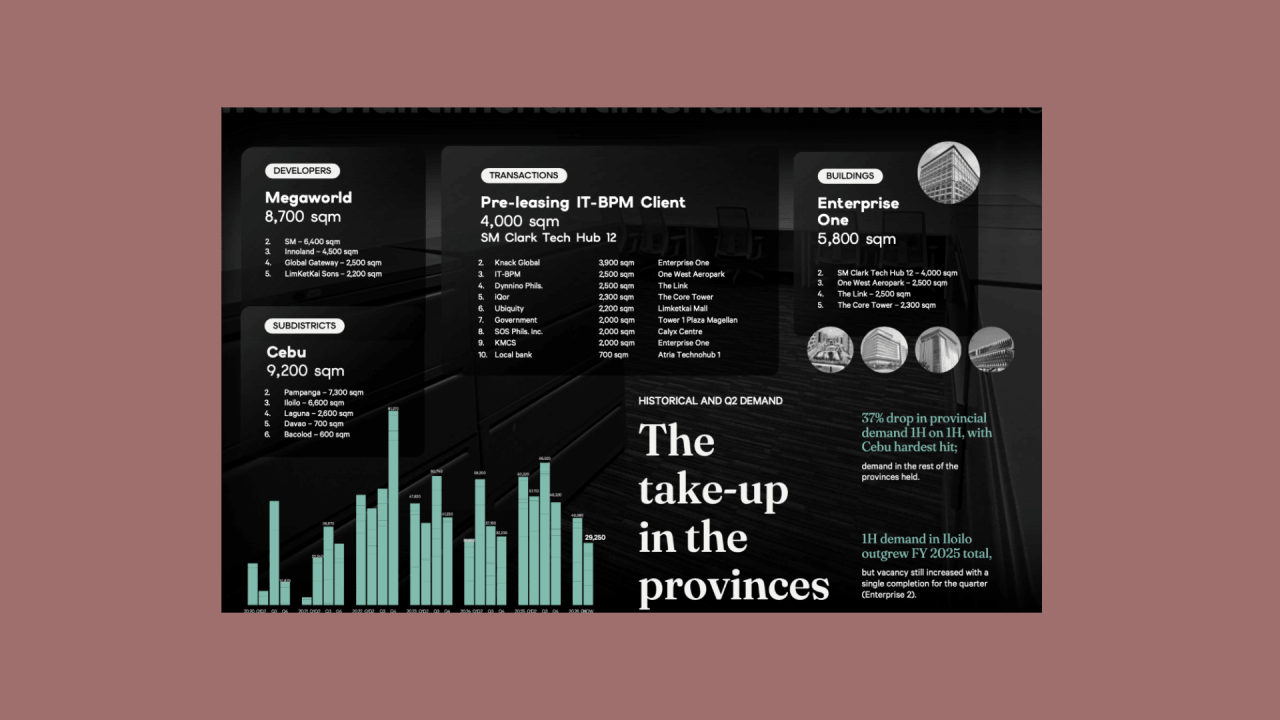
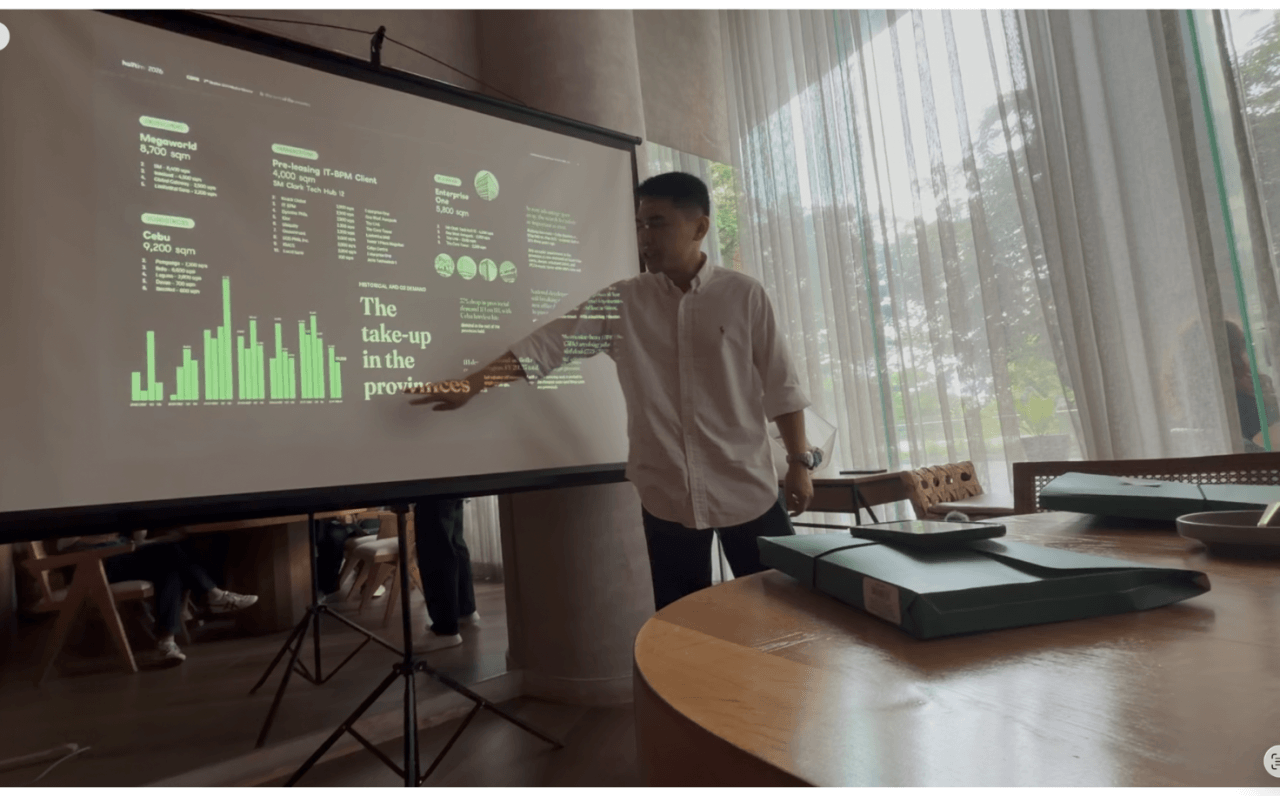
However, Zeth Soria, CBRE director for office leasing, said Cebu's second-quarter office demand remained relatively weak, as it declined from 11,000 sqm in the first quarter.
The number of transactions also fell to 11 in the second quarter from 30 in the first quarter.
Shifting market preference
Soria said companies, particularly voice-heavy business process outsourcing (BPO) firms, are opting for "pilot-sized" office spaces ranging from 700 sqm to 2,500 sqm, indicating that the sector remains under pressure. In previous years, Cebu typically saw "mega-sized" transactions involving office spaces of 5,000 sqm or more.
“A lot of the occupiers now are very measured, very cautious when approaching space take up,” he said.
Cebu's office vacancy rate edged up to 13.9 percent in the second quarter from 13.7 percent in the previous quarter, marking the first increase in five quarters.
Vacancy at Cebu Business Park, one of Ayala Land's two premier business districts in Cebu, remained relatively low at 9.1 percent. The other, Cebu I.T. Park—the country's largest IT-BPM hub outside Metro Manila—posted an office vacancy rate of 11.8 percent.
Fringe locations and Mactan Island, however, recorded significantly higher vacancy rates of 22.9 percent and 31 percent, respectively.
According to CBRE, Cebu's office vacancy rate could rise to between 18 percent and 22 percent by the end of the year.
“By the end of the year for the second half, we're seeing a lot of shadow stock that might open up in the market. When you say shadow stock, these are spaces that are not available yet now, but we know for certain that they will open up later on. The outlook could become more challenging by year-end,” said Soria.
More vacancies
Some office spaces that are currently occupied are scheduled to be vacated by the end of the year. In Cebu I.T. Park alone, about 30,000 square meters (sq m) of office space are expected to become available by the end of 2026 due to companies downsizing or consolidating their operations.
As of the second quarter, Cebu had 181,300 sq m of available office space, most of it in fringe locations outside Cebu I.T. Park and Cebu Business Park.
An additional 95,470 sqm of office space is expected to be completed by the end of the year through three major developments: SM City Cebu (60,000 sqm), Grand Tower (19,000 sqm) and Astra Corp. Centre (16,470 sqm).
These figures exclude another 24,000 sqm of office space scheduled for completion in 2027 and 64,000 sq m in 2030.
Decline in IT/BPM
Asked what caused the decline in office demand, Jie Espinosa, CBRE country head for leasing and advisory services, said the market had been driven by the information technology and business process management (IT-BPM) sector over the past decade.
However, he said the sector's average office take-up has steadily declined over the past four years, from about 2,500 square meters (sq m) before the pandemic to around 1,054 sq m at present.
One factor, Espinosa said, was that most voice-heavy BPOs were opting for "pilot-sized" deals as artificial intelligence (AI) automated some repetitive, low-level tasks, leaving only more complex work to be handled by employees.
"Some of the work gets augmented. Some of the work gets replaced. But I think it's undeniable. There's already an impact of AI on the industry," Espinosa said.
However, he said the healthcare BPO segment could offset the slowdown in voice-heavy BPOs, noting that it has performed well over the past few years.
"Last year was a banner year for the BPO industry. What fueled it is really the growth of the healthcare BPO," Espinosa said. "The graduates that we produce, a lot of those are coming from medical-related fields, and I think that's what most of the U.S. companies are seeing at the moment. They're trying to leverage that."
Old stocks
Older office buildings have seen less demand as most leasing transactions have been concentrated in newly completed, previously unleased office spaces.
CBRE data showed that 31 percent of Cebu's available office inventory is more than 10 years old, while 35 percent is between six and 10 years old. The remaining 34 percent are less than five years old.
MJ Castro, CBRE's head of operations for property management, said landlords are now "playing defense" as they try to remain competitive amid the influx of new office supply.
She advised landlords to conduct technical due diligence on their buildings to determine which areas require repairs or upgrades. They should also assess whether their floor plates, leasable areas and amenities remain competitive in the current market.
Espinosa explained that Cebu's office inventory was initially developed primarily by local firms, whose standard handover did not include centralized air-conditioning systems.
He said this changed when national developers entered the market and made integrated air-conditioning systems a standard feature in new office developments.
"Many of those first-generation office buildings that were leased to BPO companies are now dealing with aging mechanical systems," he said.
POGOs
Espinosa said Cebu was also affected by the exit of Philippine offshore gaming operators (POGOs), which had leased office space in the city several years ago.
He said some developers were fortunate because although POGO firms had committed to leasing multiple floors in their office towers, not all of the spaces were eventually fitted out. Some were left vacant in anticipation of future expansion.
However, the office spaces that had already been fitted out for POGO operations became a challenge after the firms left.
"The fit-outs they left behind are no longer usable for most IT-BPM occupiers. If you offer those spaces to an IT-BPM company, it would likely cost them more to remove the existing fit-out and build one that suits their operational requirements," he said. —Ed: Corrie S. Narisma

Contributor