That frustration, coupled with his passion for the environment, inspired agricultural engineer Victoriano Ocon to develop a locally designed waste-treatment solution, drawing on his experience in designing and fabricating agricultural machinery.
His efforts eventually earned national recognition when his company's “Gasification Process for Waste Disposal: Advanced Waste Solution” was named one of five winners of the 2026 Presidential Filipinnovation Awards, an annual national competition recognizing Filipino innovations with commercial potential and benefits to communities.
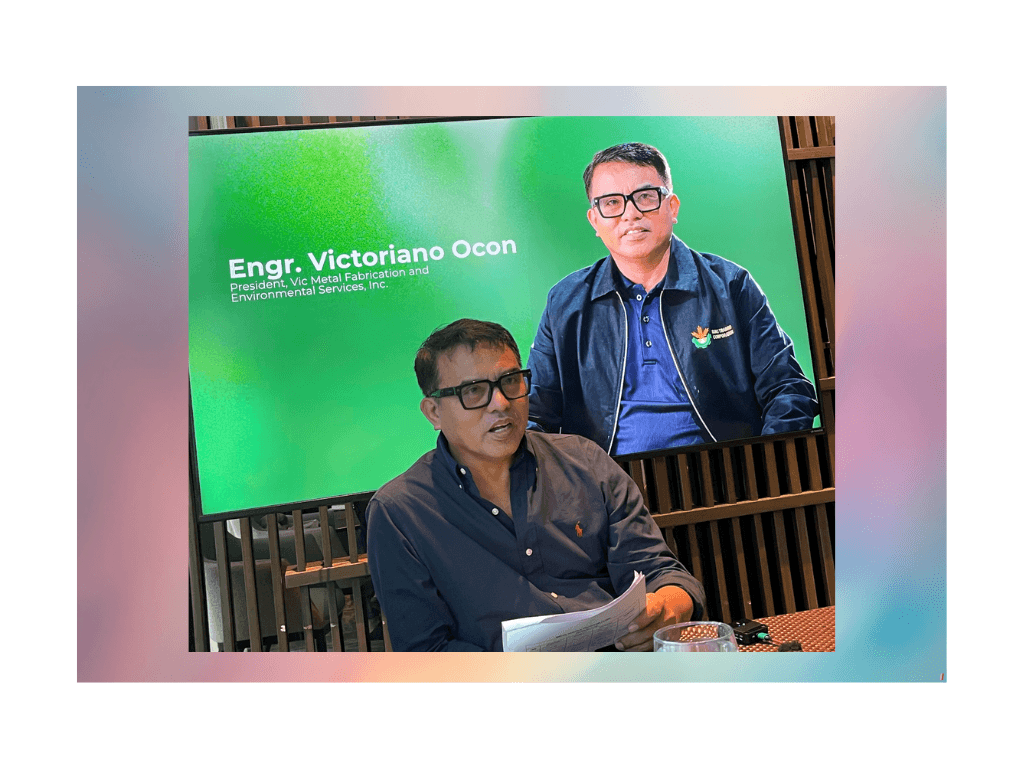
“This journey did not start with the intention of winning an innovation award. It started with a simple problem we encountered,” said Ocon, president of Vic Metal Fabrication and Environmental Services Inc.
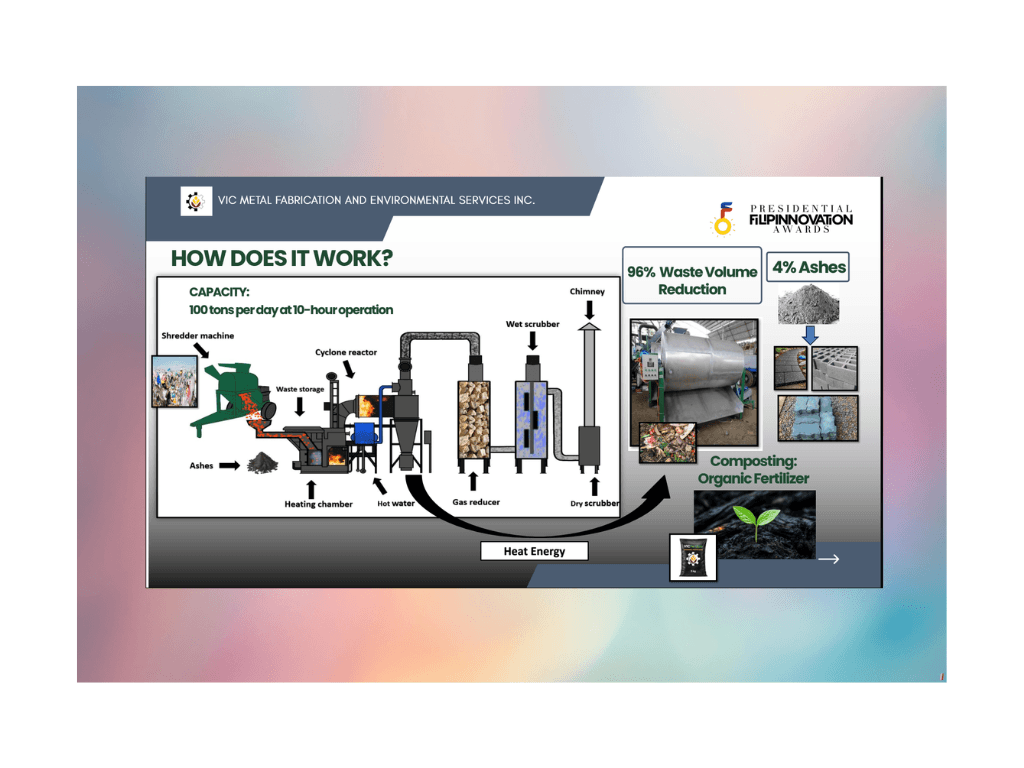
The thermal waste-treatment technology uses a controlled, low-oxygen process to convert residual waste into combustible gases and other byproducts, reducing the volume of waste requiring disposal by as much as 96 percent, according to Ocon.
Unlike conventional incineration, which burns waste with an unrestricted supply of air, the system heats residual waste in a chamber with a controlled supply of oxygen.
The resulting gases pass through a cyclone separator and scrubber, which Ocon said are designed to remove pollutants before emissions are released into the atmosphere.
Ocon maintained that the gasification system complied with environmental standards set by the Department of Environment and Natural Resources (DENR), citing third-party emissions testing.
By-products
According to Ocon, the process leaves about 40 kilograms of ash for every ton of waste treated. The recovered ash can be used as a substitute for fine sand in producing hollow blocks.
He said heat recovered from the treatment process could also speed up the processing of biodegradable waste, shortening the usual composting period from about 15 days to overnight.
Ocon is offering the technology primarily to local government units (LGUs), which are responsible for managing solid waste in their communities.
He said the system could be customized and scaled according to an LGU's daily waste volume, operational requirements and available budget.
The smallest system costs about P45 million and can process approximately 20 tons of waste per day.
Technology transfer
“We are selling only the equipment,” Ocon explained, emphasizing that the company adopts a technology-transfer approach, providing LGUs with the necessary equipment and technical know-how rather than directly operating their waste-treatment facilities.
The package includes facility construction, equipment installation and technology transfer, along with maintenance support during the first year.
After the first year, LGUs may continue using the company's maintenance services or engage another service provider.
Ocon estimated the facility's operational lifespan at 10 to 15 years, after which rehabilitation would be necessary.
The technology also requires relatively little space, with a small-scale waste-treatment facility needing only about 100 square meters of land.
Ocon said the equipment could even be installed within existing materials recovery facilities (MRFs) operated by LGUs.
Customers
According to Ocon, 20 LGUs have so far adopted the technology to help address their garbage disposal problems. Four are in Cebu—Lapu-Lapu City and the towns of Alegria, Compostela and Tuburan.
He said the processing capacity of each facility is generally determined by the LGU's available budget.
He cited one LGU that generates about 50 tons of garbage daily but has a waste-treatment facility designed to process only 20 tons per day.
The largest installation, according to Ocon, is in Malolos City, Bulacan, with a designed processing capacity of 30 cubic meters of waste per hour.
Beyond addressing garbage disposal problems, the technology also offers LGUs potential economic benefits, including cost savings and opportunities to generate additional revenue.
These include lower hauling, tipping and disposal costs, as well as potential revenue from the sale of organic fertilizer.
Some LGUs also use hollow blocks made from recovered ash for drainage projects and low-cost housing. The blocks have also been provided to families needing materials to construct burial vaults for deceased relatives.
From agricultural machinery to waste treatment
Ocon's journey into waste management began in a different field.
An agricultural engineer by profession, he retired early from a career in agricultural machinery sales at age 33 and used his modest separation pay to establish Suki Trading Corporation in 2001.
The company initially manufactured and sold agricultural and postharvest machinery before diversifying into waste-management equipment.
By 2005, Suki Trading was supplying a substantial portion of the Department of Agriculture's postharvest equipment requirements. It subsequently expanded its market to several provinces, including Quezon, Iloilo, Leyte, Samar and Agusan.
The company earned recognition for its machinery products in 2006 and received another recognition from the Philippine Center for Postharvest Development and Mechanization in 2010.
Ocon eventually ventured into the development of waste shredders, bioreactors and technologies for solid waste segregation, recycling, treatment and disposal.
His expansion into waste management also led to his involvement with Vic Metal Fabrication and Environmental Services Inc., the company behind the award-winning gasification technology.
Challenge
Ocon admitted that his initial attempt to develop the technology about 16 years ago was a dismal failure.
But he did not give up. Instead, the setback motivated him to improve and refine the design.
After years of development, Ocon said he sought patent protection for the technology in 2020.
His persistence eventually paid off.
Ocon plans to use the P3.5-million cash grant from the 2026 Presidential Filipinnovation Awards to further develop his innovation, particularly a waste-to-energy system that could harness heat generated during waste treatment to produce electricity.
“Zero waste, going to electricity, that's what we're looking for,” Ocon said.
With support from the Department of Science and Technology (DOST) and financing assistance from banks and other partners, Ocon hopes to scale up his locally developed technology to help address the country's continuing waste-management challenges.— Ed: Corrie S. Narisma
Contributor