The Philippines continues to post growth in digitally delivered services despite the rapid adoption of generative AI, with demand increasingly shifting toward financial, computer and other higher-value services, ING said in a research note titled Why India and Philippines aren't losing the AI battle — yet.
“The evidence so far suggests that AI is reshaping the composition of services exports and employment in India and the Philippines, but not yet causing a broad-based decline in exports or jobs,” ING said.
Instead, the research pointed to an industry undergoing an upgrade, with growth becoming increasingly concentrated in higher-skilled and technology-intensive activities.
High stakes
The stakes are particularly high for the Philippines, which ING estimates accounts for 15 percent to 17 percent of the global business process outsourcing market.
The sector generates more than $40 billion in annual revenue and supports roughly 1.9 million workers, making it a major source of jobs, foreign exchange and economic activity.
Services exports also play a critical role in the country's external finances. ING said telecommunications and business services exports amounted to around 7 percent of Philippine gross domestic product in 2025, more than offsetting the current account deficit equivalent to 3.5 percent of GDP.
This makes the industry an important source of support for the peso and the country's balance of payments, according to ING.
The rapid development of AI has nevertheless raised concerns because many traditionally outsourced functions involve repetitive and rules-based work that can increasingly be automated.
Large language models are already improving efficiency in customer support, legal reviews, claims processing, document verification and data entry.
AI-powered voice assistants are also becoming more capable of handling customer interactions, while AI coding tools are allowing software developers to work faster.
Exports hold up
Despite these changes, ING said there was little evidence so far that AI had materially weakened international demand for Philippine services.
Combined telecommunications, computer and business services exports increased to 7.1 percent of GDP by mid-2026 from 6.3% before the COVID-19 pandemic.
The composition of that growth, however, is changing.
Telecommunications and computer services have emerged as major growth drivers, while business services have moderated following the surge in outsourcing demand after the pandemic.
A broader measure of digitally delivered services, or DDS, tells a similar story.
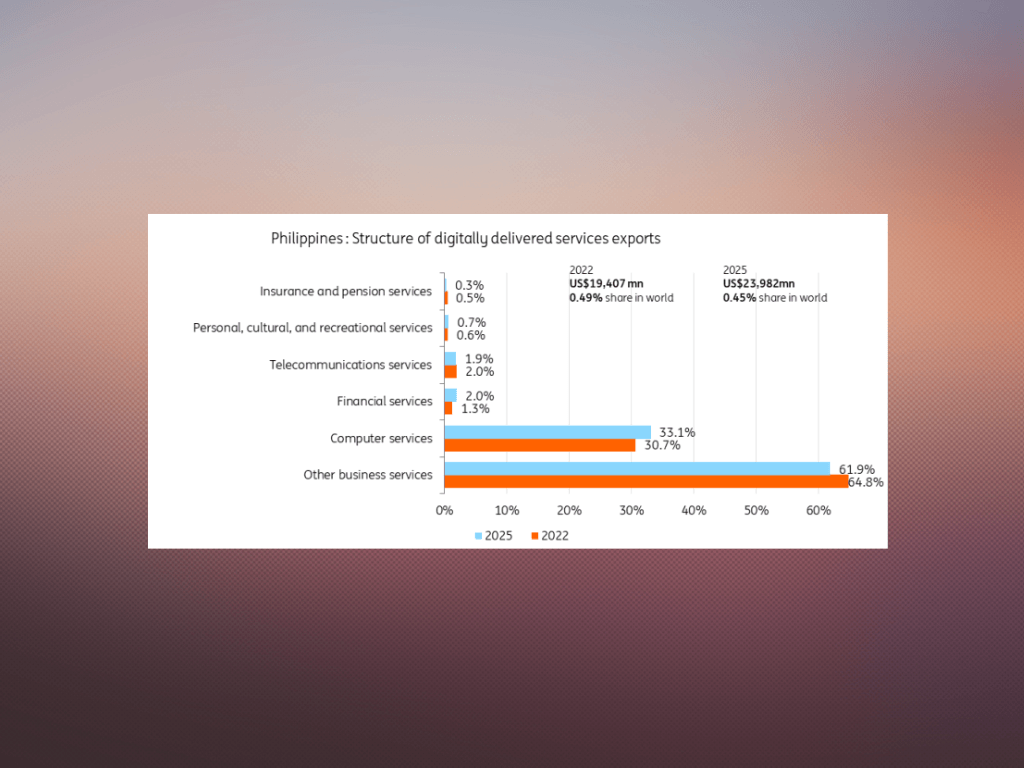
ING, citing World Trade Organization data, said Philippine DDS exports had grown 24% since 2022, although the country's share of global exports remained broadly unchanged.
Financial services exports have expanded by around 25% annually since 2022, while computer services have also recorded strong growth.
“The Philippines appears to be adjusting by increasing its exposure to faster-growing segments such as financial and computer services,” ING said.
Jobs transform
The bigger question is what the transformation means for the Philippine workforce.
ING cited International Labour Organization estimates showing that more than a quarter of Philippine jobs are potentially exposed to generative AI, the highest share among Association of Southeast Asian Nations economies with comparable data.
But exposure to AI does not necessarily mean workers will be displaced.
Only about 4 percent of Philippine jobs fall into the category facing the highest risk of automation, according to the research. Most workers exposed to generative AI are more likely to see technology augment their jobs and improve productivity rather than replace them outright.
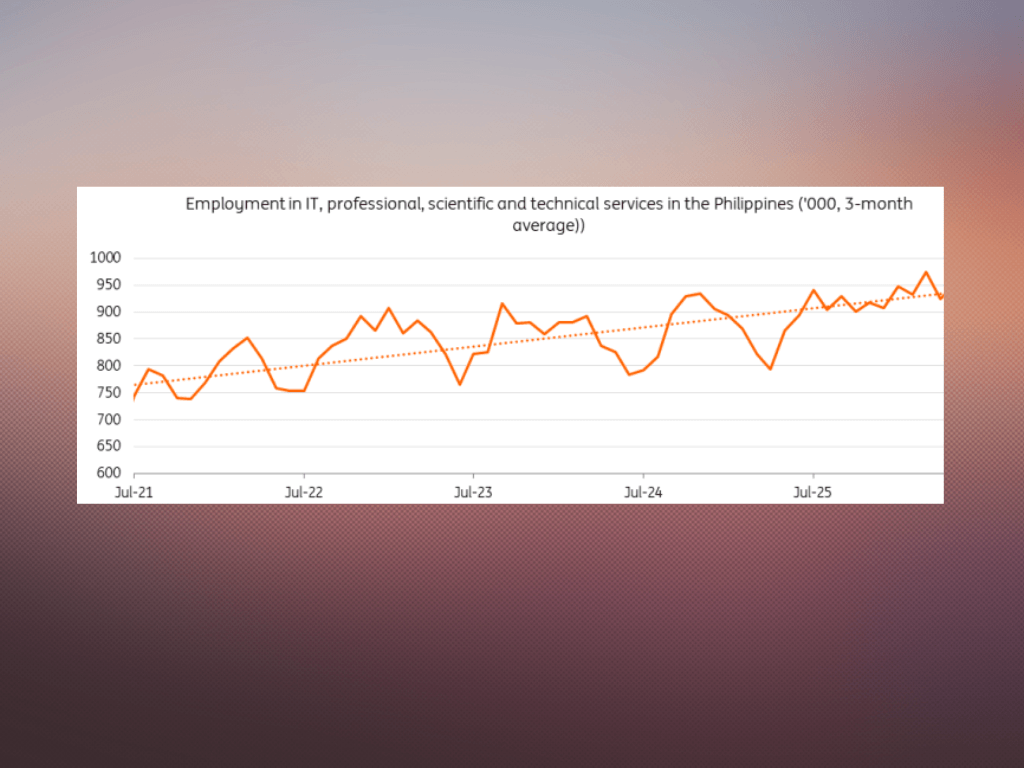
Because detailed sector-level employment figures are limited, ING used employment in the information and communication and professional, scientific and technical services sectors as a proxy.
Employment in these sectors grew about 4.5% over the past year, with recent readings remaining close to their longer-term trends, ING said.
Higher-value work
The emerging pattern suggests that routine processing jobs face greater pressure while demand shifts toward analytics, software development, financial services and other specialized functions.
The same transition is occurring globally. ING said higher-value activities account for a large portion of digitally delivered services, with “other business services” — including research and development, professional consulting, management and legal services — making up around 40% of global DDS exports.
Computer services account for another 20 percent and financial services 16 percent.
For the Philippines, ING's findings suggest the challenge is increasingly about adapting the workforce and services mix rather than defending an outsourcing model built around routine work.
AI is making some tasks less labor-intensive, but the data so far do not point to the disappearance of outsourcing demand.
“The bigger story is one of upgrading,” ING said in the research note, “with growth increasingly concentrated in higher-skilled, more technology-intensive activities.” —Ed: Corrie S. Narisma