
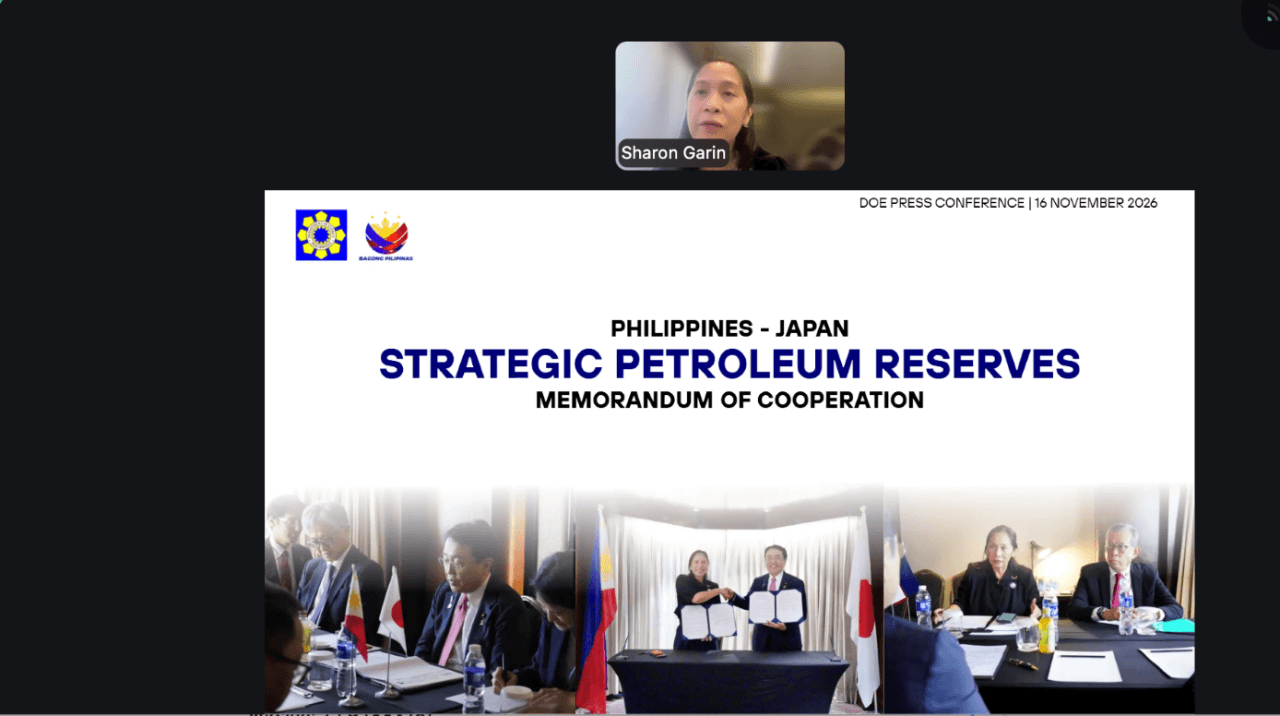
The initiative is expected to gain momentum following the signing of a Memorandum of Cooperation (MoC) between the Philippines and Japan on Nov. 16, aimed at strengthening the country's fuel security and reducing its vulnerability to disruptions in global petroleum supplies.
Energy Secretary Sharon Garin and Japanese Minister of Economy, Trade and Industry Ryosei Akazawa signed the agreement in Manila, building on commitments made during a meeting between the leaders of the Philippines and Japan in May 2026.
The agreement establishes a framework for developing, managing and releasing strategic petroleum reserves, including the construction of storage facilities, identification of financing arrangements and technical cooperation.
During a DOE press briefing on Tuesday, Nov. 17, Garin said the partnership would help the Philippines establish the infrastructure and institutional capacity needed to maintain emergency petroleum inventories.
Garin said the completion of the project's first phase would mark a historic milestone, giving the Philippine government its first state-owned petroleum reserve storage facility.
The facilities could accommodate crude oil, gasoline, diesel and other petroleum products depending on the country's requirements.
Bataan storage projects
Energy Undersecretary Alessandro Sales said in the same press briefing that Philippine National Oil Company (PNOC) has already started developing a one-million-barrel petroleum storage project on its property in Bataan.
PNOC is also exploring a larger facility with a potential storage capacity of up to 15 million barrels, with assistance from Japan's Ministry of Economy, Trade and Industry (METI).
Sales said discussions are underway with Saudi Aramco on a possible partnership to develop the larger facility.
The talks are focused on determining how the project could be structured operationally and financially, considering the substantial investment required to establish and maintain strategic petroleum reserves.
Under the Philippine-Japan agreement, Japanese companies may also participate in PNOC-led commercial stockpiling projects, opening opportunities for foreign investment in the country's petroleum storage infrastructure.
Garin said the government is looking beyond establishing its own emergency reserves, as it also explores positioning the Philippines as a regional or international oil storage hub.
PNOC is engaging potential partners from Japan, the Middle East and other countries on the development of additional storage facilities.
Alternative oil stockpiling arrangements
Beyond building storage facilities, the government is exploring alternative arrangements to secure emergency petroleum supplies without the upfront cost of purchasing and storing large volumes of fuel.
Sales said PNOC Exploration Corp. (PNOC EC) is discussing an oil-ticketing arrangement with Shell Thailand and Indonesia's Interport.
Under the proposed mechanism, the Philippines would secure the right to purchase a specified volume of petroleum products at prevailing market prices within an agreed period, ensuring access to emergency supplies without maintaining physical inventories.
Sales explained that the mechanism would work like a reservation system, allowing the government to secure access to petroleum supplies without immediately incurring the cost of purchasing and storing them.
"This is one of the methods proposed by ERIA to sort of kickstart an SPR without first buying the products, because that's a big expense," Sales said, referring to the Economic Research Institute for ASEAN and East Asia and strategic petroleum reserves.
DOE officials said letters of intent were signed on Nov. 14 to explore emergency oil access arrangements with foreign companies.
The proposed ticketing mechanism remains subject to commercial discussions and will complement, rather than replace, the government's planned physical petroleum reserves.

Japanese technical assistance
The cooperation agreement also covers the development of strategic petroleum reserve facilities based on ongoing feasibility studies and the identification of possible financing arrangements.
Technical support will involve the Japan Organization for Metals and Energy Security (JOGMEC), Japan International Cooperation Agency (JICA) and ERIA.
These institutions will assist in capacity building, oil security assessments, policy development and knowledge exchange.
Garin said establishing storage tanks and related infrastructure is only one component of the initiative, as the government must also develop the expertise to operate and maintain emergency fuel reserves.
The cooperation will initially focus on strengthening the capabilities of PNOC in managing petroleum stockpiles.
"The Philippines must be prepared for disruptions in global oil supply. Developing our strategic petroleum reserves is an important step toward ensuring that we have the systems, infrastructure, and institutional capacity to protect our country's fuel requirements during emergencies," Garin said.
The agreement also advances discussions under the Partnership on Wide Energy and Resources Resilience Asia (POWERR Asia), including voluntary cooperation with oil-producing countries and the development of a regional roadmap for petroleum stockpiling.
The DOE and METI will coordinate implementation, including the identification of priority activities, schedules and responsibilities.
The agreement provides for a three-year cooperation period, which will begin upon completion of the required domestic procedures and exchange of diplomatic notifications. It may be extended by mutual written consent.
Fuel inventories remain stable
The government's push to establish strategic petroleum reserves comes as the DOE maintains that the country's current fuel supply remains stable despite fluctuations in international oil markets.
As of Nov. 13, the Philippines had gasoline inventories equivalent to 53.27 days of consumption, diesel at 56.59 days, kerosene at 133.59 days, jet fuel at 62.9 days, fuel oil at 50.82 days and liquefied petroleum gas at 34.47 days.
Garin clarified that the figures represent the number of days existing inventories could cover domestic consumption if no additional petroleum shipments arrived.
She emphasized that oil companies continue to import fuel and maintain regular supply arrangements.
The DOE said global petroleum supply conditions have also improved, supported by increasing production from OPEC+ and non-OPEC producers, including the United States, Canada, Brazil, Argentina and Guyana.
Garin said the strategic petroleum reserve initiative is intended to strengthen the country's long-term preparedness rather than address an immediate fuel shortage.
Once established, the reserves would provide an additional layer of protection for the transport sector, businesses, industries and households during international oil supply disruptions.
The government is also pursuing regional cooperation on emergency petroleum supplies, including arrangements that would allow ASEAN countries to assist member states experiencing supply difficulties.
Garin said the broader objective is to ensure that the Philippines has sufficient fuel supplies regardless of developments in the international market.
"With our reserves in place, we will be better positioned to support our transport, markets and industries," she said.
"This is how we build energy security for Filipino families today and for the years ahead." —Ed: Corrie S. Narisma
Contributor