
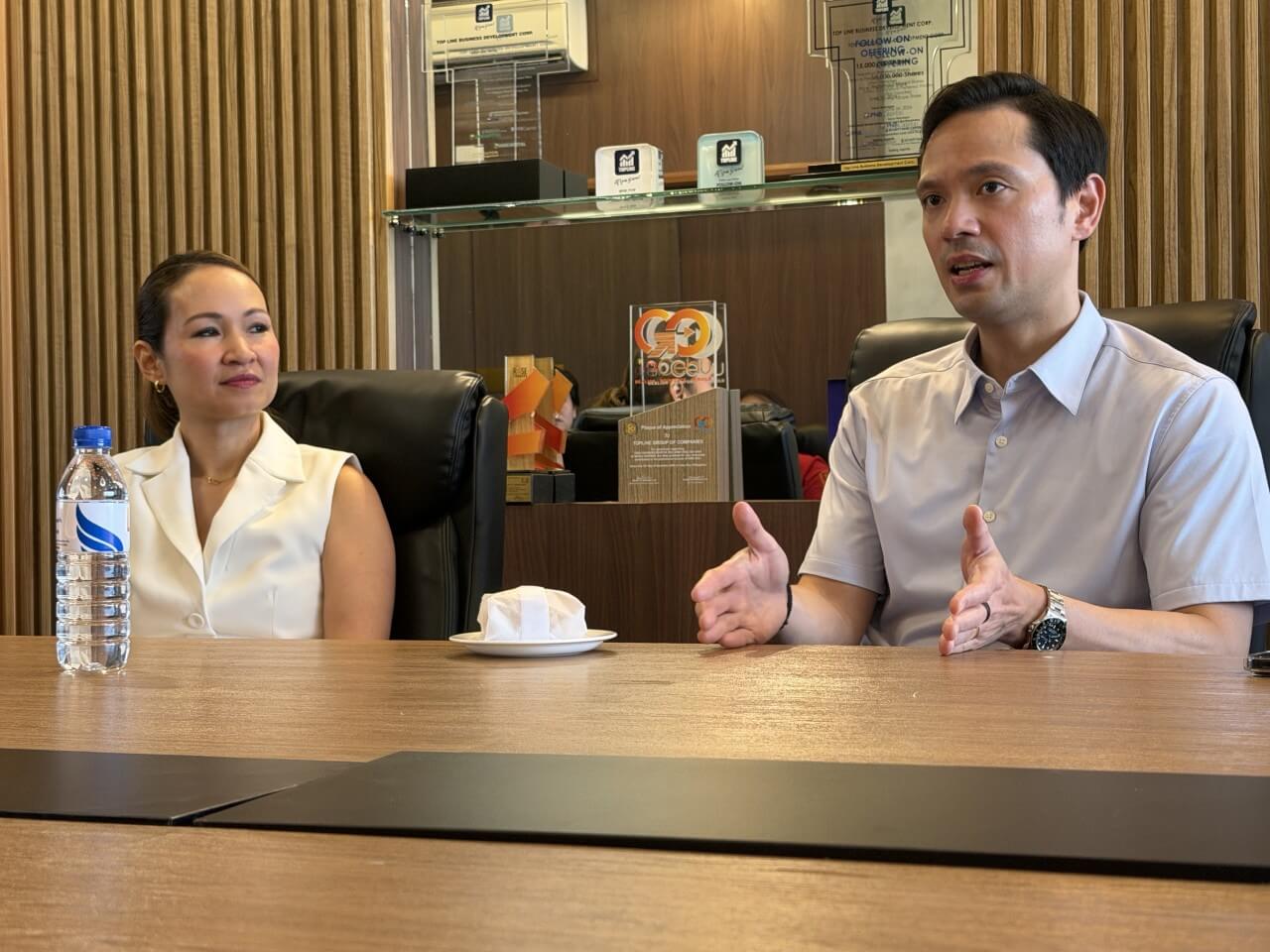
Eugene Erik Lim, Top Line chair, president and chief executive officer, said the company was exploring opportunities to develop or acquire additional fuel storage facilities in strategic locations across the Visayas.
"For us in Top Line, based on our strategic sessions, we're looking at adding more capacity, not only just for the company, but for energy security, hopefully for the Visayas," Lim said during a briefing with reporters on Nov. 12.
The planned expansion is part of the company's strategy to build a more integrated energy platform covering fuel importation, storage, distribution and retail operations.
Among its major projects is the ongoing rehabilitation of the Ludo fuel storage facility in Cebu, which has an estimated capacity of 30 million liters.
Fuel storage expansion
Lim said the Ludo facility, which occupies approximately 10 hectares, was undergoing refurbishment, with completion tentatively targeted for mid- to late 2027.
Top Line, through its subsidiary Topline Logistics and Development Corp., entered into a sublease agreement with the Lu Do & LuYm Group, which is engaged in storage facility rentals, for the approximately 30-million-liter fuel depot in Cebu.
According to a company statement issued in May, the first phase of the project involves the refurbishment and optimization of the facility.
Once completed, the project is expected to add approximately 30 million liters to Top Line's existing 10-million-liter storage capacity, representing a 300% increase and significantly strengthening its logistics capabilities, operational efficiency and supply chain reliability.
Top Line is also exploring opportunities to expand its depot network to other parts of the Visayas, although specific locations and investment amounts have yet to be finalized.
Lim said developing fuel depots requires substantial capital, suitable coastal locations and time to secure environmental and other regulatory permits.
The company's planned storage expansion is aligned with the Department of Energy's (DOE) efforts to strengthen the country's petroleum reserves and reduce its vulnerability to international supply disruptions.
"We are aligned actually with the DOE to add more stockpiling capacity," Lim said.
Fuel storage expansion
Lim said the Ludo facility, which occupies approximately 10 hectares, was undergoing refurbishment, with completion tentatively targeted for mid- to late 2027.
Top Line, through its subsidiary Topline Logistics and Development Corp., entered into a sublease agreement with the Lu Do & LuYm Group, which is engaged in storage facility rentals, for the approximately 30-million-liter fuel depot in Cebu.
According to a company statement issued in May, the first phase of the project involves the refurbishment and optimization of the facility.
Once completed, the project is expected to add approximately 30 million liters to Top Line's existing 10-million-liter storage capacity, representing a 300- percent increase and significantly strengthening its logistics capabilities, operational efficiency and supply chain reliability.
Top Line is also exploring opportunities to expand its depot network to other parts of the Visayas, although specific locations and investment amounts have yet to be finalized.
Lim said developing fuel depots requires substantial capital, suitable coastal locations and time to secure environmental and other regulatory permits.
The company's planned storage expansion is aligned with the Department of Energy's (DOE) efforts to strengthen the country's petroleum reserves and reduce its vulnerability to international supply disruptions.
"We are aligned actually with the DOE to add more stockpiling capacity," Lim said.
Fuel supply security
Philippine National Oil Co. (PNOC) is pursuing a strategic petroleum reserve facility at its industrial park in Bataan, initially targeting six storage tanks with a combined capacity of one million barrels.
The first tank, with a capacity of approximately 180,000 barrels, is targeted for completion by the end of 2027.
Lim emphasized that ensuring adequate fuel supplies was more critical than short-term price movements, particularly for an import-dependent country like the Philippines.
"What's important is we have the supply. If you don't have supply, that's a big, big problem," Lim said.
With its planned depot expansion, diversified supply sources and growing retail network, Top Line aims to strengthen its position in the downstream petroleum industry while helping secure the Visayas' long-term fuel requirements.
Top Line's expansion comes amid continued growth in its fuel distribution and retail operations.
Strong business growth
In the first nine months of 2026, the company generated P6.42 billion in consolidated revenues, up 107.4 percent from P3.09 billion in the same period last year.
Net income rose 77.2 percent to P194.22 million, while total fuel sales volume increased 46.4 percent to 100.64 million liters.
Commercial fuel trading remained the company's main revenue driver, generating P5.81 billion, or approximately 90.5 percent of consolidated revenues.
Retail fuel revenues, meanwhile, surged 357.8 percent to P607.54 million as the company expanded its service station network.
Retail fuel sales volume also increased 255.5 percent to 8.53 million liters during the nine-month period.
During the briefing, Brigitte Carmel Lapasaran Lim, Top Line senior vice president and chief operating officer, said the company had not experienced a drop in fuel sales volume despite higher pump prices following the tension in the Middle East that skyrocketed petroleum prices.
“We don't know with other players but so far, our volume has increased," she said.
Erik Lim said the company was closely monitoring both revenue and fuel sales volumes to assess its performance, particularly during periods of volatile petroleum prices.
He emphasized that revenue growth alone does not necessarily reflect the company's operating performance because higher fuel prices could inflate sales values without a corresponding increase in volumes.
The company sources refined petroleum products from domestic suppliers and international markets, including Singapore, South Korea and other Southeast Asian countries.
Lim said Top Line's Singapore trading operation allows the company to diversify its procurement sources and strengthen its ability to secure fuel supplies during international market disruptions.
"We're now looking at a more integrated energy platform," he said.
Retail expansion
Alongside its storage expansion, Top Line is accelerating the rollout of its Light Fuels service stations across the Visayas.
Brigitte Carmel Lapasaran Lim said the company has 25 operational service stations, with another 25 targeted for opening by December 2026.
If completed as scheduled, the expansion would double the company's operational retail network to 50 stations by year-end.
The company is also broadening the services offered at its outlets beyond conventional gasoline and diesel retailing.
These include automated motorcycle washing, car washing, convenience retail partnerships and planned electric vehicle (EV) charging facilities.
Eugene Erik Lim said the company wanted to position its outlets as full-service stations rather than simply gasoline stations, providing motorists with additional services while encouraging repeat visits.
The company is also installing solar panels on service station canopies and preparing to introduce EV charging facilities as part of efforts to accommodate changing energy requirements.
Lim said EV adoption was expected to increase in the coming years, although the company had yet to determine how much revenue charging services could contribute to its operations.
Despite the rapid expansion of its retail network, commercial and industrial fuel trading continues to account for the bulk of Top Line's business, including fuel sales to shipping companies and other industrial customers. —Ed: Corrie S. Narisma
Contributor