
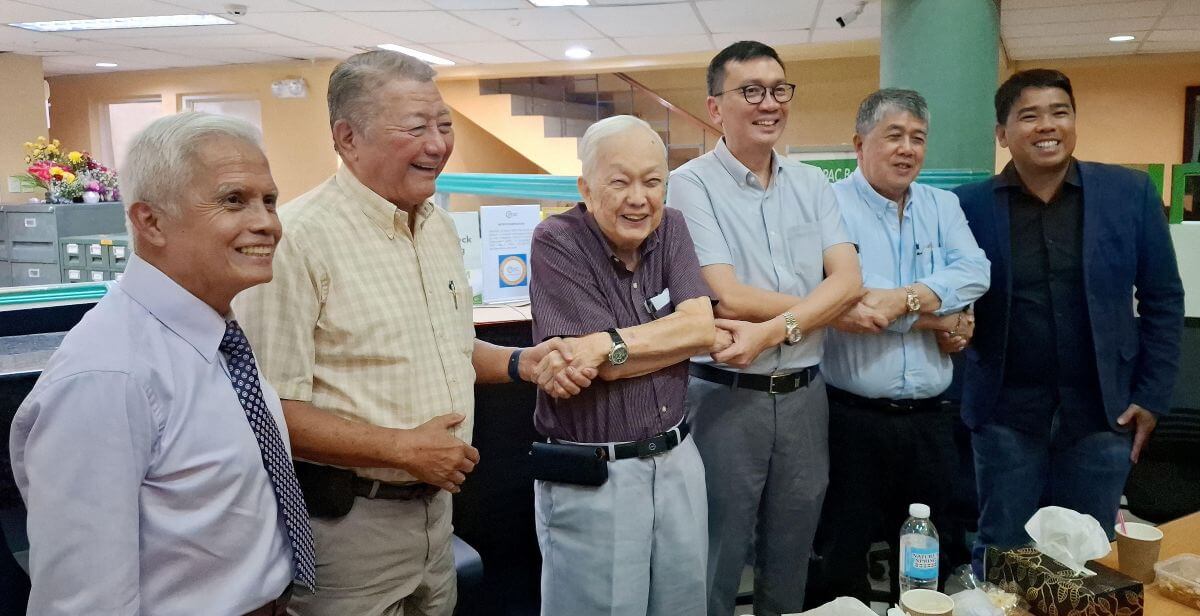
Chair emeritus Augusto W. Go said the fresh capital supports ASPAC’s long-term role as a grassroots financial partner for entrepreneurs and working Filipinos, while positioning the bank for its planned transition to a thrift bank.
Expansion roadmap
“This is about enabling small businesses, professionals and ordinary employees to move forward,” Go said in a recent press briefing at the bank’s head office in Mandaue City, Cebu.
“With stronger capital, we can support more enterprises, open more branches and grow responsibly with our clients,” he pointed out.
ASPAC president and CEO Jose Levi S. Villanueva said the investment allowed the bank to “lend more, lend smarter, and reach more people who are productive but underserved.”
He said the bank already has the assets, systems and governance structure required by the Bangko Sentral ng Pilipinas (BSP) to obtain a thrift bank license.
“We already meet the requirements,” Villanueva said. “This investment reinforces our readiness and gives us more capacity to serve our clients better.”
Long-term goal
Both Go and Villanueva said ASPAC’s medium-term goal is to become a thrift bank, with a longer-term vision of evolving into a commercial bank and eventually a universal bank.
They look forward to the possibility of the bank soon being able to offer a broader range of financial products, while remaining focused on community-based banking.
ASPAC’S board of directors met in a special session on Jan. 14 to approve the deal with CIFC whose president and CEO, Ruben D. Almendras, and director, Alvin Y. Tan Unjo, now represent the new minority shareholders.
Villanueva sits on the ASPAC board alongside Kenneth L. Go, president and CEO of Visayan Surety and Insurance Corp., as chair; University of Cebu (UC) Chancellor Candice G. Gotianuy as treasurer; and independent director Christian Tiongko.
The investment strengthens ASPAC’s capital base, allowing the bank to expand lending, speed up loan approvals and roll out more digital services, especially for borrowers often underserved by larger commercial banks.
Branch network
ASPAC operates 12 branches across Cebu, including in the cities of Mandaue, Lapu-Lapu, Consolacion, Talisay, Carcar, Toledo, Danao, Cebu and Bogo, as well as on Bantayan Island in northern Cebu.
Go said all 12 branches stand on properties owned by the bank helping lower fixed costs and improving resilience.
“Depositors can be confident that their savings are safe because the bank owns the property where it operates,” he said.
About 60 percent of ASPAC’s loan portfolio is made up of micro, small and medium enterprises (MSMEs), ranging from small traders to mid-sized enterprises, said Villanueva.
The bank also has a strong presence in consumer lending, particularly for teachers and professionals, whose loans are processed through online and inter-branch platforms, he said.
With teachers accounting for nearly one-fourth of its borrowers, Go said, “ASPAC is among the fastest to lend to teachers. We do it in just 36 hours.”
Sound investment opportunities
Almendras said in a press briefing that CIFC’s partnership with ASPAC reflects the company’s confidence in the bank’s governance, risk controls and community-anchored business model.
He said CIFC, which holds banking and financial interests across the region and is among the few non–Metro Manila firms with a quasi-banking license, is constantly on the lookout for sound investment opportunities.
ASPAC has also invested heavily in technology and is among the more digitized rural banks in the country, offering real-time, inter-branch transactions, he noted. He cited this capability as one of the reasons for CIFC’s entry, saying it recognized the bank’s potential.
Villanueva revealed that the bank is preparing to launch a digital wallet with no maintaining balance requirement, aimed at students, families, entrepreneurs and first-time bank clients.
In the pipeline
The bank plans to open two additional branches in southern growth areas, using a hybrid model that combines physical branches with digital services to reduce costs while maintaining accessibility, he further disclosed.
Villanueva said people still look for brick-and-mortar banking, especially in the countryside, noting that physical presence continues to matter to depositors. “We are physically present,” he said.
Contributor