Kanda said the region faces “multiple, compounding shocks,” underscoring the need for continuity in leadership as ADB supports its developing member countries.
Leadership bid
“In this time of radical transformation, the Asian Development Bank provides an anchor of stability for our developing member countries in Asia and the Pacific,” Kanda said in a statement.
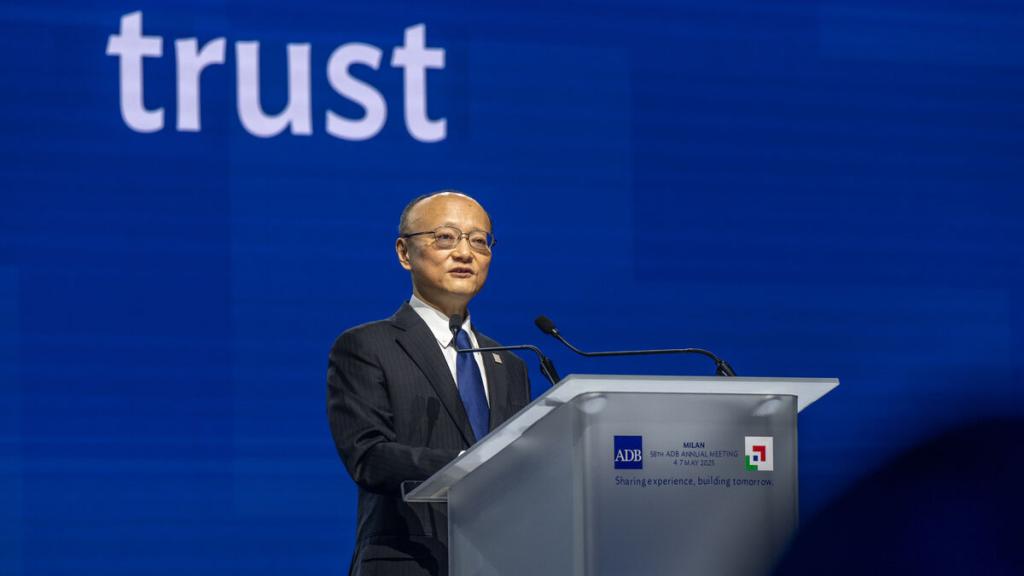
“With the trust of our partners, it would be my honor to continue leading ADB for the next five years,” he added, noting that his priority, if reelected, would be to address urgent challenges while building long-term resilience.
ADB presidents are nominated by regional members and elected by the board of governors for a five-year term. Kanda was elected on Nov. 28, 2024, and assumed office in February 2025 to complete the term of his predecessor, Masatsugu Asakawa.
Record support
Under Kanda’s leadership, ADB ramped up its operations in 2025, committing $29.3 billion from its own resources—20 percent higher than the previous year. With partner contributions of $14.7 billion, total development financing reached $44 billion.
The bank also advanced major regional initiatives, including $10 billion for the ASEAN Power Grid and more than $10 billion for the Central Asia Regional Economic Cooperation (CAREC) Program. It also helped establish a regional connectivity fund to support cross-border energy integration.
ADB delivered $14 billion toward its $40-billion food systems transformation commitment and is supporting the Philippines’ preparations for its ASEAN 2026 chairship.
Reforms, response
The bank also responded to global crises, providing early support for the Middle East conflict and delivering assistance for disasters across Asia, including in Afghanistan, Myanmar, Pakistan, the Philippines, Sri Lanka, Thailand, and Vietnam.
To meet evolving demands, ADB updated its energy policy to include nuclear power, introduced a new environmental and social framework, and strengthened procurement systems. It also entered into a landmark agreement with the World Bank Group to streamline cofinanced projects.
ADB said reforms, including its first charter amendment in 60 years, will expand its operations by 50 percent, positioning the bank to better address the region’s development challenges.---Ed: Corrie S. Narisma